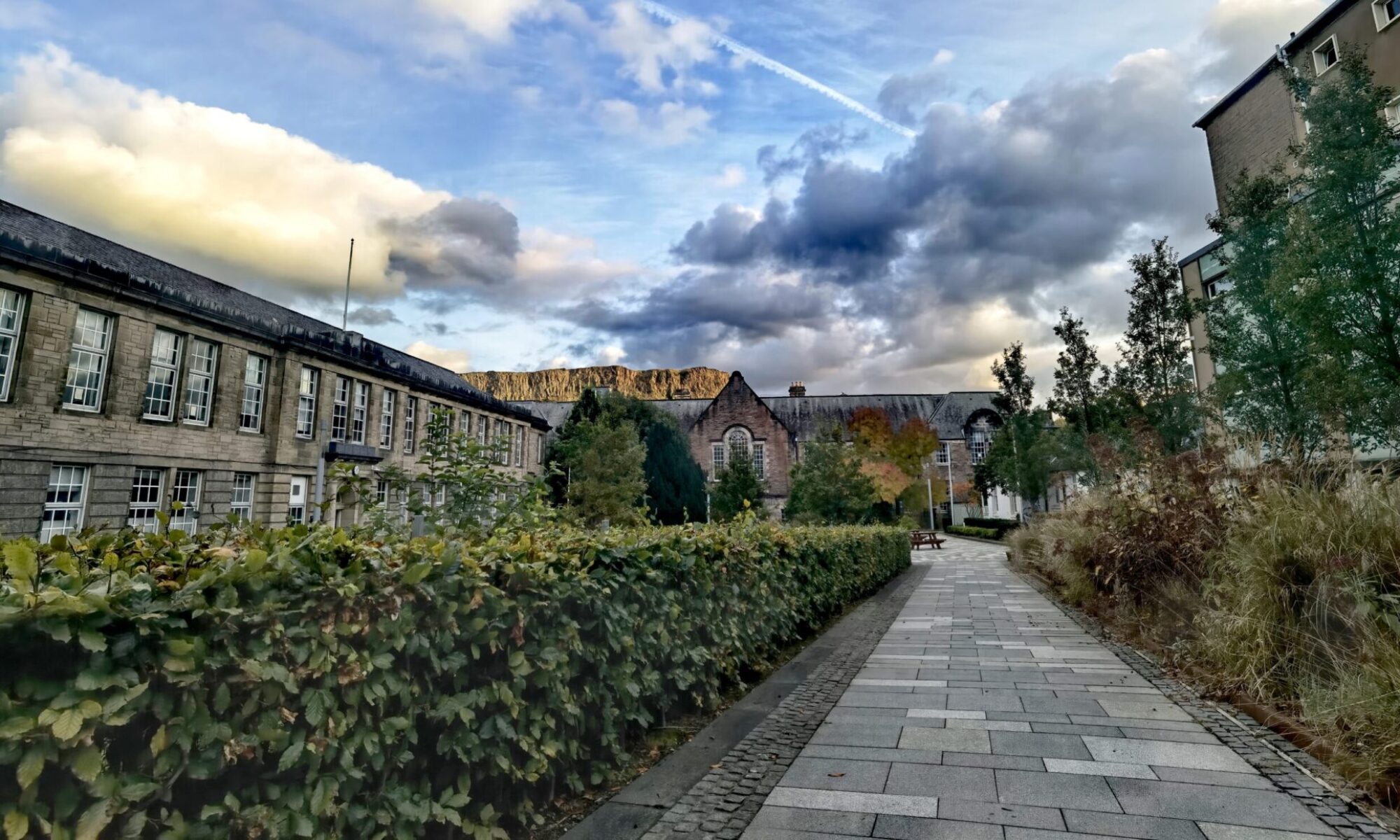

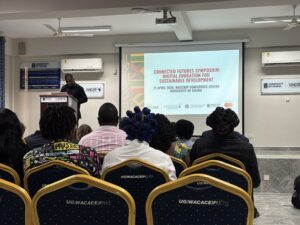
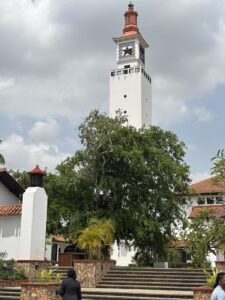
In April, CEID Research Group member Michael Gallagher travelled with his peers at the Centre for Research in Digital Education (CRDE) Alice Dias Lopes and Pete Evans to Accra, Ghana for the Mastercard Foundation African Scholars Programme Summer School which lasted the better part of a week. The events in this busy week spoke to the growing relationships between the attending universities (primarily the University of Ghana, the University of Edinburgh, and the University of Witswatersrand) around the role that digital technology has played and will continue to play in educational development in Ghana and throughout the African continent.
During this week, there was a one-day symposium at the University of Ghana emphasising the role that digital education plays in educational sustainability titled Connected Futures: Digital Education for Sustainable Development. Our own MSc in Digital Education student and current Visiting Scholar at the Centre for Research in Digital Education (and former Director General of the Ghana Education Service (GES) at the Ministry of Education) Dr Eric Nkansah gave the opening keynote on the role that digital education must play in realising sustainability on the African continent.
The relationship with the Ministry of Education in Ghana, the University of Ghana, and the University of Edinburgh is an important in many different, mutually beneficial ways. Ghana has been and remains a leading light in Pan-Africanism, a movement towards the solidarity of all African nations and diaspora groups, the defense of local autonomy, and the overall decolonisation of Africa (Nugha, 2021). Ghana has not shied away from finding educational models that support their significant intellectual and cultural traditions (and in turn, Pan-Africanism).
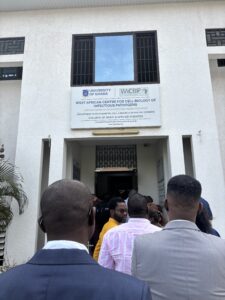
At GES and at the Centre for National Distance Learning and Open Schooling (CENDLOS) at the MoE, they have crafted confident and decidedly Ghanaian approaches to the use of digital technology in education, rather than merely bending to the tropes of seeing digital technology merely as instruments of standardisation and homogenisation, and subsequently to import them wholesale. Ghana doesn’t do this. It has invested in its digital infrastructure, an investment that shows no signs of abating (and which Dr Nkansah is looking to explore in research on innovative educational financing models). The MoE has created and distributed its own educational technology (iBox and iCampus are two examples), and its own open university frameworks. It is using this activity not only for maintaining the diverse knowledge traditions present in Ghana but potentially using them to inform further ‘open futures’ (Adeyeye and Mason, 2020) unbound by the discursive closure of much digital education development.
Our collaborations at CEID and CRDE with the MoE of Ghana and the University of Ghana are mutually beneficial ones as we learn from these Ghanaian experiences and the candour of our colleagues, see how individual countries can confidently navigate these decidedly uneven digital terrains, and chart a more open future for themselves.
If interested in learning more, consider the following:
1. Adeyeye, B. A., & Mason, J. (2020). Opening futures for Nigerian Education-integrating educational technologies with indigenous knowledge and practices. Open Praxis, 12(1), 27-37. https://search.informit.org/doi/10.3316/informit.219235558450433
2. Gallagher, M., Evans, P., & Sarpong-Duah, J. (2024). Radiating out rather than scaling up: Horizontalism and digital educational governance in Ghana. International Journal of Educational Development, 111, 103168. https://doi.org/10.1016/j.ijedudev.2024.103168
3. Royston, R. (2025). Pan-African Futurism: Ghana and the Paradox of Technology for Development. University of California Press. https://www.ucpress.edu/books/pan-african-futurism/paper
4. Nugha, T. P. (2021). Nkrumah’s pan-Africanism: a proposal for African integration. International Journal of New Economics and Social Sciences IJONESS, 14(2), 197-210.
