For living is apparently shared with plants, but what we are looking for is the special function of a human being; hence, we should set aside the life of nutrition and growth. The next life in order is some sort of life of sense perception; but this too is apparently shared with horse, ox, and every animal. The remaining possibility, then, is some sort of life of action of the <part of the soul> that has reason.
As we can see, Aristotle’s argument proceeds by identifying what is distinctive of human beings among living things. Nutrition and growth belong to plants; perception belongs more broadly to animals. Human flourishing (eudaimonia), therefore, cannot consist merely in being alive or in experiencing the world, but in the excellent exercise of the specifically human capacity: reason.
Aquinas develops a related but distinct account in Summa Theologiae I–II, q.94, a.2. Rather than asking directly about the human function, Aquinas asks how natural law is grounded in the natural inclinations of human beings. His account retains something of Aristotle’s layered understanding of life, but reinterprets it morally: inclinations disclose goods, and goods generate the precepts of natural law.
In human beings there is first of all an inclination to the good in accordance with the nature which they have in common with all substances, insofar as every substance seeks the preservation of its own being according to its nature. And due to this inclination, whatever is a means of preserving human life, and of defending against its obstacles, belongs to the natural law.
Secondly, there is in human beings an inclination to things that pertain to him more specifically, according to the nature which he has in common with other animals: and in virtue of this inclination, those are said to belong to the natural law … such as sexual intercourse, education of offspring, etc.
Thirdly, there is in human beings an inclination to the good according to the nature of reason, which is proper to them. Thus human beings have a natural inclination to know the truth about God, and to live in society: and in this respect, whatever pertains to this inclination belongs to the natural law; for instance, to avoid ignorance, to avoid offending those among whom one has to live, and other things related to the above inclination.
For Aquinas, these inclinations are not competing ends but dimensions of human flourishing. They are all ordered under the first principle of practical reason and natural law: good is to be pursued and done, and evil avoided. The movement from Aristotle to Aquinas is therefore not from biology to morality as separate domains, but from an account of what human beings are to an account of the goods toward which human beings are naturally directed.
A simple mapping of Aristotle’s functions of life to Aquinas’s natural inclinations illustrates the structural resemblance while recognising that Aquinas is developing, rather than reproducing, Aristotle’s framework:
| Creature Type | Aristotle’s Function (Type of Soul) | Aquinas’s Natural Inclination (Natural Law) |
|---|---|---|
| All living things (vegetative life) | Nutritive / Vegetative: nutrition, growth, and reproduction | Preservation of Being: inclination to preserve one’s existence and resist what threatens life |
| Animals | Sensitive: perception, appetite, movement | Shared Animal Goods: sexual union, procreation, and care/education of offspring |
| Humans | Rational: activity of soul in accordance with reason | Rational and Social Goods: seeking truth (especially about God) and living in ordered society |
Though neat, perhaps the correspondence should not be pressed too far. Aristotle is identifying the distinctive human function as part of an account of flourishing, whereas Aquinas is identifying natural inclinations as the basis of natural-law precepts. But the ascending order in Aquinas – from preservation, to animal life, to rational and social goods – clearly echoes Aristotle’s layered account of living beings.
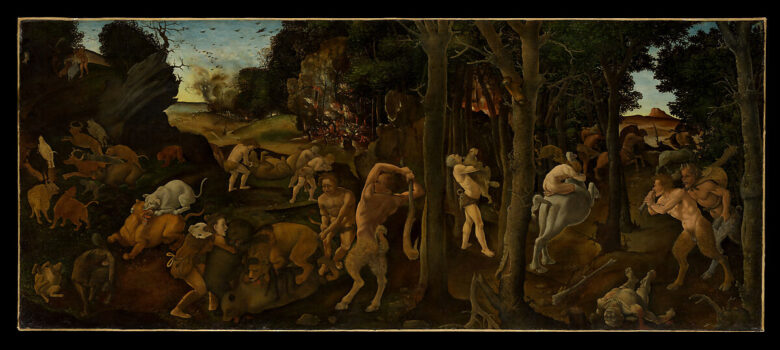
(Piero di Cosimo: A Hunting Scene, c. 1494–1500. )