MacIntyre’s well-known summary of the Aristotelian ethical scheme comprises three elements:
- Human nature as it happens to be.
- The precepts of rational ethics that guide development.
- Human nature as it could be if it realised its telos.
My interest is in applying this scheme to education, and more specifically to the university. The parallel may be expressed as follows:
| Aristotelian ethics | Education |
| The person as they are | The student as they are on entry |
| The virtues, disciplines, and forms of guidance that enable transformation | Teaching, curriculum, study, assessment, and intellectual formation |
| The person as they could become if their telos is realised | The educated person |
Or, in more MacIntyrean terms:
- The student as he or she is.
- The educational practices and virtues required for development.
- The student as an educated, practically rational agent capable of participating in the pursuit of individual and common goods.
On this reading, education is not primarily the transmission of information. It is a transformative activity directed towards a conception of human flourishing or excellence. The student enters the university in one condition and, through appropriate forms of teaching, study, discipline, and intellectual formation, is enabled to become something else.
Indeed, the reason MacIntyre discusses the threefold scheme is that it explains why education is necessary. If there were no gap between human nature as it is and human nature as it could become, there would be no need for moral formation. By extension, if there were no gap between the student as they are and the educated person they might become, there would be no need for education.
This perspective illuminates a recurring theme in MacIntyre’s writings on universities. Although he does not explicitly formulate the issue in quite these terms, he repeatedly expresses concern that universities have become uncertain about the kind of person they are trying to form. Once the telos of university education becomes obscure, it becomes increasingly difficult to sustain a coherent understanding of the curriculum as a whole. The university risks becoming a fragmented collection of specialised disciplines, each pursuing its own goods and standards with little sense of how they contribute to a unified educational purpose.
One consequence of this analysis is that many contemporary educational orthodoxies sit uneasily within an Aristotelian framework. If educators are reluctant to articulate what students ought to become, then the third term of the scheme disappears. But once the third term disappears, the second term – the rationale for particular educational practices – becomes increasingly difficult to justify. Why teach this rather than that? Why require students to master difficult material? Why judge some work to be better than other work? Traditionally, such questions were answered in relation to the kind of person education was intended to form.
A similar concern can be found in John Henry Newman. For Newman, a university was not simply a place where discrete bodies of knowledge were accumulated and transmitted. Its task was the cultivation of a particular intellectual character through engagement with knowledge as an interconnected whole. The fragmentation of knowledge was therefore not merely an organisational problem but an educational one, since it undermined the formation of the educated person.
This is a recognisably Aristotelian and MacIntyrean account of education. It is also close to Newman’s vision of the university. Teaching occupies the same mediating position that the moral precepts occupy in MacIntyre’s account of ethics: it is the bridge between what the student presently is and what the student could become.
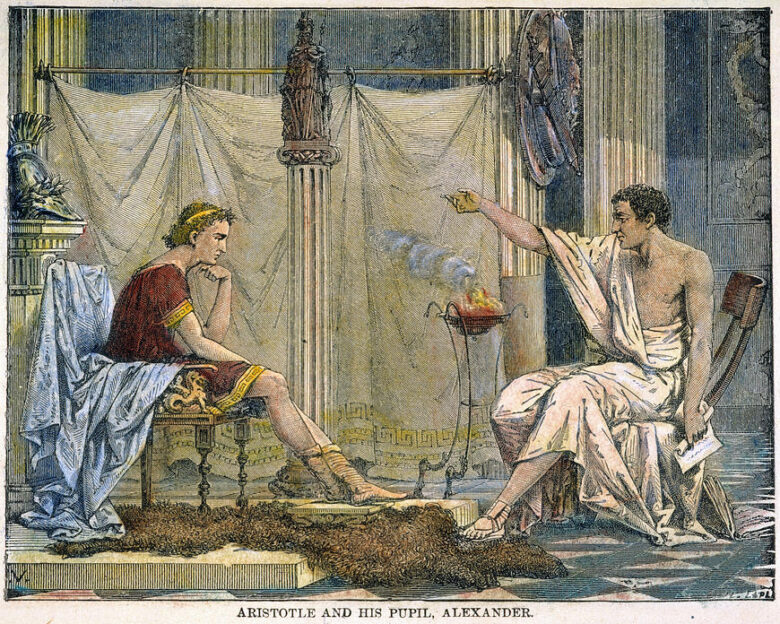
(Charles Laplante: Aristotle and his pupil, Alexander (1866))