
Reimagining lifelong learning in HE
Reimagining Lifelong Learning in Higher Education was the theme of the Universities Association for Lifelong Learning Conference (UALL) and SCUTREA Conference this year, held at the University of Warwick. Here are my reflections on just a handful of the topics we explored.

[Birds at Warwick University Campus]
Conceptualising an inclusive and integrated lifelong learning eco-system: a framework for action
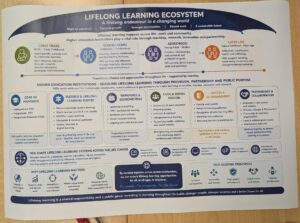
Lois McGrath (University of Bangor) and Liz Marr (University of London) & the UALL Trustees presented an excellent interactive session where we were invited to endorse and challenge a Lifelong Learning Ecosystem they had designed. We kept moving around the room to answer fresh prompts at each table – most welcome on a Monday afternoon when you can be feeling a little slow after lunch! We suggested they add in learning for leisure – not all lifelong learners have a work-related skills agenda – lifelong learning should spark joy! We are looking forward to seeing the updated version (first draft version shown in picture below).
Embedding lifelong learning into our institutions
Ang Davies from the University of Manchester talked about the future-ready university and how they’ve been working to change the models, markets and mindsets within their institution. She highlight the fact that some topics move too quickly for traditional degrees and our approval cycles – this is where lifelong learning can be more agile and responsive. But there are also many barriers within our institutions that prevent us from growing or delivering lifelong learning. They identified three enablers:
1) Protected time for creating lifelong learning – adjusting the workload allocation model is essential
2) Space to fail in a supported way, such as pilots and in collaboration with industry
3) Building capacity through fit for purpose costing models and approval processes
I was interested to hear they had done a survey with their alumni to further understand the barriers this group saw to undertaking lifelong learning. 70% of surveyed alumni saw personal development as the biggest benefit of lifelong learning.
Lyndsey El Amoud, University College Cork, spoke about research undertaken into how lifelong learning is conceptualised among senior stakeholders within the Irish HE system. Her project identified four recurring configurations: Peripheral, market responsive, strategically integrated and Ecosystem/transformative. 75% of unis they spoke to were in the market responsive model (see photo).
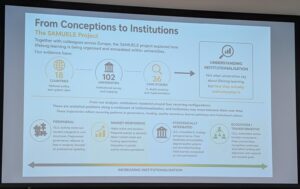
For universities where lifelong learning is fully integrated, there were four common characteristics:
- Strategic – lifelong learning was linked to broader mission and identity and more than a buzzword;
- Governance and quality systems were adapted and catered to lifelong learners as much as to students;
- Responsibility extended beyond lifelong learning units, it was a normal part of the job, not something extra;
- Institutions who fully integrated lifelong learning had invested in resources and infrastructure
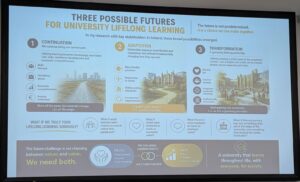
She mooted three possible futures for university lifelong learning: continuation | adaptation | transformation (see photo).
Government and policy
James Robson from Oxford University provided food for thought on the Skills Revolution. He questioned the fact that the government seems to always tie lifelong learning to the economy. Governments recognise that lifelong learning is required but it’s never fully integrated into policies, missing the opportunity to create a stable, navigable, inclusive infrastructure that adult learners need. We need to ask why it remains peripheral and move from thinking of linear systems like ‘education followed by work’. Might a skills revolution be coming?
Location of lifelong learning
It was great to see the theme of delivering lifelong learning from different locations come up in many presentations. Anthony Angelini from Cork talked about a free four-week course he’d run in Cork City Libraries on The War on Truth: Disinformation in the Digital Age, targeting school kids but also reaching parents/carers by delivering learning in a public community space. Michelle Graffagnino, University of Bristol, talked about how opening a micro-campus in an area of deprivation on the outskirts of the city enabled them to deliver lifelong learning into the heart of the local community.
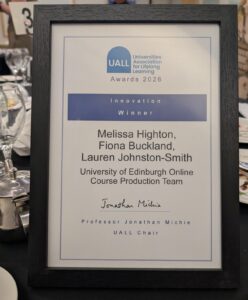
And finally, Fiona and I presented a showcase on how our suite of climate-themed short online courses have met the needs of local audiences through co-created courses (with alumni) and native language versions, enabling the University to share knowledge across the globe. We were delighted also to win the UALL Innovation Award for our work in this space – well done to all involved in this at the University of Edinburgh!

Share