From disruption to direction: Reflections from Digifest 2026
This year’s Digifest conference in Birmingham has just wrapped up, and my brain is buzzing with ideas. The 2026 theme, ‘From disruption to direction’, landed exactly where my head has been at lately. As I attend talks and workshops, I tend to map what I’m hearing to the work our team is doing back at Edinburgh, and this year that reflection felt reassuring rather than daunting. We’re not only living through the disruption; we’re actively shaping the direction.
Melati Wijsen’s opening keynote set the tone with a clear invitation: build more authentic collaborations between young people and those of us further into our careers. This message was resurfaced on day two in the student experience panel when Katrina Scales called for ‘reframing students as experts’. It made me think about our brilliant student interns who don’t just support our Digital Skills Programme – they shape it. Our students help us spot responsible, useful and impactful use cases of technology, and they lead the development and delivery of training sessions on these topics. I’m particularly proud of our student-led programming offering. Over the past eight years, it has grown from a single, experimental Python course into a full portfolio of programming training – designed and delivered by students, for students. This evolution didn’t happen by accident – it’s what you get when you treat students as experts.
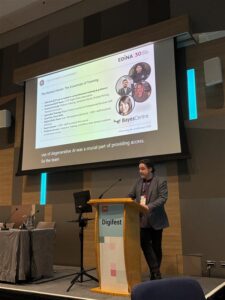
Jim Killough talking about training as a key driver of ELM adoption at the University of Edinburgh.
AI was, of course, everywhere. However, this year felt different – more grounded, more confident, more about doing rather than debating. As Danny Liu put it in his day two keynote, AI is no longer something that happens to us – it’s something we can learn to harness. That framing really resonated with me. Paddy Shepperd’s session on Jisc’s AI literacy programme further prompted me to look back at how far our own in-house AI literacy work has come since last year’s Digifest. Last March we had just launched our first AI training course for staff. Fast-forward a year and our AI training team has grown, our portfolio now spans students and staff, and is constantly evolving with more advanced and specialised use cases as our institution’s AI literacy grows. The conversation around AI has moved from ‘what is this?’ to ‘how do I use this ethically and effectively?’ and our training reflects that shift. It was great to see my thoughts mirrored in Jim Killough’s presentation on our very own ELM. Jim highlighted how training has been a real driver of ELM adoption across the University of Edinburgh. When people have space to learn, practice and ask awkward questions, confidence follows – and so does thoughtful uptake. I left these sessions (once again) feeling grateful to work in an organisation that continually and consistently recognises the value of investing in digital skills development.
Digital leadership is something I have been thinking about a lot lately. I’ve been trying to hone in on what I actually mean when I talk about ‘digital leadership’. I attended two panel conversations that helped me formulate my thoughts on this subject, and two points specifically stuck with me: digital leaders focus on creating the conditions in which others can act; and digital leaders model digital inclusivity. As the brilliant Debra Gray put it during the keynote panel on day two: ‘digital inclusion is social inclusion’. Digital inclusion is something I’m passionate about, particularly as it pertains to older adults. The risk isn’t just that they miss out on new tools, it’s that they get locked out of essential services. This is something I am actively involved with in my life outside of the University, through my work with the charity ACE IT.
Another theme that always piques my interest is playfulness. Playfulness isn’t (always) frivolous. It’s a way of lowering the stakes so that people feel safe to try, fail, iterate and learn. Digifest always includes an element of playfulness. This year, the central Jisc Hub in the main exhibition hall leaned into the theme of evolution of technology through time. I made a beeline for the nostalgia corner, and played a round (or three) of the original Mario Kart on a Nintendo 64. It was fun, of course, but also sparked conversations that might not have taken place in a more formal setting. Professor Victoria Baines’ closing keynote on day one neatly tied together playfulness with the long history of technological evolution. By walking us through how technology has shaped society in the past, she offered an insight into what might be coming next (hint: everything, everywhere, all at once).
In today’s world, digital skills are non-negotiable. They should be purposefully designed into our programmes, services and support rather than treated as an enrichment activity, or a nice-to-have. As I wrote at the beginning of this blog post, I feel like we are well on our way from disruption to direction in terms of the work we do in our team. That might look like doubling down on what’s already working, while keeping a firm eye on the future – confident that we will be able to tackle whatever new disruptions are thrown our way.