Any views expressed within media held on this service are those of the contributors, should not be taken as approved or endorsed by the University, and do not necessarily reflect the views of the University in respect of any particular issue.

Sydney’s Finland Adventure

Reflecting on My Experience at the 2023 GINTL Seminar of International Education and Development

By Sydney Harrington, MSc CEID (class of 2023)

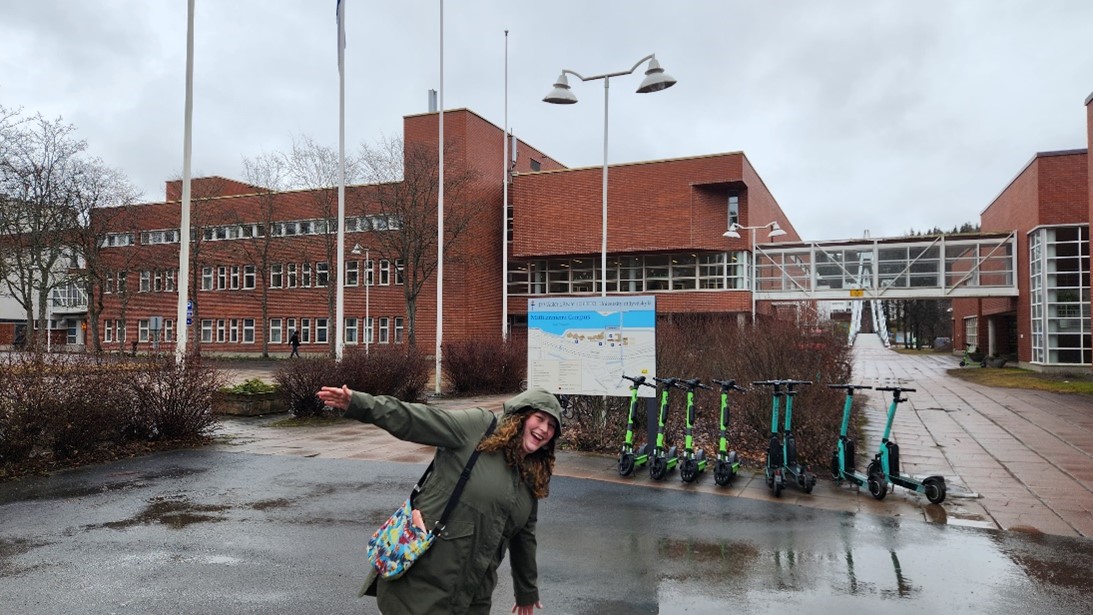
Outside the University of Jyvaskyla in Finland


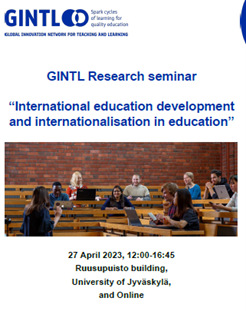
This is a reflection on one MSc Comparative Education and International Development (CEID) student’s experience at the 2023 GINTL Seminar: International Education Development and Internationalisation in Education. To read more about the seminar and advice from MSc CEID students that participated click here

I’m sure it’s an unwritten law of the universe in pretty much any event that if there is something that could go wrong then it probably will, in some way, go wrong.

That being said, I think the GINTL seminar went very well and I had an incredible time visiting Finland and learning about others’ research while sharing my own.

I was one of two presenters from Edinburgh who went in person, and I’ll be honest and say that I was more than a little anxious. I couldn’t help but heave a small sigh of relief when I saw Will, our program director, come up to the front of the stage. He was one of the opening panelists and would be doing the closing remarks as well, and it felt good to be in a completely new environment with two familiar faces.

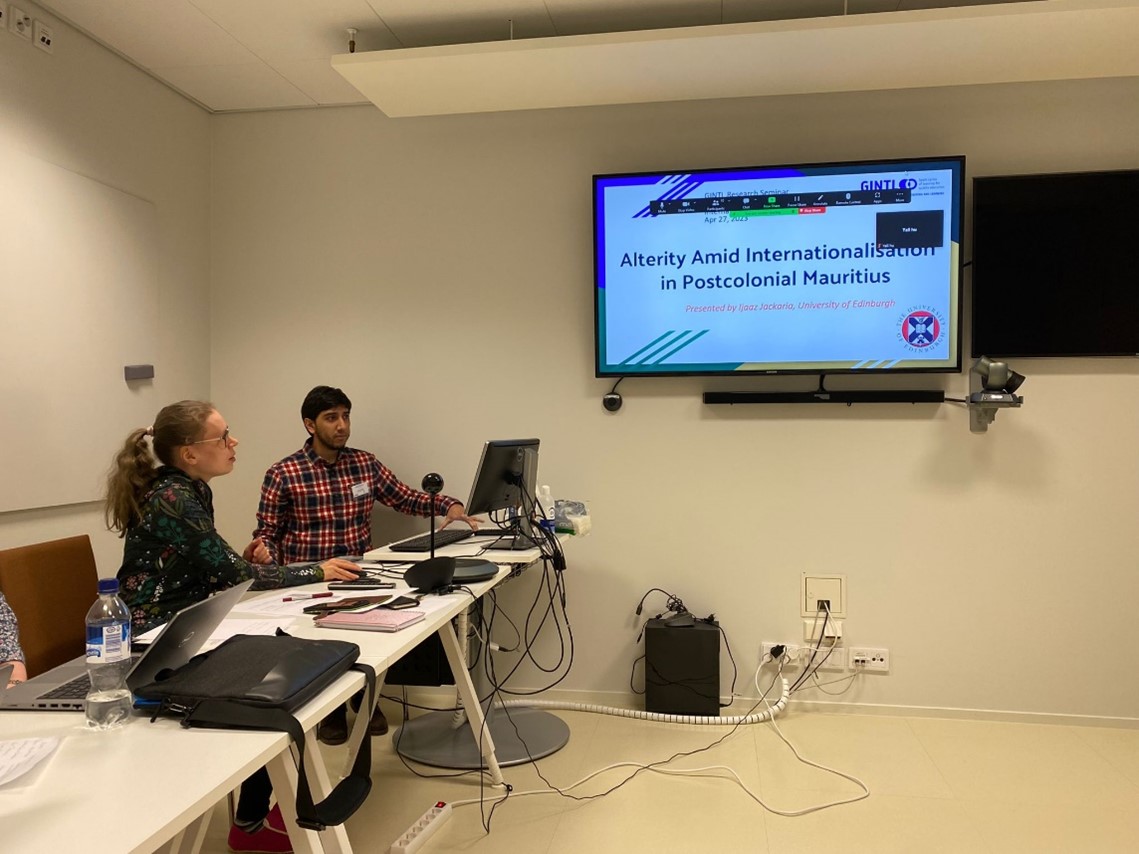
The morning of the seminar went well, and I sat in on Ijaaz’s panel asking questions and offering praise when I felt it was warranted, which I felt often. Did I fully understand what an auto-ethnography was? Nope. Did I understand the philosophical underpinnings behind his research question? Also no. But that didn’t stop me from clapping the loudest and taking as many pictures as I could subtly get away with to later share with the CEID group chat.

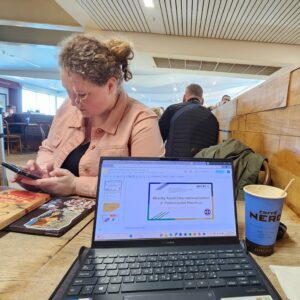
Ijaaz and Sydney at an airport café preparing for their presentations

After the coffee break, it came to my turn to present and when I got to the room and realized that I was the only panelist who hadn’t emailed their presentation and instead brought my slides in on a USB, I started getting a bit nervous. When I realized that I had all my notes on my PowerPoint and would need to reformat the display of the computer so that no one but me would see my notes, I started to panic.

It took a bit of finagling, and I’m sure I said something amusing to the waiting audience as I got a few chuckles, but eventually, I was able to start my presentation.  I remember absolutely nothing of it besides the fact that I was passionate about what I was saying and that my heart was in my throat the entire time. Once I had landed on my reference slide and received the usual polite applause, the chair thanked me for the presentation and made a remark about how quick it was, instantly turning me beet red. I’m sure I looked a bit like an ice cream cone, my white dress offset by my quickly deepening pink cheeks.

Sydney presenting on Education and Liberal Peace

I answered the questions that were asked and defended my choice of topic, gladly accepting the praise and critiques. That’s why I was there, after all. I wanted the help and needed the practice, especially if I wanted to continue on to a Ph.D. someday.

When one of the GINTL conference leaders asked me about how I was going to cut down the research to make it appropriate for a master’s dissertation and to fit the timeframe I had, I hesitated. “To me, I guess there isn’t such a thing as too much research–” I started and noticed the wince on Will and Ijaaz’s faces, “but of course, I’m going to make sure to break it down into the relevant pieces for my dissertation.” I laughed a bit breathlessly, color darkening my cheeks again. “I suppose I have an academic’s heart–” Another wince from Will and Ijaaz.

I swear I swallowed my tongue.

“This has all the potential to turn into a Ph.D. research project as well, so that’s something to keep in mind,” I finally squeaked, not entirely sure how to defend my love of learning for learning’s sake, especially since the people looking at me were there to judge the application of my research on future endeavors.

Despite it, I felt rather good about my presentation, and when we left the conference room and Will teased me saying “Honestly, you were slower than you normally speak!” while Ijaaz laughed, I was able to elbow him good-naturedly with a mumbled, “oh shut up”. There is a reason that we call Will our CEID Dad, he’s just as supportive as we need him to be.

Being able to share my research project in Finland was a fantastic opportunity and I am so glad I swallowed my initial hesitation to send in my abstract. I got to meet a group of incredible people who were on a similar path and I connected with academics that have been able to help me with different inquiries around my dissertation.

If you get the opportunity to go in person to a seminar, I would say that you should definitely try to go. It was an amazing experience and I feel more prepared to tackle my dissertation and the rest of my academic journey.

Conversation on Gender and Education: Why we need to rethink education for girls

MSc CEID faculty and students meeting with Professor Elaine Unterhalter

By Katia Mackley, MSc CEID class of 2023

On 31st March 2023, our Comparative Education and International Development (CEID) Society hosted Professor Elaine Unterhalter from University College London. As a master’s student from the CEID programme I had come across her name several times in my courses and was excited to be able to meet her in person and learn more about her current work.

Professor Unterhalter presented on girls’ education and specifically on four common framings found in the research and advocacy on girls’ education: what works, what matters, what disorganises and what connects. I found it very interesting to dig a little deeper on the topic of girl’s education and think about how it can be framed. I was already a little familiar with some concepts but an idea that struck me is how she presented gender as grammar, in the way that it is not just a noun but can also be understood as an adjective and a verb.  This is an important way of looking at gender because it highlights its complexity of the concept of gender and helps to think through the different ways that gender impacts education. I also enjoyed learning more about her current Accountability for Gender Equality in Education (AGEE) project and how the AGEE framework connects with the capability approach.

One of the best parts of the event was learning from the audience which I found had very interesting comments and questions.  A comment that struck me was on the idea of co-creation linked to the AGEE framework and how we need to be careful of power dynamics within this space. We also had a brief discussion on how we can finance education and what could be implemented. The idea of tax justice and redistribution was brought up. It felt quite special to be in a room full of other students and faculty members who are passionate about their topic and care about making education more inclusive and more accessible! There were about 25 people who attended, some joined us from Glasgow. Lastly, CEID students had the opportunity to go out to dinner with Elaine and continue the conversation on gender and education. She was very down to earth and easy to talk to. I felt very inspired after the event and a little more hopeful about the world.

CEID Featured Alumni: Maria-Rafaela Kaldi

                                                                            Maria-Rafaela Kaldi, CEID class of 2020                                                            Nationality: Greek                                                                                                                  Current Position: Education Policy and Research Consultant at the Global  Education Monitoring (GEM) Report, UNESCO

I have been working as a research consultant at the Global Monitoring (GEM) Report since November 2020, three months following the completion of my CEID master’s degree. As a consultant, I have the flexibility to work remotely from Athens (where I’m from), and travel to the office in Paris every few months for big team meetings or events. My position at GEM is largely research-based; I am the lead author of one of the chapters for the upcoming GEM Report on technology in education and am now working on a chapter for the upcoming regional report on Southeast Asia. I also work as part of the PEER team, where I draft country profiles based on a review of national education laws, policies and programs on issues central to achieving SDG4  on the PEER website.

My CEID master’s degree and connections I made during my time at Edinburgh were central in being offered a position at GEM (so much so that it surprised me)! I was first introduced to the topic of low-fee private schools through a talk by expert Joanna Härmä which was organized during the first semester. I was immediately intrigued by the issue, dedicated two or three assignments to exploring it further, and finally decided to pursue it for my dissertation, where I had the space to properly dive in and explore the nuances and gaps that existed. I was lucky enough to have Joanna as my supervisor, one of the key experts on the issue of low-fee private schools globally. Once I had completed my dissertation, Joanna decided to send it to her former colleagues at the GEM Report, which were preparing the very relevant 2021/2 GEM Report on non-state actors in education during that time. It was through that important connection and great recommendation on Joanna’s part that I eventually got offered a role as a research consultant on the team, assisting in the preparation of the 2021/2 report.

Before starting my work with GEM, our program coordinator Will Smith, which knew of my work and interest in this area, also introduced me to Alice Beste, the coordinator of the Privatization in Education and Human Rights Consortium (PEHRC), who was looking for a fellow to support PEHRC’s work. Following this initial introduction and an interview where I shared my work on low-fee private schools and public-private partnerships developed during my degree, I was offered a position as a part-time fellow for one year, where I was exposed to the inner workings and most recent developments in the field, while meeting inspiring and dedicated people all across the world that were advocating for issues I strongly believed in.

I am well aware my journey had a big element of luck involved (which of course is out of our control and can often make or break a situation), but I think it can also serve as an example of how important connections can be in this field, how far a good recommendation can go to get your foot in the door, and how to use the crazy amount of work you did for your dissertation to your benefit. Getting your foot in the door is often the most challenging part, so try and use all the connections, knowledge, and events the CEID community offers to your benefit. Being part of the CEID community does not end after you complete your degree – so continue participating, be curious, critical, passionate, and above all – active!

css.php

Report this page

To report inappropriate content on this page, please use the form below. Upon receiving your report, we will be in touch as per the Take Down Policy of the service.

Please note that personal data collected through this form is used and stored for the purposes of processing this report and communication with you.

If you are unable to report a concern about content via this form please contact the Service Owner.

Please enter an email address you wish to be contacted on. Please describe the unacceptable content in sufficient detail to allow us to locate it, and why you consider it to be unacceptable.
By submitting this report, you accept that it is accurate and that fraudulent or nuisance complaints may result in action by the University.

  Cancel