My client is not in a hurry. (Antoni Gaudí)
I have spent most of the last two weeks in Catalonia, first in Cap de Salou with Iona, then at the Walking Assembly 2026 in Girona and the Pyrenees, and yesterday as a solo tourist in Barcelona. I returned late last night. Today, I have been plunged back into the emails and tasks that have mounted up in my absence. It is hard to believe that just hours ago I was sitting on Montjuïc looking out over the city, with Gaudí’s Sagrada Família in the distance. Now, I am escaping the admin by walking round a peatbog with my friend, Jo.
Jo is an important person in my career journey. When I was working on my PhD in theatre studies at the University of Glasgow in 2010, on the recommendation of my supervisor, I wrote a letter (back when we used to write such things) to the heads of related degree programmes at local universities, asking if they might have any teaching work available. One of these landed on Jo’s desk at the University of the West of Scotland’s Ayr campus, just as she was looking for performance teachers who could bridge theory and practice. We met for a coffee in Glasgow and within two years I had a full-time academic post. I worked at UWS for five years and by the time I left, my life had changed completely. Jo has been a mentor and friend ever since and I have plenty to thank her for.
We have lots to catch up on. Not only do I want to regale Jo with stories of my recent adventures, but we also have all the news of our families, and our work in art and education to share. Jo is one of the most energetic and enthusiastic people I know; her conversation is fast-flowing and lively, and she is always interested in what I have been up to and how my children are doing. We will have to be disciplined if we want to keep our attention on the task at hand. So we agree to share a cup of tea after our exploration of the Moss and hold all the other topics for now.
Jo has been reading some of the previous entries on the blog and is enthusiastic about the project. Jo has had some challenging professional experiences over the years – often bravely standing up to injustices and always prepared to take on the egos in charge of cultural and education institutions. She is therefore particularly drawn to projects like this, which she sees as an antidote to the extractive and unethical practices that have become so prevalent elsewhere. Taking time to build relationships with people and place, de-centring the researcher, and learning how to be other – I am pleased that Jo sees all these qualities in this work.
Jo is now semi-retired and has more time for exploring places like this. She arrived at Lenzie on an earlier train, having never visited before, and has been wandering round the town. Jo initially wondered whether the enthusiastic waves of a passing van driver were due to the friendly disposition of the residents. In fact, this was Gavin – an actor she has worked with a lot, and who I also know, and once bumped into on a walk round the Moss. Jo is scoping out routes to take her husband on and says she will return to Lenzie. I point out the route through the woods to the canal, which they have often walked along closer to their home in the west end of Glasgow.
Jo asks me about the peat bog, and I learn that her interest is driven partly by a love of whisky. She recalls a trip to Highland Park Distillery in the Orkneys and says that the whisky that is made there has a light peaty taste, which she compares favourably to the intensely smoky whiskies most associated with the Isle of Islay distilleries. While Islay’s Laphroaig kilns are fuelled by ‘a heady mix of the heather, lichen, seaweed, moss and woodland that decayed over the centuries’, Highland Park burns Orkney heathered peat, ‘which delivers complex floral aromas’. I wonder what whisky would be produced by smoking barley with peat from Lenzie Moss.
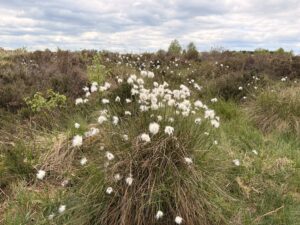
As we are not in any rush, we sit on one of the benches and look out over the bog. We watch swallows darting over the bog cotton, which is now growing all around us. Various timescales coalesce in this moment. It is now two days short of a full year since I began this project. I have walked with the Moss as it has changed through its annual cycle and look forward to at least another year of this project. I have known Jo for over 15 years now and we have followed each other’s work through many other projects at various other places. Reflection on time and personal history comes easily as we sit above centuries-old peat, slowly accumulating again, despite that rate at which it was extracted from this place.
I think about Gaudí, who began work on the basilica in 1883, but did not live to see its completion (the building is still under construction to this day). With God as his client, he wasn’t in any great hurry to finish his great project. But great it certainly was. When I stood before it yesterday, as I sheltered from the thousands of tourists behind a bin, I felt overwhelmed and conflicted. Famously, the Sagrada Família’s height of 172.5 meters (which was only reached earlier this year) was deliberately capped by Gaudí to remain lower than the tallest point of the Montjuïc hill (just over five meters higher), because ‘the work of man must not surpass that of God’. Nevertheless, the building is designed to induce awe. I watched a crane lift a section of stonework into place and went on my way.
24 hours later, I reflect on the qualities that Jo sees in my own durational project and think about how light the traces are that I will leave behind. How many hours will I have spent walking round this site and writing about my encounters here? But sitting here with Jo, looking back over 12 months of walking Lenzie Moss, I am pleased to say that I have created nothing visible or enduring. The materials of this project are relational, the medium is ephemeral, and the legacy is words and memories.
I am grateful to Jo for helping me see the value in this way of working. As we reach the end of our walk and head to my house to finish our meeting with that promised cuppa, I realise how central time is to this project. Committing to these 100 circles has given me many hours of close connection to the Moss, but it has also afforded time to get to know my neighbours, learn from my guests, and maintain my friendships. As Gaudí knew, as did the whisky distillers from Islay to Orkney, time is the most important ingredient to any great project.