Any views expressed within media held on this service are those of the contributors, should not be taken as approved or endorsed by the University, and do not necessarily reflect the views of the University in respect of any particular issue.

49. Julia

Just before I meet Julia, a pair of herons fly over Lenzie. I have never seen two flying together before. They soar fast and high, riding the wind, determined to get somewhere; at odds with the lazy feeling of this sunny spring morning.

I meet Julia outside her house and say a quick hello to her husband, Tony. Since Julia had to accompany Tony when I walked with him back in January, we planned another walk so I could find out more about Julia’s connection to the Moss. It is now exactly three months later – a deliberate delay since I know that Julia is enthusiastic about the birds of Lenzie Moss, and at this time of year, on a day like this, the air is filled with all kinds of birdsong.

Before we set off, I open the Merlin app and place my phone upside down in the drinks holder of my rucksack, so that the microphone can capture everything clearly as we walk. We will check the screen for a ‘bird audit’ every kilometre or so. I am not sure that we need it, though. Julia talks me through the different bird habitats of the Moss: chiffchaffs to the east; wrens to the north; stonechats to the west; and treecreepers to the south. As we follow Bea’s Path, a chiffchaff obliges us and Julia easily recognises its call.

Julia tells me that she has always been enchanted by birds, and that her interest is shared by her daughter. As a family, they have explored places in Scotland with unique birdlife: the Arctic geese of Islay; the eagles of Mull; and the seabirds of the Orkneys. But the Moss is almost on their doorstep and they have also enjoyed some memorable avian encounters closer to home. Julia tells me about the sparrowhawk that has visited their garden. And while they didn’t see one themselves, they have heard about ospreys at the Gadloch. I tell Julia about my fleeting encounters with a sparrowhawk and a buzzard, and my more regular sightings of kestrels, which she has also seen here.

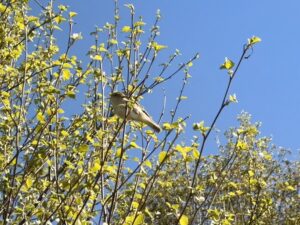
We stop to check my phone: goldcrest, bullfinch, dunnock, jackdaw, chaffinch, willow warbler, blue tit, robin, great tit, chiffchaff, wren, blackbird, sparrow, treecreeper, coal tit, and goldfinch. And we are only at the boardwalk. We then see, and hear, an olive-yellow bird, singing away, on its perch in a birch tree. Its cascading song is very distinctive, so Julia has no doubt that this is a willow warbler.

As we walk south, we see that the bog cotton has burst into seed with thousands of fluffy white clumps bobbing in the breeze. Last year, Richard noted how late that had happened. We pause at the bottom of the boardwalk, beside the bog rosemary enclosure. When I walked with Bob a month ago, we studied the sign that had been pinned to the fencepost at this spot. I returned the next day to find that it had been torn down. It has since been replaced. Julia feels that this is an important dimension of the conservation work here.

As we chat, I notice a man on his knees further along the path. I don’t think anything of it at first, but when he stands up and walks towards us with his black labrador, I notice that he is covered in blood. He has tripped over the exposed roots and knocked his nose. We make sure he is okay and Julia gives him some tissues. Luckily, it seems that the injury looks worse than it is and as he lives nearby, he is happy to continue on his way.

We walk on across the boardwalk and add a meadow pipit to our cast of characters. Like skylarks, which Julia and Tony saw recently here, meadow pipits are ground nesting birds. From March to October, when they are raising chicks, it is best to keep dogs on the lead at the boardwalk side of the Moss. Julia feels strongly about our collective responsibility to prioritise and make space for the wildlife that makes the Moss so special. If this means staying off the bog or keeping dogs close by during these vital months of the year, then we may need to accept that our habitual or established ways of being here may need to change. It is about finding the balance between our desires and the needs of the wildlife. We know enough about the ecological impact of our actions to make the right decisions about what we do here. Having said this, there needs to be a serious and sustained effort to involve the community in these decisions – a topic I have discussed with many of the walkers on this project.

Julia talks about the landscape here: the industrial history of the area; the distinct zones of woodland, grassland and peatland; the view of the city in one direction and the hills in another. All this is important to Julia and her family. But she talks about the soundscape as equally precious and meaningful. We listen to chiffchaffs in the birchwood as the wind moves through the branches, and a distant train sounds its air chime, while the school break adds the voices of children to the soundtrack. An aeroplane flies over and we can just hear its faint rumbling engines. There is so much human and nonhuman life here, and for now at least, it all seems to be co-existing peacefully.

While I am well aware of the environmental impact of air travel and try to limit my air miles, I will be on a plane myself tomorrow. For the next couple of weeks, I will be spending time in Catalonia – visiting Reus, Tarragona, Barcelona and Girona, before joining the Walking Assembly 2026 at the Muga River in the Pyrenees. Last night, I joined a video call to meet some of the group and hear about what we would be up to. Birdsong was played throughout the meeting, and we were introduced to some of the Catalonian species we would be encountering. I am particularly keen to spot a golden oriole – a striking yellow migrant from Africa. Missing from the list, though, was the common chiffchaff. But they, too, spend time in Catalonia. Maybe a Lenzie chiffchaff will be there with me and the orioles.

Since I moved here three years ago, I have been enchanted by the vibrant lives of the many birds who make the Moss their home. Walking with Julia today has enhanced my connection to them, and taught me to identify more of them by sight and song. I understand entirely why so many people like Julia and her family are drawn to birds and spend so much of their time travelling to meet them and staying in their company. Birds take us out of ourselves and show us that there is more to this world than our human limitations. They fly high above us and commune with the wind.
48. Eilidh G

When I started this project in May last year, I ventured out to the Moss on a beautiful summer day, accompanied by blossom and birdsong. While it is not quite summer yet, and I am a couple of walks short of the halfway point, today is one of those days. I will wait until I reach the fifty-walk milestone before I allow myself a midpoint celebration, but after a year of changing seasons, including many walks in rain, snow and wind, I will enjoy a return to the Moss in the sunshine, once again surrounded by new life.

I am walking with Eilidh – an environmental artist from Kilcreggan on the Rosneath Peninsula on the west coast. Eilidh now lives near Forfar in Angus, where she is a PhD student at Duncan of Jordanstone College of Art and Design in Dundee. Eilidh’s supervisor is Professor Mary Modeen, who I worked with at the University of Edinburgh recently, where we co-examined a PhD together. Eilidh’s artistic practice includes writing, sculpture and installation. She is concerned with the sustainability of art-making and often works with natural dyes and clays, or found materials like plant ashes, egg shells and sand.

Eilidh is researching Scottish wetland regeneration, using her creative practice as a research methodology. She is interested in the role of artists in rewilding initiatives, asking how we can engage the public with processes of species reintroduction and habitat restoration. Her research will involve collaborations with communities, artists and scientists and will lead to maps and documents of her field sites. Eilidh’s work resonates with my research and the emerging story of Lenzie Moss that I have encountered through these walks. But there is one aspect of her PhD project that I am particularly interested in: her focus on landscapes shaped by beavers.

I have always thought that the woodland to the north of the Moss looks very similar to the ‘terraqueous’ (land and water) environments that beavers thrive within, and create for themselves. These shifting watery and earthy borderlands are shaped by routes for feeding and escape – pathways between the underwater entrances to their lodges and to their food supply of grasses, leaves and bark. I think we can learn a lot from beavers’ boundary-crossing ways.

I know beaver habitats well, having spent time in the years before the pandemic at Bamff Estate in Perthshire – the site of one of Scotland’s longest established beaver populations. Over several visits, I worked with a group of artists and scientists to explore the ways in which humans might collaborate and become part of the beavers’ worlds. We made sculptures, films and songs, wrote poems and essays, and I published a chapter about the project, which I am delighted to hear Eilidh has read. She has also visited Bamff, so we compare our experiences there. We chat about the contested politics of beaver reintroductions – a controversial subject in Scotland, due to the impact that beavers can have on waterways and the adjoining fields and woodland.

We see parallels in some of the tensions that I have encountered here. We investigate the paths and signs, and reflect on the dogs that run around us off their leads (as Clyde often does), and the impact this has on the environment. Eilidh says that as humans, we dominate every landscape; we strive for control over land and stomp wherever we like. For Eilidh, change is vital, however difficult that may be. She asks: as the rewilding movement grows in numbers and projects, how do we encourage the loosening of our grip on the land? How do we let go, and watch our terrain become patchy and messy, dynamic and unpredictable? Eilidh believes that this starts with community engagement and public education, listening to the people who live here and establishing relationships that can move forward together. There are lessons here for the beaver reintroduction movement, just as there are for peatland conservation.

While there are no beavers at Lenzie Moss, both beavers and bogs are connected through their relationship with water. As the Wildlife Trusts explain, beavers, who are often referred to as ‘ecosystem engineers’,

[…] make changes to their habitats, such as coppicing trees, damming smaller water courses, and digging ‘beaver canal’ systems. These activities create diverse and dynamic wetlands that can bring enormous benefits to other species, such as otters, water shrews, water voles, birds, invertebrates (especially dragonflies) and breeding fish, as well as sequestering carbon.

Bogs, too, sequester carbon, and both beavers and bogs can help to prevent flooding (‘the channels, dams and wetland habitats that beavers create hold back water and release it more slowly after heavy rain’). I wonder what beavers would make of, and make with, this place. As we walk along the north woods path, I point out that the gardens of the houses that border the Moss are prone to flooding. Perhaps beaver inhabitation would help solve this problem? (I am sure there are plenty of counterarguments to this suggestion, so I only make it speculatively).

Eilidh tells me that in 2023, when Storm Babet crashed through the country, her house was badly flooded. When she initially pitched her PhD research, Eilidh was interested in natural flood management. But she says that the experience is too recent and too raw for her to fully embrace an artistic exploration of flooding, at least for now. She is nevertheless drawn to wetlands and their water retaining qualities. Beavers allow an exploration of these dynamics from a different perspective.

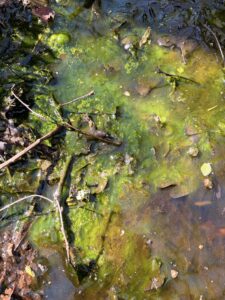
During my fieldwork at Bamff, we studied maps of the site and examined aerial photographs that showed the landscape alterations that the beavers had brought about. I was struck by the difference between the fragmented mosaic of the beaverlands and the monocultural fields of the neighbouring farmlands. When Eilidh and I pass the ponds to the south of the Moss, we peer into the green algae filled water and I am struck by how reminiscent it is of those beaver pools – albeit on a much smaller scale. The sticks are fallen trees, brought down by roots weakened by expanded waterways, or by gnawing teeth; the leaves and moss are patches of earth amongst the ponds.

Mapping, aerial images, measuring and both qualitative and quantitative data are all important parts of Eilidh’s artistic practice. She makes sculptural forms through contour mapping, moulds with wild clay, and makes zines, maps and notebooks. Eilidh describes her practice as a form of ‘deep mapping’ – an expansion of traditional cartography through ongoing performances, exchanges, assemblages and experiments. I am familiar with the concept of deep mapping and have used it before in my own work (I once attempted to deep map my commute between Glasgow and Ayr). The point is to keep things open and moving, rather than fixing place into a ‘flat’ representation.

Discussing this method with Eilidh today reminds me that these 100 walks round Lenzie Moss might also usefully be thought of as a process of deep mapping, and the blog as a textual deep map. Ongoing conversations, reflections, documentation and dissemination are at the heart of this extended encounter with the site. Eilidh’s creative research has a similar aspiration. I am looking forward to following her deep mapping process over the next years.

css.php

Report this page

To report inappropriate content on this page, please use the form below. Upon receiving your report, we will be in touch as per the Take Down Policy of the service.

Please note that personal data collected through this form is used and stored for the purposes of processing this report and communication with you.

If you are unable to report a concern about content via this form please contact the Service Owner.

Please enter an email address you wish to be contacted on. Please describe the unacceptable content in sufficient detail to allow us to locate it, and why you consider it to be unacceptable.
By submitting this report, you accept that it is accurate and that fraudulent or nuisance complaints may result in action by the University.

  Cancel