When I started this project in May last year, I ventured out to the Moss on a beautiful summer day, accompanied by blossom and birdsong. While it is not quite summer yet, and I am a couple of walks short of the halfway point, today is one of those days. I will wait until I reach the fifty-walk milestone before I allow myself a midpoint celebration, but after a year of changing seasons, including many walks in rain, snow and wind, I will enjoy a return to the Moss in the sunshine, once again surrounded by new life.
I am walking with Eilidh – an environmental artist from Kilcreggan on the Rosneath Peninsula on the west coast. Eilidh now lives near Forfar in Angus, where she is a PhD student at Duncan of Jordanstone College of Art and Design in Dundee. Eilidh’s supervisor is Professor Mary Modeen, who I worked with at the University of Edinburgh recently, where we co-examined a PhD together. Eilidh’s artistic practice includes writing, sculpture and installation. She is concerned with the sustainability of art-making and often works with natural dyes and clays, or found materials like plant ashes, egg shells and sand.
Eilidh is researching Scottish wetland regeneration, using her creative practice as a research methodology. She is interested in the role of artists in rewilding initiatives, asking how we can engage the public with processes of species reintroduction and habitat restoration. Her research will involve collaborations with communities, artists and scientists and will lead to maps and documents of her field sites. Eilidh’s work resonates with my research and the emerging story of Lenzie Moss that I have encountered through these walks. But there is one aspect of her PhD project that I am particularly interested in: her focus on landscapes shaped by beavers.
I have always thought that the woodland to the north of the Moss looks very similar to the ‘terraqueous’ (land and water) environments that beavers thrive within, and create for themselves. These shifting watery and earthy borderlands are shaped by routes for feeding and escape – pathways between the underwater entrances to their lodges and to their food supply of grasses, leaves and bark. I think we can learn a lot from beavers’ boundary-crossing ways.
I know beaver habitats well, having spent time in the years before the pandemic at Bamff Estate in Perthshire – the site of one of Scotland’s longest established beaver populations. Over several visits, I worked with a group of artists and scientists to explore the ways in which humans might collaborate and become part of the beavers’ worlds. We made sculptures, films and songs, wrote poems and essays, and I published a chapter about the project, which I am delighted to hear Eilidh has read. She has also visited Bamff, so we compare our experiences there. We chat about the contested politics of beaver reintroductions – a controversial subject in Scotland, due to the impact that beavers can have on waterways and the adjoining fields and woodland.
We see parallels in some of the tensions that I have encountered here. We investigate the paths and signs, and reflect on the dogs that run around us off their leads (as Clyde often does), and the impact this has on the environment. Eilidh says that as humans, we dominate every landscape; we strive for control over land and stomp wherever we like. For Eilidh, change is vital, however difficult that may be. She asks: as the rewilding movement grows in numbers and projects, how do we encourage the loosening of our grip on the land? How do we let go, and watch our terrain become patchy and messy, dynamic and unpredictable? Eilidh believes that this starts with community engagement and public education, listening to the people who live here and establishing relationships that can move forward together. There are lessons here for the beaver reintroduction movement, just as there are for peatland conservation.
While there are no beavers at Lenzie Moss, both beavers and bogs are connected through their relationship with water. As the Wildlife Trusts explain, beavers, who are often referred to as ‘ecosystem engineers’,
[…] make changes to their habitats, such as coppicing trees, damming smaller water courses, and digging ‘beaver canal’ systems. These activities create diverse and dynamic wetlands that can bring enormous benefits to other species, such as otters, water shrews, water voles, birds, invertebrates (especially dragonflies) and breeding fish, as well as sequestering carbon.
Bogs, too, sequester carbon, and both beavers and bogs can help to prevent flooding (‘the channels, dams and wetland habitats that beavers create hold back water and release it more slowly after heavy rain’). I wonder what beavers would make of, and make with, this place. As we walk along the north woods path, I point out that the gardens of the houses that border the Moss are prone to flooding. Perhaps beaver inhabitation would help solve this problem? (I am sure there are plenty of counterarguments to this suggestion, so I only make it speculatively).
Eilidh tells me that in 2023, when Storm Babet crashed through the country, her house was badly flooded. When she initially pitched her PhD research, Eilidh was interested in natural flood management. But she says that the experience is too recent and too raw for her to fully embrace an artistic exploration of flooding, at least for now. She is nevertheless drawn to wetlands and their water retaining qualities. Beavers allow an exploration of these dynamics from a different perspective.
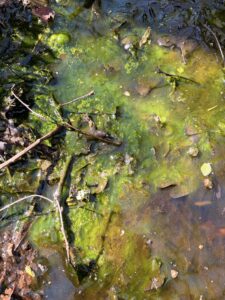
During my fieldwork at Bamff, we studied maps of the site and examined aerial photographs that showed the landscape alterations that the beavers had brought about. I was struck by the difference between the fragmented mosaic of the beaverlands and the monocultural fields of the neighbouring farmlands. When Eilidh and I pass the ponds to the south of the Moss, we peer into the green algae filled water and I am struck by how reminiscent it is of those beaver pools – albeit on a much smaller scale. The sticks are fallen trees, brought down by roots weakened by expanded waterways, or by gnawing teeth; the leaves and moss are patches of earth amongst the ponds.
Mapping, aerial images, measuring and both qualitative and quantitative data are all important parts of Eilidh’s artistic practice. She makes sculptural forms through contour mapping, moulds with wild clay, and makes zines, maps and notebooks. Eilidh describes her practice as a form of ‘deep mapping’ – an expansion of traditional cartography through ongoing performances, exchanges, assemblages and experiments. I am familiar with the concept of deep mapping and have used it before in my own work (I once attempted to deep map my commute between Glasgow and Ayr). The point is to keep things open and moving, rather than fixing place into a ‘flat’ representation.
Discussing this method with Eilidh today reminds me that these 100 walks round Lenzie Moss might also usefully be thought of as a process of deep mapping, and the blog as a textual deep map. Ongoing conversations, reflections, documentation and dissemination are at the heart of this extended encounter with the site. Eilidh’s creative research has a similar aspiration. I am looking forward to following her deep mapping process over the next years.