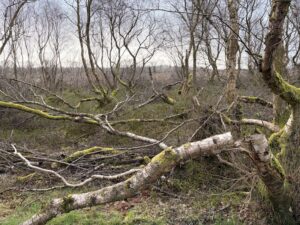
I arrange to meet Eilidh at the far side of the Moss to my home, so I walk there on my own, along the north woods path to Heather Drive, where the woodland meets the concrete. On my way, I am treated to a chorus of birds: greenfinch, bluetit, robin and wren. Higher in the trees, crows, magpies and pigeons join in; and gulls soar above. I pass the broken birch branches, and the tangled shapes of the oaks that border the path. Peering into the wood between me and the houses, I notice a swing and a traffic cone and wonder about a section of the Moss that I have yet to explore.
Eilidh joins me after walking the dog and dropping her two children off at primary school. I remember that Clare had suggested that I should walk with Eilidh (their children are in the same class), due to her influential work in forestry and outdoor learning. Other parents – all mums – are dispersing around us and chatting on the footpath on their way back from the school run. Eilidh mentions how safe this place feels; she is pleased that many local women feel comfortable walking and running here.
Eilidh is Education Programme Manager for Scottish Forestry, where she coordinates the Outdoor and Woodland Learning (OWL) Scotland network, ‘supporting practitioners to engage young people in outdoor learning and connect their broader learning with the world around them’. This involves national networking events, upskilling and raising confidence in teachers and youth leaders, engaging them in conversations about how to connect young people with nature. I remember David K suggesting that this is exactly what is needed for the future of places like the Moss.
Eilidh remembers visiting the Moss with her school, soon after moving here from Bishopbriggs as a teenager. She talks about its transitional places, between residential gardens, communal grasslands, woodland, bog, and farmland. While my journey to meet Eilidh was soundtracked by the woodland birds, we are now walking down the boardwalk, where I have seen swallows, meadow pipits and stonechats. The different ecologies of the Moss meet and mingle and create a unique environment, which needs to be protected. For Eilidh, it is a ‘magical place’ that invites exploration. Eilidh’s children now play on the Moss, so she knows how important the opportunity for wild adventure can be.
We turn off the boardwalk and not for the first time, my folded A4 paper and note taking attract attention. A woman with a red setter asks us if we are involved with the conservation works. I tell her that I am actually writing about the Moss. We chat for a while and she shares what she knows, most of which tallies with the things I have learnt before: the army training on peat hill, the timeline of the peatworks, and the environmental protections. She also shares her concerns about the management of the site, and voices her opposition to the fences and other efforts to block access to the paths. She says that the bog has been fine for hundreds of years and that she doesn’t think a few people walking their dogs here makes enough of a difference to justify the barriers.
I realise that both the dog and this perspective on the Moss are familiar, and when I mention my walking project, it is confirmed that this is Andy’s wife, Janice. The setter is Juno, who I walked with back in September. I remember Andy telling me how upset he was by the tree felling. While Andy and Janice are among the strongest voices opposing these interventions, they are not alone in their concerns. I have spoken to many people now who have raised questions about the approach being taken here. I am yet to hear from anyone who was supportive of the recently torn down fences in the centre of the bog. We continue in opposite directions – Janice heads north up the boardwalk and we walk onto the main path across the bog.
Eilidh tells me that she moved into forestry via freshwater biology, by way of community engagement and outreach. She therefore understands how important it is to take diverse points of view into consideration and to develop projects carefully, in dialogue with the people who are involved and invested in a place. Eilidh agrees with me that there is an opportunity for more of this work here.
I ask Eilidh more about her job and she explains the complex systems of the forestry sector, which involves geneticists, ecologists, educators, technicians, lawyers, and a whole host of other professions, all with different knowledge, methods, and opinions. There are also contentious debates, including about the balance between investing in new productive plantations and restoring native woodland (both of which Eilidh says are needed). For Eilidh, when working with this level of complexity, the important thing is to identify the most urgent issues. Biodiversity loss and climate change are paramount, she says, but that can involve more timber production, which otherwise takes place in countries without strong guidance and legislation on sustainable forest management. In this country this is upheld by the UK Forestry Standard and the UK Woodland Assurance Standard.
We walk north and I re-trace my steps towards Heather Drive, this time in company. I ask about the state of the woodland here, which Eilidh tells me is another little mosaic of habitat, with the dominant birch growing comfortably amongst some more diverse areas. Birch are pioneer species, which can thrive in harsh conditions. But there are also oaks, beech and holly. There is a similarly another pocket of mixed woodland along the railway line. On close inspection, the variety of life here – lichen, bryophytes, and often overlooked smaller species – demonstrates the complexity and importance of this fragile habitat within this semi urban area.
We complete the circle and Eilidh’s way home is along a path that borders the houses on the north side of the Moss. I have never walked this route before, so I accompany her and satisfy my curiosity by exploring the mixed woodland we have just been discussing, and the play area that I noticed earlier. After we go our separate ways, I wander along a water channel, which is bridged at intervals, providing access to a line of gateways to each of the neighbouring gardens. There are bike tracks in the mud – this is clearly a well-travelled path.
I rejoin the main path near the primary school and reflect on the complexity of the Moss and all its visitors and residents – human and nonhuman. I am sure that there will always be differing opinions and diverging uses of this place. The important thing is to engage with this multiplicity of experience, listening and learning, and finding the best ways to be here, to enjoy the site, and to protect it.