One of my neighbour Marie’s earliest memoires of the Moss is from the 1970s. When she met her husband, John, he lived on Blackthorne Avenue to the northwest of the site. As they both worked in Glasgow, they would get the train together from Lenzie Station. Marie remembers running late one morning and the two of them making use of the old peatworks tracks to take a shortcut directly across the bog. They managed to dodge puddles and avoided muddy boots, making it just in time for their commute.
At that time, the Moss was a very different place. Lenzie Peat Development Company had closed down a few years earlier, but as I have been told before, people were still removing peat for their fires. Marie says that she didn’t particularly like the Moss back then. It was wilder and less popular, and parts felt dark and claustrophobic. Marie says it was a bit of a ‘no man’s land’ between the residential areas. This aligns with what I have been told by others who knew this place back then. It seems that the site was reeling from the shock of industry, and its identity was still being reformed.
Marie has lived on my street for just a couple of years longer than me. But before that, she spent most of her life in Kirkintilloch so knew the area well. She talks about the snobbery that she has sometimes encountered from those who regard Lenzie as superior to its adjoining town, but she has no time for this. Marie and John made the move to be close to their family, having been blessed with five grandchildren in quick succession – including Eloise, who I walked with last month. Their family’s close geographical connection has been important in recent years.
My own children don’t go to school in Lenzie, and my parents and siblings live far away (about 11,000 miles in the case of my sister). So I am envious of those with the ability to drop kids off with relatives or walk them to school. Iona is visiting her new high school on Wednesday. From August, several round trips to Glasgow’s Finnieston will become part of my weekly schedule. Marie tells me that she worked there in her first job, as an assistant at a men’s clothing store. Today, the area is known for its ‘foodie’ culture and hip bars, but its post-industrial history is still evident in the architecture, and its proximity to the old shipyards on the Clyde, including the iconic Finnieston Crane. I remember the area twenty years ago, when I started to frequent its new pubs and restaurants, and even then, it was very different to the place Iona will get to know well over the next six years.
Places change both physically and culturally, and the Moss has come to mean something quite different to Marie. Now it is a place that she has walked with her husband, and their son and daughter, and their grandchildren and dogs. It is a place that she has tentatively returned to after a hip replacement, slowly building strength and managing to travel further. And it is somewhere her husband walks when his health allows. The Moss is a place of growth and healing that she has come to love.
It has been raining today, but the weather has improved for our walk. We can smell the post-shower earthy aroma of petrichor. Marie has noticed the changing scents of the Moss through the seasons: in spring, buds awaken, triggering hay fever; in summer, the pollen and floral perfumes drift down from the trees; in autumn, the air thickens into a closer, damper smell; winter brings a boggy, muddy atmosphere to the Moss. Marie enjoys the seasonal shifts of this place, and she says she would much rather live here through the invigorating changes of the seasons than somewhere with a more stable climate that doesn’t have all this variety.
Marie mentions that she was unsure about joining me for this project since she doesn’t know very much about the Moss. It is clear to me that she knows a great deal more than she realises. Marie has great enthusiasm for the ecology of this place. She pauses our walk often to comment on the birds and the trees and the flowers. She loves the rich purples of the heather, and we notice the passage of a butterfly, which Marie notes with sadness have severely declined since the years when she crossed the bog from John’s house.
As we chat about the wildlife, Marie also says good morning to several people who she knows. Then, on the boardwalk, we pass another resident of our street, walking his dog. I don’t recognise him at first, but we have met a few times. I tell him about the walking project and without being rude, he sidesteps the implied invitation. Fair enough. Marie says that she usually bumps into someone she knows when she wanders around the Moss. That used to be the case for me in Finnieston, and it is becoming much more likely for me to see a familiar face as I wander around Lenzie. I am slowly becoming part of a community here. Spending time with several of my neighbours for this walking project has really helped with that.
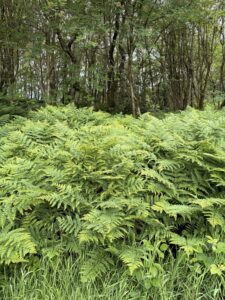
As we reach the end of our walk, we pass a huge patch of ferns – the namesake of our street. Some ferns are deciduous and die back in the late autumn; others are evergreen and abundant here all year round. These ones are vivid green and growing strong today. Marie says that for her, the Moss is a place of extremes: the seasons bring radically different conditions; various plants grow or die, and birds move in, or on, as the weather turns; these pathways have enabled journeys of health and resilience and have been the background to difficult times, as well as happy moments for their family. Over the years, Marie has come to understand and respect these extremes. This has allowed the Moss to grow on her. Just as the place has changed over the years, so has Marie’s relationship with it.