Any views expressed within media held on this service are those of the contributors, should not be taken as approved or endorsed by the University, and do not necessarily reflect the views of the University in respect of any particular issue.

54. Sandro

Ten years ago, I moved on from my job as a lecturer at the University of the West of Scotland (UWS), where I had worked with Jo for five years in my first academic post. During my time there, I met Sandro – another early career lecturer – who had just moved from his home in São Paulo to the town of Hamilton to the south of Glasgow, where the university has a campus. While I worked in Ayr, our paths crossed several times and we found a shared interest in the performance of place, and embodied learning experiences. Sandro was part of a festival I worked on at the Arches arts centre, and he even saw one of my plays at Glasgow’s lunchtime theatre, A Play, a Pie and a Pint. I left UWS for a new post at Royal Holloway in 2016 and we didn’t stay in touch.

A decade later, Sandro – now a Professor of Tourism and Leisure Studies at UWS – was driving through Lenzie, where he lives with his family, and noticed me walking up Kirkintilloch Road. Shortly afterwards, he was chatting to one of the other parents at his son’s school. Knowing that she also worked in theatre, he mentioned this sighting, in case she happened to know me. This was my next door neighbour, Nalini, who was the first person I walked with for this project. Nalini confirmed that I was now living here too, and told Sandro about my walking project. So he got in touch and here we are meeting again after all these years, ready to walk round the Moss.

We catch up on major life events as the deer accompany us up Bea’s Path – they are enjoying the sunshine as much as we are. Sandro says this is only the second time he has seen them here. Sandro moved to Lenzie in 2017 between having his first and second child. His youngest is the same age as Ruairidh, having been born in the early weeks of the first COVID-19 lockdown. He is in the same class as both my next door and upstairs neighbours and will soon be attending a birthday party in the garden adjoining mine. The family began visiting the Moss quite regularly during the lockdown, as did many who I have walked with here. Their eldest learnt to ride her bike here – gathering speed and confidence along the boardwalk. Soon after lockdown, that part of the Moss was closed for a long time while maintenance work took place, and as they couldn’t walk round the site, and lockdown restrictions eased, the habit fell away. Since those years, Sandro hasn’t been here much, so he is pleased to have the excuse to return today.

I tell Sandro that over the course of this project so far, I have walked with a disproportionate number of academics – from professors and lecturers to postgraduate students. There are a few reasons for this: these are the people I see every day at work and who are more likely to know about this project; researchers have time to take part in unusual walking projects like this; and as an affluent town with good transport links to the university towns, there are a lot of educated folk living round here. I confess to being a bit uneasy about the ratio, but as I have also walked with plenty of people from different backgrounds and professions, I hope I am gathering enough diverse perspectives on this place, even if my ‘sample group’ is a bit imbalanced.

Sandro tells me a story about another academic and another restriction of access. A couple of years ago, several roads were closed near his home to the north of the Moss. Little information was shared by the authorities, but there was talk of hazardous substances at a private property. Speculation among the community was that this was the home of a professor of chemistry, who had lived alone and recently died. When his vacated house was valued for the market, an elaborate laboratory was discovered, full of potentially dangerous chemicals. Explosive Ordnance Disposal officers and police were in the area for the day, and the roads were opened again several hours later.

Now that roads and boardwalks are open, and the negative experiences of the lockdown have faded in memory, Sandro is happy to be walking here again. We sit on a bench and look out across the bog to the hills beyond. We discuss how this place is experienced and understood differently by all the people I have walked with and how – regardless of how academic these perspectives might be – the Moss is created and performed through the relationships between them. Sandro has experience in bringing diverse voices into a dialogue about place through his work in tourism.

Sandro’s research concerns the inequalities and injustices that can be created and exacerbated through the tourist industry. He talks about the commercialisation of leisure and the way that time becomes capitalised. While he and his family recently enjoyed a trip to Disneyland, where I also had a wonderful day with Iona back in September, we discuss these hyper commercial places as the antithesis of Lenzie Moss. For Sandro, places like this are vitally important – places that we can come to for connections to nature, relaxation and exercise that are not wholly determined by the commercial systems and structures that define so much of our everyday leisure.

Beyond the university, Sandro has chaired the Renfrewshire Tourism Leadership Group. Working in a wide geographical area with many competing interests and some big players like Glasgow International Airport and Braehead Shopping Centre, the group have ensured that members of the community have a voice, and that the natural environment is considered alongside transport and retail opportunities. The RSPB’s Lochwinnoch Nature Reserve and Castle Semple Loch are important wetland habitats that balance the heavily industrialised side of the council area. As tourists fly into Scotland and locals visit for shopping and entertainment, many others are drawn to the rich birdlife and beautiful landscapes of the parks. Sandro’s group has brought many stakeholders together to deliver Renfrewshire’s tourism plan. I remember my walk with Stewart, when he talked about the value of coordinated approaches to site management, and I wonder whether East Dunbartonshire has an equivalent project that includes Lenzie Moss.

As we complete our circle, it is clear that 60 minutes walking round the Moss is nowhere near enough time to bring each other up to speed on everything that has happened since we last met. So we switch modes and head to Billington’s for a beer, and Sandro also treats himself to an ice-cream. One of the things that I hoped would come from this project is a greater connection to the Lenzie community. I am delighted that my research project has helped me connect with Sandro again. As we chat away in the cafe, I am thankful for the opportunity to spend my leisure time in this way too.

53. Eloise

Tired of walking, I stop and stand
Thinking back on my home town
But that road leading up the hill
Is telling me to move on
Country road…
(Hayao Miyazaki, Whisper of the Heart)

Lenzie is one of those towns that people move away from when they leave school. Often, they spend time living elsewhere, then move back when they have experienced more of the world and maybe had families of their own. I have walked with several people who followed that pattern – Paul, Alison, Michael. I have walked with young children (including my own) and those who have lived by the Moss for decades. But this is the first time I have persuaded someone in their teenage years to walk with me. And it is the first time I have walked with someone who has lived here their entire life.

Eloise is the granddaughter of my neighbours, Marie and John. She has recently turned 18 and has just finished her exams. Having received an unconditional offer from the University of Edinburgh, she plans to accept a place studying Global Law. There are many other subjects that she could have chosen – archaeology, international relations, and art were all possibilities. In the statement she wrote to apply for the archaeology course, she wrote about the Moss and the fact that we are always so close to history.

Eloise is feeling a huge sense of relief, and release, now that her school days are over. In the final couple of years, she doesn’t feel she found the right balance. Now that she anxiously awaits her grades (although some pressure has been taken away thanks to that offer), she looks forward to spreading her wings. Eloise will leave home for the first time, live in a city, and meet people from all over the world. As her course features a compulsory year abroad, she will also be living in another country in a little over two years. I sense that Eloise is ready for all this – that she needs it.

The tradition of ‘muck up day’, marking the last day of classes in the final school year, has become popular in Scotland over the last decade or so. I have often seen pupils creating (good natured) havoc round the town, wearing school shirts covered in messages and pictures, and sometimes armed with shaving foam and toilet paper for their pranks. At Eloise’s school – Lenzie Academy – the tradition is for everyone to head to ‘the Burroughs’, a part of the Moss to the south of the trainline, where school leavers gather after school is finished to get the party started, before they move on to celebrate in houses around the town. I haven’t heard of the Burroughs before, and I can’t find any references to it online. It is good to know that some local names and locations are known about through word of mouth still, and that not everything is captured by maps and databases.

Eloise tells me that she ended up hanging out with new people, who she hadn’t spent time with before that day. While she has often been seen as shy and lacking in self-confidence, she is coming out of her shell and finding new connections and opportunities. I think she will do really well at university, where there are so many different groups and societies and different types of people doing all sorts of things.

As we walk on a very hot day in May, the air is filled – as it was on my very first walk – with floating seeds. Eloise is a fan of Japanese anime and the films of Hayao Miyazaki, so she gets my reference to Nausicaä of the Valley of the Wind, in which the air is filled with toxic spores. The Moss looks like a scene from that film today, but these floating seeds are thankfully benign. Eloise recommends the Studio Ghibli film Grave of the Fireflies and I plan to watch it soon (although I know enough about the plot to emotionally prepare myself first). I try once more to photograph the air and once again the results are unimpressive. Another thing that can’t be captured digitally.

As we reach the far side of the Moss, Eloise tells me that as children, her friendship group used to come to the Moss to act like they were older, getting up to mischief and enjoying moments away from their teachers and parents. She says that her younger brother and his friends do the same now, and she looks back at her 13 year old self with a mix of pity and fondness. Over the years, others have been there too. Both Alison and Michael recalled their childhood visits to this place. Many have had some of their most formative experiences between the heather and the clouds.

This western border was the furthest point Eloise and her friends were allowed to roam. We are at the edge of her childhood geography, then. It is a perfect place to reflect on Eloise’s new phase of life, as she steps onto the threshold of new experiences in distant places. What a time of transitions! We look out beyond the Moss to an exciting future. I am reminded of my walk with Iona, when we stood here and looked out to Bishopbriggs and the Campsies, and imagined what the future had in store for her. I called this a liminal place then, and it seems so now as well.

Another of Eloise’s favourite Studio Ghibli films is Whisper of the Heart. In that film, there is a scene when 14 year-old Shizuku and a boy named Seiji cycle up to the top of a hill in Tama, Tokyo, and imagine their future together. She will be a writer and he will be a violin maker. They watch as the sun rises and casts its light over the city. The portrayal of place in these films is so vibrant and enchanting. I have wanted to visit Japan ever since I watched them for the first time. Eloise, also, wants to spend time in the metropolises of East Asia. She wonders about Hong Kong or Singapore.

As we talk of distant places and future possibilities, a plane flies overhead and I wonder where it is travelling to. The Moss feels like the starting point of a journey that could take Eloise anywhere she wants to go. But I am sure that like Shizuku and Seiji, she will often follow the country road back to her home town again.

52. Isabella

Isabella is a first year PhD student in my research centre at the University of Edinburgh. She is interested in research and writing spaces and has started to explore the ‘knowledge-making and meaning-making experiences’ of history students. She is wondering how to use walking methods as part of this work and we recently met to discuss this aspect of her project, so I invited her to walk with me here. One of Isabella’s supervisors is my colleague James, who joined me for a walk round the Moss back in November. It is no surprise, then, that Isabella is thinking about postdigital education: recognising the entanglement of digital technologies in our research practices. As I found with James, there is no reason to discount a walk round a peat bog.

Isabella has not been to Lenzie before. She has only recently moved to Scotland for her PhD and is enjoying living in Edinburgh and exploring the nearby towns and cities. Isabella is from South Africa and has been studying history at the University of Cape Town. This is her first time living in another country. After our walk, Isabella will take the train to Glasgow and wander round the west end. As I lived there for two decades, I fully endorse her plans to visit the Botanic Gardens and the Kelvingrove Museum. I suggest stopping for a coffee on Ashton Lane. I am feeling nostalgic for this part of the city at the moment and I am excited for Isabella, discovering new places.

As we walk, we talk more about Isabella’s research plans. At a recent meeting with her supervisors, they discussed the possibility of expanding the scope of the project. Isabella is now thinking through the implications of working with other types of learners in different contexts. She feels that walking methods would be a good way of expanding the field of her studies. Could she accompany participants on their routes to work? Perhaps mapping and creative writing exercises would bring journeys into the project. Perhaps, like Brian, Isabella will start to explore learning spaces outside the academy.

When I walked with Ruby, she told me about a recent fieldtrip to Fala Moor in Midlothian, where a group of students worked with singer and composer duo, Karine Polwart and Pippa Murphy. It turns out that Isabella was also there. Isabella was inspired by their collaboration and the openness and responsiveness of their creative process. It prompted her to listen more to her environments and showed how a connection to place can be enhanced through creative methods like songwriting, composing, or poetry. Isabella wonders whether her own research methods could move in that direction.

Isabella asks me about my project and the approach I have taken here. I return to the conversation I had yesterday with Jimmy. We discussed the ‘openness’ of the exchanges and encounters that comprise this project and noted how loosely they might be defined as interviews. I agree that there can be huge value in the insights that writing prompts and artistic methods can provide. But last week in Spain, working with the Walking Assembly, I realised how the lightest of frameworks and plans can effectively hold space for unexpected experiences and outcomes to emerge. The theme of that gathering was ‘learning without teaching’ and I think that is what I am experiencing here.

Halfway round the route, I realise that we have been talking about place-based research, rather than doing the work (however that might be understood). Of course, talking is part of fieldwork, but sometimes the conversation can delay a connection with the site. I have walked with a lot of researchers, including several PhD students (Ada, Ali, Ellie, Deirdre, Kyriaki, Brian and Eilidh), and with many of them, also, there has been a careful discussion about their research before we have settled into the environment. It is hard for me to avoid falling into supervisor mode. But it has also been important to understand the specific interest that my co-walkers bring to the Moss: the questions that they are asking and the methods they are using to find answers.

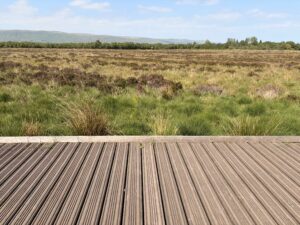
But there is a point on this route when conversation gives way to something else. This happens on leaving the birchwood, when the path joins the boardwalk. As the vista opens up and the bog reveals itself, with all its muted colours and shifting scales, there is a moment of change in pace and purpose. Isabella and I pause our walk and take in the atmosphere of this place. We watch a great black corvid swooping down into the heather. I am sure it is a crow, but it seems way bigger than I expect it to be. Sometimes scale is hard to gauge here. As I attempt to verify my assumption with the Merlin app, I record a skylark – the first time I have encountered one here, although others I have walked with have told me they have seen them.

We walk along the southern pathway across the bog and encounter another chapter in the war of attrition that I have been monitoring here. I review the stages of this story:

First, a desire line emerged leading to the tree swing.
Second, a section of fence was rolled out over the boggy ground, as a makeshift boardwalk.
Third, the fence was moved aside, and contractors dug a series of ponds across the path.
Fourth, the fencing returned and was placed in a meandering route around the new pools.
Fifth, the fencing was removed from the site.

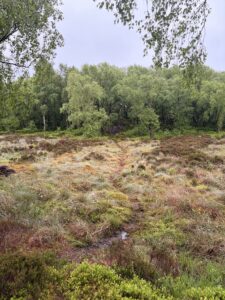
The sixth stage, which we encounter today, is the appearance of a brand-new desire line to the right of the original. This new route takes a completely different path to the wood. Check. I wonder what the council’s next move will be? Surely, we won’t see more barriers and ponds in this area? The oneupmanship seems unhelpful.

This part of the Moss, which I have studied for over a year now, is the best example of the contested relationship between the users and managers of this site. I have learnt about the context by speaking with both dog walkers and council officers, but I have only understood its implications by being here so often and observing the changes and developments over a long period of time. For me, walking methods have been an effective way to build a connection with Lenzie Moss as a more-than-human environment, of which I am a part. I am pleased to know that younger researchers see the value in this way of working as well, and I look forward to finding out what new pathways Isabella will follow.

51. Jimmy

For the grain of the tree consists of lines of growth rather than particles of matter, and it is held together by knots rather than by the equilibrating force of gravity. (Tim Ingold, Correspondences)

My colleague Jimmy is the only person I know who describes themselves as both a woodworker and an anthropologist. Maybe there are many others who combine these disciplines, but I suspect this is a bit of a niche job. For several years now, Jimmy has been working with the Binks Hub – ‘a network of academics researchers, community members, practitioners and policy-makers using creativity and the arts to co-create research that makes a difference to people’s lives’. I have often wondered how a co-creation process might benefit the Moss so I’m looking forward to introducing Jimmy to the stories that I have encountered here.

Jimmy tells me that despite working with wood (they make sculptures and furniture) they don’t know much about trees. But we are walking through birchwood now and the silver birches are easy to identify. Neither does Jimmy know much about peat. I tell them a little of what I have learnt: how the peat is formed as the slowly decaying sphagnum moss accumulates beneath the living layer – a phenomenon that can happen because this moss is alive and dead at the same time.

Jimmy is intrigued by this alive-deadness of sphagnum, particularly since they recently worked on a project that creatively explored death and dying. With the Utopia Lab, Jimmy and the other participants undertook a series of ‘imaginative experiments’. These included writing exercises and a group walk to Greyfriars Kirkyard in Edinburgh. Using the small makers kit that they always carry, Jimmy made a sculptural response to the site, using materials that they gathered there. They reflect on the connections these items had with death – including the earth itself, which is formed through myriad decomposing flora and fauna, including the dead people buried there historically.

I wonder what materials the Moss could offer, and show Jimmy the fungal growths on the branches above us – the ‘witches brooms’ that I saw with Iona, along with the unusual bulges protruding from the trunks. Woodworkers are often keen to work with these tumorous woody growths on trees, known as burrs, due to the unique patterns of the grain. I have been reading the anthropologist Tim Ingold’s ‘correspondences’ with trees recently and I mention his discussion of grain to Jimmy. ‘Lines of growth’ are important, but Jimmy tells me that grain is not held together by knots, as such. Rather, it is bound by a natural glue-like substance called lignum and also various processes of ‘interlocking’, wherein it wraps around itself. There are rich metaphors in the wood. In Jimmy’s sculpting and furniture making, they find and work with the shapes that are already there in their materials, rather than imposing a predetermined form. They are far less interested in the kind of design that prioritises silhouettes over surfaces, preferring work that responds to the irregularity and textures of wood.

We discuss the methodology of my work at the Moss, and Jimmy suggests that these are ‘research walks’ rather than interviews, but accepts my suggestion that they are ‘radically open interviews’. Although I sometimes have an instinct about what we might discuss – in Jimmy’s case, co-creative work with communities – I never prepare questions or suggest a particular agenda. The invitation is simply to walk and chat and see what happens.

The connection between woodworking and anthropology is becoming clearer to me. Could an analogy be made between the trees and the walkers? While Jimmy would take time to feel their way into the shapes and grains of the wood that they create new things with, during my walks round the Moss, I am taking time to feel my way into the stories and perspectives that different people bring to the site. When Jimmy makes a sculpture, it is a collaboration – or to use Ingold’s term, a correspondence – between the tree, the wood and the maker. My accounts of these walks on this blog are correspondences between the Moss, the walker and the writer. In both cases, we are establishing a process of emergence rather than deciding in advance what we want to create.

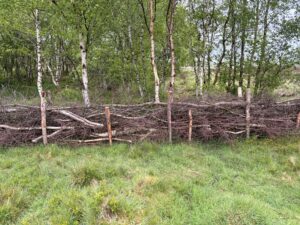
We pass the deadwood hedge and Jimmy admires the craft and aesthetic. I use this opportunity to explain some of the relational dynamics of this site. I have sometimes seen an opening appear in this barrier, as it blocks a pathway onto the bog so has been kicked down. These are swiftly repaired and today it is intact. Jimmy is surprised by this behaviour and has limited and ambiguous sympathy for those who feel entitled enough to impose their own preferences in this way. Jimmy, as a person made anxious by unleashed dogs, is critical of ‘some dog walkers’ and even though I consider myself respectful and sensitive to the places I am walking with Clyde, I bristle at the association.

Our walk down the boardwalk is accompanied by birds: stonechats and meadow pipits, and swallows overhead. Since I learnt the call of the willow warbler from Julia, I have been taking pride in telling others about them and I point them out to Jimmy now. I have realised recently how my way of being here has changed over the last year. When I walked with Nalini on the second walk, I felt ‘underinformed and unsure’. A year later, I have learnt so much about this place.

The final section of our walk takes us past the controversial fencing (which seems to have been accepted now, after the previous version was destroyed). I tell Jimmy about the tensions and conflicting viewpoints that I have encountered here, and suggest that a co-creative process with the community would be valuable. Jimmy doesn’t disagree with this, but does offer a new perspective. They are also clear about the difference between participatory research as a knowledge production methodology (which is mainly what they do) and community engagement and consensus building practices, which they don’t claim expertise in. This is a helpful distinction for me, and it explains why there is no clear route from my participatory research walks round the Moss, to the community-engaged initiatives that might be valuable here. There is overlap, of course. But some more careful thinking is required about how and whether this project has the seeds of something more impactful.

For those who engage openly and constructively, the workshops and creative methods that Jimmy uses can be powerful methods that increase engagement and provide a sense of ownership and agency. But there will always be those who don’t choose to engage, perhaps because they are unable to do so, and often those who claim to speak for others and assert their opinions without listening to alternative ideas. This is not to assign blame – Jimmy recognises that the material conditions of someone’s life may prevent them from being able to engage. But Jimmy suggests that community engagement workshops would offer no guarantees that barriers would remain standing.

Every time I think I have this place worked out, a new walking partner disrupts my direction of travel. I welcome this. The lesson I have taken from today’s walk is that we need to enter into correspondence with the site itself – the birchwood and the stonechats, the burrs and the willow warblers, as well as the people who visit. If we spent time with this place, we can get a sense of its grain and start to work with it without preconceptions. If we can do this, then the right form will emerge.

50. Jo

My client is not in a hurry. (Antoni Gaudí)

I have spent most of the last two weeks in Catalonia, first in Cap de Salou with Iona, then at the Walking Assembly 2026 in Girona and the Pyrenees, and yesterday as a solo tourist in Barcelona. I returned late last night. Today, I have been plunged back into the emails and tasks that have mounted up in my absence. It is hard to believe that just hours ago I was sitting on Montjuïc looking out over the city, with Gaudí’s Sagrada Família in the distance. Now, I am escaping the admin by walking round a peatbog with my friend, Jo.

Jo is an important person in my career journey. When I was working on my PhD in theatre studies at the University of Glasgow in 2010, on the recommendation of my supervisor, I wrote a letter (back when we used to write such things) to the heads of related degree programmes at local universities, asking if they might have any teaching work available. One of these landed on Jo’s desk at the University of the West of Scotland’s Ayr campus, just as she was looking for performance teachers who could bridge theory and practice. We met for a coffee in Glasgow and within two years I had a full-time academic post. I worked at UWS for five years and by the time I left, my life had changed completely. Jo has been a mentor and friend ever since and I have plenty to thank her for.

We have lots to catch up on. Not only do I want to regale Jo with stories of my recent adventures, but we also have all the news of our families, and our work in art and education to share. Jo is one of the most energetic and enthusiastic people I know; her conversation is fast-flowing and lively, and she is always interested in what I have been up to and how my children are doing. We will have to be disciplined if we want to keep our attention on the task at hand. So we agree to share a cup of tea after our exploration of the Moss and hold all the other topics for now.

Jo has had some challenging professional experiences over the years – often bravely standing up to injustices and always prepared to take on the egos in charge of cultural and education institutions. She is therefore particularly drawn to projects like this, which she sees as an antidote to the extractive and unethical practices that have become so prevalent elsewhere. Taking time to build relationships with people and place, de-centring the researcher, and learning how to be other – I am pleased that Jo sees all these qualities in this work.

Jo is now semi-retired and has more time for exploring places like this. She arrived at Lenzie on an earlier train, having never visited before, and has been wandering round the town. Jo initially wondered whether the enthusiastic waves of a passing van driver were due to the friendly disposition of the residents. In fact, this was Gavin – an actor she has worked with a lot, and who I also know, and once bumped into on a walk round the Moss. Jo is scoping out routes to take her husband on and says she will return to Lenzie. I point out the route through the woods to the canal, which they have often walked along closer to their home in the west end of Glasgow.

Jo asks me about the peat bog, and I learn that her interest is driven partly by a love of whisky. She recalls a trip to Highland Park Distillery in the Orkneys and says that the whisky that is made there has a light peaty taste, which she compares favourably to the intensely smoky whiskies most associated with the Isle of Islay distilleries. While Islay’s Laphroaig kilns are fuelled by ‘a heady mix of the heather, lichen, seaweed, moss and woodland that decayed over the centuries’, Highland Park burns Orkney heathered peat, ‘which delivers complex floral aromas’. I wonder what whisky would be produced by smoking barley with peat from Lenzie Moss.

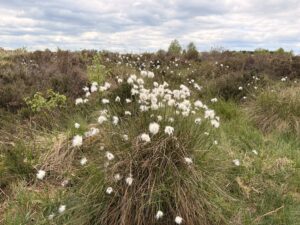
As we are not in any rush, we sit on one of the benches and look out over the bog. We watch swallows darting over the bog cotton, which is now growing all around us. Various timescales coalesce in this moment. It is now two days short of a full year since I began this project. I have walked with the Moss as it has changed through its annual cycle and look forward to at least another year of this project. I have known Jo for over 15 years now and we have followed each other’s work through many other projects at various other places. Reflection on time and personal history comes easily as we sit above centuries-old peat, slowly accumulating again, despite that rate at which it was extracted from this place.

I think about Gaudí, who began work on the basilica in 1883, but did not live to see its completion (the building is still under construction to this day). With God as his client, he wasn’t in any hurry to finish his great project. But great it certainly was. When I stood before it yesterday, as I sheltered from the thousands of tourists behind a bin, I felt overwhelmed and conflicted. Famously, the Sagrada Família’s height of 172.5 meters (which was only reached earlier this year) was deliberately capped by Gaudí to remain lower than the tallest point of the Montjuïc hill (just over five meters higher), because ‘the work of man must not surpass that of God’. Nevertheless, the building is designed to induce awe. I watched a crane lift a section of stonework into place and went on my way.

24 hours later, I reflect on the qualities that Jo sees in my own durational project and think about how light the traces are that I will leave behind. How many hours will I have spent walking round this site and writing about my encounters here? But sitting here with Jo, looking back over 12 months of walking Lenzie Moss, I am pleased to say that I have created nothing visible or enduring. The materials of this project are relational, the medium is ephemeral, and the legacy is words and memories.

I am grateful to Jo for helping me see the value in this way of working. As we reach the end of our walk and head to my house to finish our meeting with that promised cuppa, I realise how central time is to this project. Committing to these 100 circles has given me many hours of close connection to the Moss, but it has also afforded time to get to know my neighbours, learn from my guests, and maintain my friendships. As Gaudí knew, as did the whisky distillers from Islay to Orkney, time is the most important ingredient in any creative endeavour.

css.php

Report this page

To report inappropriate content on this page, please use the form below. Upon receiving your report, we will be in touch as per the Take Down Policy of the service.

Please note that personal data collected through this form is used and stored for the purposes of processing this report and communication with you.

If you are unable to report a concern about content via this form please contact the Service Owner.

Please enter an email address you wish to be contacted on. Please describe the unacceptable content in sufficient detail to allow us to locate it, and why you consider it to be unacceptable.
By submitting this report, you accept that it is accurate and that fraudulent or nuisance complaints may result in action by the University.

  Cancel