Alison grew up in Lenzie in the 1970s and 80s. She went to school on the old site of Lenzie Moss Primary, which is now the playground for the new, larger school. It was said that the building sank a little into the bog each year.
Alison takes me to this place at the start of our walk. There are high fences around the perimeter now, which she says weren’t there before. At break times, the children were allowed to play on the Moss unsupervised. The school was connected to the bog by well-trodden pathways through the grassland. There were large holes in the ground – most likely created for the removal of peat – which the children would climb into. They felt surrounded by and connected to wildness. Alison says that she feels lucky to have had so much freedom growing up.
It is the first day of the October school holidays. Some young children cycle along Bea’s Path with their parents close behind, but it is generally quiet today. There is a gentle breeze whipping up fallen birch leaves into a perfect autumnal sky. We see a heron flying close overhead and a flock of geese passing far above. A gentle light draws us through the woods towards the peatlands. We pass a couple of teenage boys, lost in conversation.
The Moss was the backdrop to Alison’s teenage years, too. She and her friends would head up the ‘peat hill’ at the far side of the bog. The youth of Lenzie would meet up there to play and hang out. Everybody knew the spot. Their parents didn’t know where they were or what they were doing, but back then people were much more relaxed about their children’s whereabouts. I recall my own childhood days spent in the woodland near our village and I have to admit that I wouldn’t feel comfortable if my own children were to do the same. These wild, unruly landscapes are appropriate settings for rule breaking and risk taking.
Many of the houses that border the Moss were built in the years after Alison had left Lenzie. Some of them now stand on areas that she remembers as woodland, thick with blaeberry bushes. There are more established pathways and new ways onto the site. It is strange to realise that many of the features that have become waymarkers for me as I walk round the Moss – the cul-de-sac on Heather Drive, the pathway by my house, the boardwalk – were not there fifty years ago. Alison welcomes these developments to the extent that she is supportive of enhanced access to the site. At the same time, she feels a sense of loss, as the Moss is no longer as wild and unknowable as it was before.
Alison moved away to spend her student days in Edinburgh (where her daughter is now studying). After living elsewhere for some time, and after becoming a parent, she moved back to the area to be close to family. In the intervening years, a lot has changed. We approach the peat hill, and Alison observes that it is not much of a hill anymore. She wonders whether it seemed so much bigger and steeper because she was so much smaller, and that memory might have added a few feet. But we both think it more likely that erosion and peat extraction have flattened what was once a much higher area. Alison remembers fires burning here and thinks that some were set on purpose. I tell Alison something that Kay told me: that this hill was used for musket training in the 1700s. Surely, presuming that is true, this was a much more pronounced feature of the landscape.
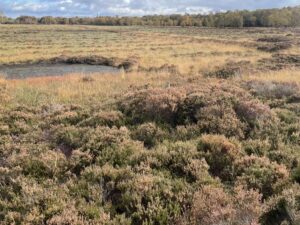
We walk to the top of the hill – or perhaps it should now be called a mound or a knoll – to look out over the bog. I have never done this before and despite it only being a slight elevation, this position still offers a new vantage point. We can see a peaty, stagnant pool at the bottom of the slope, and beyond it is the open space of the mire. Alison remembers the ditches and the raised baulks that cut across the site in the years before she left Lenzie. Around the same time that she moved back, the large-scale restoration work took place, which Jackie told me involved in-filling these hollows and levelling the landscape. Alison had not noticed this reprofiling of the Moss before now.
At the bottom of the boardwalk, we turn onto the path across the bog. It has been raining a lot this month, so the ground is muddy and holds so much water that it springs under foot. Alison says you haven’t really visited a bog if you don’t get filthy or lose a boot. She remembers trudging home with mud-soaked socks. Thankfully, this doesn’t happen today, but we do tempt fate by following the raised path into the middle of the bog. When we get there, we stand still for a while amongst the sphagnum and the bog cotton. The wind hurries along a single meadow pipit, rising and falling through the air. Sunlight shifts across the Campsie hills to the north and Alison plans her next hike.
We enjoy the feeling of remoteness despite our proximity to the city. Looking to the southwest, there is a clear view of the high-rise flats in Springburn, marking the edge of the Glasgow conurbation. As we look out across this varied landscape, it strikes me that on these many walks that I am taking round the Moss, I have rarely stopped and taken it all in like this – felt the wind on my face, allowed my gaze to travel out into the distance, and revelled in the calm and quiet that this place offers so much of. While a lot might have changed here, I imagine that this feeling has persisted over the decades. It must have been very special growing up here, and I am happy that my own children will have this experience as well.