Any views expressed within media held on this service are those of the contributors, should not be taken as approved or endorsed by the University, and do not necessarily reflect the views of the University in respect of any particular issue.

Blog

47. Bob

‘The Lady’s Mile’, 1905 Postmark, Auld Kirk Museum, Accession number: KITAK: 2004.20

This is my second circle of the Moss today. When I walked with Clyde this morning, I noticed that the contractors were back on site. The fence across the central path had been reinstalled – this time with a lower, sturdier structure. This version would be easy to climb over, for anyone who was determined. I think it will have more chance of staying put, but I will be interested to see what happens after the last attempt was destroyed in the night.

I meet Bob outside the station. He lives on the other side of the track and for decades, he has walked and jogged round the Moss. Bob is a retired maths professor and moved up to Glasgow in 1980. He discovered a love of hillwalking and has been an active member of the Ramblers ever since. Like David K, Bob learnt about my project from Carol. I am grateful to her for recruiting new walkers on my behalf! Bob has a slight ankle injury today, so he tells me he might struggle a bit, but should be fine to complete a circle. Bob no longer runs here, but he often walks this route. He tells me he is ‘law abiding’ and always sticks to the main paths.

My semi-regular run takes me round the Moss in the other direction before cutting through Boghead Wood and up Christine’s Way to the canal. This is one of Bob’s favourite routes, too. He tells me about the other pathways that he enjoys. One of these is the Ladies’ Mile (or Lady’s Mile, as it is sometimes spelled), which I have never walked along, but which is clearly visible on the other side of the trainline.

There is information about the path on the arts and heritage website, Trails + Tails (the project that commissioned the Stacks artworks, which I explored with Ada, and which Iona climbed onto). A postcard at the Auld Kirk Museum in Kirkintilloch tells its story:

This postcard relates to an access controversy of 1904. The Lady’s Mile footpath ran between Boghead and Lenzie Station. Most of its route was on railway property along the south side of the line. The path was not an official right of way and to retain ownership the railway company locked the gates at either end from time to time, to the annoyance of local residents who vented their frustration by vandalising the chain that held the gate shut. However, a few months later, path users were forced to acknowledge the railway’s right and recognise that the closure had been intended to last about 24 hours. This postcard is postmarked 12th December 1905 and is addressed to South India with Christmas and New Year good wishes.

This anecdotal evidence of vandalism at the start of the twentieth century suggests that disputes about land use and access are nothing new here. I wonder whether I have met some of the decedents of those frustrated residents.

Bob and I catch glimpses of the sunlit Campsies through the trees, and he tells me that he was up there earlier today, playing indoor bowls in village of Fintry, which is hidden up in the hills in the strath of the River Endrick. I have visited Fintry from time to time and was there earlier this month with my children, shopping for Mother’s Day presents at the Courtyard Cafe – a favourite of Bob’s wife and her friends. Bob has been bowling for years now at the Sports and Recreation Club (he tells me that there is another good cafe there) and he recently persuaded some of his Rambling friends to give it a go.

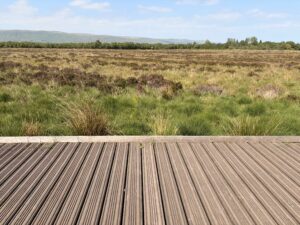
As we wander down the boardwalk, we look out towards Bishopbriggs, and Bob points out the route over the humpback bridge that links the Ladies’ Mile to Boghead Wood. I will walk this with Clyde one day soon. Bob also tells me about the route from the bottom of Victoria Road, past the Gadloch and over to Auchinloch (which has a pub that I have always wanted to try out). I am grateful to Bob for all these tips for further exploration of the Lenzie area. I remember that all this used to be connected to the Moss, prior to the railway line and the mid nineteenth century building works that created both Bob and my houses.

At the exact spot where Eilidh and I met Janice last week, we find a laminated sign pinned to a fencepost. The notice is about restoration works and tells us that ‘further access and biodiversity works will be undertaken in line with conservation objectives set out in East Dunbartonshire Council’s Lenzie Moss [Local Nature Reserve] Management Plan’. There is a list of works undertaken so far:

◦ Rewetting, regrading and reprofiling works to initiate recovery of peat and vegetation
◦ Scrub removal and thinning of Birch woodland
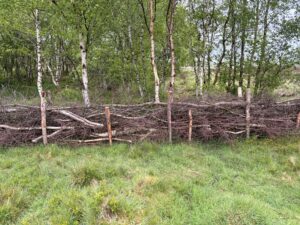
◦ Habitat Creation – ponds, dead hedges etc
◦ Path/boardwalk upgrades and maintenance

The sign includes QR code links to information about the NatureScot Peatland ACTION programme and the Scottish Outdoor Access Code. It also explains why it is important to protect peat bogs:

◦ Stores carbon reducing greenhouse gas release
◦ International important habitat (European Priority)
◦ Regulates water flow, quality and stores water
◦ Healthy peat supports key wetland species

There are pictures, of a skylark, a meadow pipit, a common snipe, a roe deer and a sundew. There are also some suggestions ‘for your own safety and protection of this site’:

◦ Stay on designated pathways and boardwalk
◦ Do not wander beyond fencing, dead hedges or into the peat bog
◦ Keep your dog(s) alongside you or on a short lead at all times
◦ Admire but do not disturb the wildlife

The sign seems to respond directly to the concerns raised by Andy and Janice: ‘Lenzie Moss is a very sensitive site, walking across the peatland can cause irreversible [sic], undoing thousands of years of growth and emitting greenhouse gases such as CO2 or methene!’ It concludes with a simple plea: ‘Please Respect Lenzie Moss’.

It is good to see this effort to communicate the reasons and intentions of the conservation work. But I have seen over the last year that these A4 signs tend to get damaged or removed easily. I wonder whether more permanent and enduring signage might be of value.

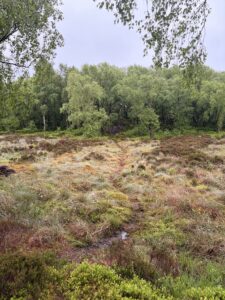
In return for Bob’s walking tips, I invite him to explore a path that is new to him, and we set off across the bog and through the woodland to the old peat shed. We stick to what I assume is one of the designated pathways, but I allow myself a short detour to inspect the new fence. Bob asks me about the ruins, and I show him the concrete platform, which I am assuming was part of the railway infrastructure.

This afternoon, Bob and I have shared what we know about this place with each other. I now have some new walking routes to explore, and Bob has seen a side of the Moss that he hadn’t yet encountered after all those years of running and walking here. We have followed the rules today, but it seems there will always be those prepared to break them.

45. Suzanne (and Lina)

… ‘field’ describes a place to learn from, to research, to draw from. (Suzanne Ewing, Introduction to Architecture and Field/Work)

Today’s walk starts with low, bright sunshine and cold, dry air. I forget that that my colleague Suzanne is bringing her dog with her, so when she steps off the train at the far end of the westbound platform, it is a lovely surprise to see Lina the black labrador by her side. Suzanne is a Professor of Architectural Criticism at the University of Edinburgh. I have enjoyed contributing to her postgraduate course on ‘Cities as Creative Sites’ at Edinburgh Futures Institute, as well as co-authoring a book chapter with her. Like me, Suzanne is interested in fieldwork and has an incredible eye for the materials, patterns and spatial configurations that create places.

For the last two decades, Suzanne has worked at the Edinburgh School of Architecture and Landscape Architecture (ESALA), which she directed from 2016 to 2019. She teaches her students to attend carefully to the edges of things, the objects and lines that demark a place, the surfaces and marks that inscribe patterns on the landscape. Good architecture grows from these starting points and enters into a dialogue with them, rather than imposing a predetermined structure on a blank canvas. I am interested in Suzanne’s perspective on the architectures of the Moss.

I haven’t seen Suzanne for a couple of months, since she had a bad accident on her bike. Cycling home from work one day, she hit a pothole, tumbled face-first over the handlebars, and ended up in A&E with a cracked cheek bone. Suzanne doesn’t remember it happening, but she was helped, and looked after, by a group of people who were at the scene. Suzanne says she was lucky and is recovering well. I admire her optimism.

After some time off work, Suzanne has eased back into teaching and research. Today, she is in no rush and will head back to Edinburgh later to meet a friend for another walk. For Suzanne, the freedom and flexibility that academia can sometimes provide is key to the creative practice that she uses in her work, and teaches to her students. These walks round Lenzie Moss have brought this into focus for me – the benefits of wandering, exploring, talking and learning. This is the work of fieldwork.

As we walk up Bea’s Path, the weather changes dramatically. Within minutes we are struggling through heavy snowfall. We pass several dog walkers, all of whom have been caught off guard. Luckily, we are in waterproofs and hats, although the snow quickly gives way to rain, and water runs down my jacket to soak my jeans. Lina is excitedly exploring this new place and jumps confidently into the large pools of water that have formed amongst the birch trees. Her muddy paw prints add another layer to my wet clothes.

We make our way along the north woods path, and by the time we reach the boardwalk, the sky has cleared again, and we are back in the sun. Suzanne talks about fieldwork and says that when she started studying architecture at the age of eighteen, their class took many trips. This cultivated a sensibility to the expanded field of an architectural site, and the work that might take place there. Suzanne has written that ‘fieldwork is a practice, not a discipline’.

At Lenzie Moss, Suzanne considers the bridges, dams, and enclosures that are now part of navigating the bog. She says that these features ‘inhabit its thicknesses’, by which I think she means that a certain quality emerges over time, which shapes the way that this site is used and perceived. In the boardwalk, the fences, the paths and the waterways, there is something of a taxonomy of architecture and material that ‘feels appropriate in its scale and deliberation’. Suzanne is interested in the tensions here between management and access, which are encapsulated in the anti-vandal painted fence posts that now stand ineffectively in the centre of the Moss.

Despite the sunlight casting birch shadows across the glowing sphagnum, it is still very cold. I am finding it hard to write notes on my rain-soaked paper and I give up after scrawling ‘cold hand’, almost illegibly. We pass a dam and Lina explores its wooden structure, which leads to one of the clearly visible desire lines that Stewart and I followed earlier this month – marking a connection to the south woods through the heather. Suzanne sees the fundamental building blocks of architecture in this arrangement of lines, edges, surfaces and materials. Where are the areas of stability? What kind of structures could be developed here? How does the field provide clues, offer suggestions, and open up an enquiry?

We arrive at the ruined buildings and I show Suzanne around. A couple of days after my walk with Stewart, I visited ESALA to talk about my Lenzie Moss project with some postgraduates. We also heard from architect and PhD student Adrian McNaught, who shared an experiment with materials left in the woods, to be marked and shaped by the environment. It struck me that ruins work in the same way: co-created by the elements and the flora that take root in the cracks and openings. Suzanne and I explore the old peat plant – imagining its past uses and comparing its solid, enduring foundations to the more fleeting installations of the fencing and the dams.

We have time for a post-walk coffee, so return to Billingtons, only to find that the outdoor seating – that most temporary of architectures – has been stacked away. It is now a beautiful spring morning in Lenzie and it is hard to accept that there was a blizzard here just 45 minutes ago. We can’t go inside with Lina, especially now that she has brought half the bog back with her. So we head up the road to share a cafetiere in my kitchen. Lina meets Clyde, who has been patiently awaiting my return, and they play power games with a bone while Suzanne and I chat away.

My house, too, is part of the architecture of the bog. Reminiscent of the West End of Glasgow, which Suzanne and I both know well, these streets were created over 150 years ago (which I now know thanks to my walks with Eddie and Sophie). The new buildings and streets stabilised and fixed the edges of the Moss, and established a local population, who accompanied the flourishing and decline of the peatworks, and eventually fought for environmental protections and rights to access the site. We are still very much in the expanded field of Lenzie Moss and I entertain the thought that enjoying a cup of coffee with Suzanne in my kitchen is, in fact, still part of our fieldwork.

44. David K

When I meet David on Kirkintilloch Road, he is wearing a camouflage jacket, which he attributes to his career as a deer stalker. David used to work for Scottish Natural Heritage (now NatureScot) in the Cairngorms National Park. He then went on to study countryside management and was involved in surveying the deer population across the East Dunbartonshire area, including at Lenzie Moss. David also remembers working for the council in this area in the 1990s, when he was employed to clear rhododendrons from the north part of the Moss. I hope we will see the roes on our walk today.

It is one of those days in Scotland when all the seasons come together: frost on the ground among the daffodils; snow on the hills beyond; clouds in the sky; and sunshine cutting through the trees. There is also a strong breeze. Given our direction of travel, this might help us locate the deer, who will not be able to smell us coming.

When I walked with my brother, Phil, just before Christmas, he recounted some recent deer stalking adventures and talked about the appeal of slowing down and paying careful attention to the environment. This is a sensibility that David knows well. David reads the landscape as we walk, noting the way that the wind moves through the branches – which are still without leaves – and the direction of the higher clouds, as well as the behaviour of the dogs we meet, and the flight of birds. It is fascinating to walk with someone who experiences the Moss in this way.

A silver-grey Weimaraner dog runs ahead of us and David notices that it has picked up a scent. We suddenly veer off the path and walk slowly through the trees towards the bog. As we reach the other side of the narrow strip of birchwood, we encounter two deer enjoying the sunshine. As they move away from us, David makes a squeaking call and instructs me to head slowly back towards the main path. We meet the dog once more, and his owner puts him on the lead, on our suggestion. But the deer have taken a different route now, and we don’t see them again.

As we reach the top of the boardwalk, David points out the location of the entrance to the drainage tunnel that runs between the Gadloch, south of the railway line, and Park Burn in Boghead Wood, to the west of the Moss. David tells me that the tunnel was dug by Napoleonic prisoners of war. We examine the area through his binoculars (David extols the benefits of a good pair) and notice an access point by the railway bridge on Crosshill Road, which seems aligned with the path of the tunnel.

We reach the boardwalk and look out across the bog. When I walked with Tony and Julia six weeks ago, we noticed the sections of fencing that had appeared, preventing access to the centre of the site. I said at the time that I wasn’t sure that they would be there for long. After various signs were put up and quickly removed, Carol and I noticed the addition of anti-vandal paint. Today, David and I observe what is left after someone has visited in the night and torn down most of the fencing. The route has been opened again, leaving only the deep-set posts that would have been difficult to remove on the fly.

David says it is all a bit of an eye-sore, but he is sensitive to the efforts to discourage access. David sees the bog as a vast carbon sink. He notes that the Moss used to extend further – reaching Bishopbriggs and further south than the trainline. He sees the fragment that is left as an important place that needs to be protected. For David, the answer lies in education. If people knew what was at stake, they would take more care.

David worries that people are becoming disconnected from landscapes like this. Young people stay inside on their screens (a situation I am often attempting to counter at the very local level of my own household). But if we can get them outside, engaged with the issues of conservation and biodiversity, then sites like the Moss are more likely to be protected. David says that we need to appreciate nature and the natural world more.

David tells me about a walk with the Ramblers (where he met Carol, who put us in touch). Half-way along the ‘Magnificent 11’ route round Linn Park, King’s Park and Castlemilk Park in the south side of Glasgow, he asked the group to stop. They stood in a circle with hands linked and eyes closed. And they listened. This invitation to become immersed in the environment and to take part in a listening exercise together had a profound effect on some of the group. Some told David they had not expected to be so deeply moved.

David encourages me to close my eyes and listen now. For a couple of minutes, I tune into the wind. It sounds different notes from various directions: a shrill whistling through the trees and a low, rumbling countermelody from the west. An approaching train joins the harmony, and I open my eyes to sunshine falling across the heather.

Suddenly, there is a commotion, and David excitedly directs my attention to the far side of the bog. He tells me there is a buzzard being mobbed by crows. I see a flash of brown dropping to the ground and we watch as a single, brave corvid sustains the attack. This is similar behaviour to the incident that I noticed with Carol, in the nearby trees. I wonder whether there was more going on then than I realised at the time. Perhaps the buzzard was involved then, too.

For the final section of our walk, we return to the main path. We say good morning to a jogger, who I have chatted with during the Lenzie Running Club outings. He is always very encouraging to Ruairidh, who joins in too. A mother pushes her baby in a pram. A couple walk their labrador.

I feel like I have just returned from an adventure into a wilder Moss, which exists just beyond the everyday journeys that people take here. David has shown me that there are roe deer, buzzards, and shifting winds out there to be discovered by those who take the time to listen. I think we can all learn something from David’s way of being in a place like this.

43. Stewart

In every town and city today, cutting across parks and waste ground, you’ll see unofficial paths created by walkers who have abandoned the pavements and roads to take short cuts and make asides. (Robert Macfarlane, The Old Ways)

I meet Stewart on the high street and appreciate his energy right away. We set off at a quick pace, and our conversation matches our passage. Stewart grew up on the Isle of Arran, works in property development, and has lived in Lenzie with his family since 2018. His wife is from the town, and they now live in her old family home. They have three children at the local primary and secondary schools and relatives nearby – in Lenzie and Bishopbriggs. While Stewart occasionally walks their dog on the Moss, it isn’t a place that he spends much of his time, but he is enthusiastic about the chance to walk with me today and to think about the possible futures for this place.

Stewart’s thinking is shaped by a varied career, including ten years as a navy officer and several in a senior banking role, with RBS and Barclays. He is used to being part of and leading complex multi-partner projects. Now, in his current job, he is always thinking about chains and networks and management. What would it mean to manage the ‘project’ of Lenzie Moss differently?

Stewart tells me about the ‘dig once’ concept in urban planning, which encourages the integration of different workstreams. If a gas engineer is digging up a high street to replace pipes, then it makes sense for the telecommunications, electricity and draining projects to come together to use the opportunity to do their work at the same time. That makes a lot of sense, but it requires clear communication channels, effective databases and strong project management. Stewart suggests that these things might be missing here and that they may be key to navigating the multiple interests and requirements of the Moss – from broken benches to hydrological surveys to community access. Everyone needs to have ‘skin in the game’.

We also discuss the funding required to maintain a place like this. Local councils are under severe financial pressure at the moment, leading to increases in tax and difficult decisions about priorities. In the long term, there is no guarantee that the Moss will receive the same level of investment. But if I have learnt one thing about bogs over the last year, it is that they are always changing. As Jackie said to me at the start of the project, without continual conservation, homes could flood and fires could start; the site would quickly dry out and revert to scrub-land, and birch trees would take over.

Stewart mentions the plans for community ownership of Lenzie Public Hall, which I learnt about when I walked with Clare. For community-driven development projects like this, Stewart promotes pragmatism about sustaining the business. Leasing, corporate hires, philanthropy – all these could be key to sustaining the community groups and education activities that people want to see thrive. I think back to my time working at the Arches arts centre in Glasgow, which closed in 2015 after many years of large-scale club events supporting a vibrant artistic community and arts programme. I remember lots of tension between the different uses of the building; every new project involved a negotiation with the different programming teams about space and resources.

We leave the boardwalk and wander across the bog, following the well-established ‘desire path’ that skirts this side of the south woods path. Desire lines have been mentioned several times during this project. These are trails made by people or animals taking the most desirable route through a landscape and sometimes creating an ‘unofficial’ pathway through repeated footfall. In The Old Ways, Robert Macfarlane explains that these rough trails establish themselves and become part of the physical and cultural landscape.

There are examples of Scandinavian and North American landscape architecture responding to desire lines. Perhaps most famously, the Ohio State University paved the lines created by student’s repeated footfall over the years, modelling the network of new paths on the lines made by previous generations. It seems that this has happened on the Moss as well, as the relatively new boardwalk includes a short side route with steps down onto the main desire path – just at the point where Deirdre and I noticed the exposed root system, which I took as a metaphor for the entanglement of lines that comprise this project.

The Moss is criss-crossed with desire lines, which are most prominent in the woodland around edges of the bog. The newly erected fencing, placed at intervals along the central raised bank, is intended to prevent this practice from continuing into the centre of the site. Today, it would be difficult to circumvent these structures due to the wetness of the mire. But in very icy or very hot weather, it would be possible to simply walk around them. Elsewhere on the Moss, when barriers are put in place, desire paths form as routes meander round pools and fences. We follow the unofficial lines through the wood to return to the main path, which takes us back to the station carpark.

As we walk up Kirkintilloch Road together, Stewart offers more examples of planning and infrastructure projects, which have shaped his approach to site development and long-term planning. From navy boat docking to aeroplane engineering, medical bookings to large-scale tourist events: Stewart pays close attention to how systems work and applies this thinking to the Moss, too.

What else could Lenzie Moss be used for? What are the alternative funding streams that haven’t yet been considered? How can the different users be brought together to work towards the same goals? How should such coordination be managed? Stewart suggests that we need to ask such questions here. He implies that the Moss would benefit from more ambitious and radical plans. He talks about the importance of listening to the ‘voice of the customer’. By bringing together what the different groups – such as conservationists, dog walkers, and families – actually want, we can define the ‘so what’ and the ‘why’. This would allow the Moss to develop in a way that is intertwined with its users, rather than treating different needs as ‘parallel pillars’.

Just before we go our separate ways, Stewart mentions that his perspective and his way of talking about community spaces isn’t always welcome. To bring a property developer into the room is often to disrupt established approaches; to set a cat amongst the pigeons. I can see how some of Stewart’s terms, questions and suggestions could run counter to the slow, careful conservation that is often preferred for the Moss. But my own thinking about the site has been challenged today and I have valued the many examples and analogies that Stewart has shared with me. Thinking differently about the Moss might be just what is required for more ‘customers’ to invest in its future. Perhaps this is how new desire lines are formed?

42. Carol

March has arrived with birdsong, sunshine and new shoots. Today I am walking with Carol, who got in touch after hearing about the project through Walk Run Cycle East Dunbartonshire. Carol had originally suggested meeting a couple of weeks ago in the hope that her granddaughter would accompany us during the half term school holidays. But perhaps unsurprisingly, the prospect of a wander round a bog with a random researcher did not appeal to an eight-year-old, so only Carol and I will be circling the Moss this morning.

We set off and are soon witness to a drama in the skies, as crows swoop down to the birch trees to fend off rivals. Their ‘caw-caws’ and screeches reach out across the bog. Smaller birds fly off to safer perches. After the stillness of winter, there is a notable change in the land this week. The tiniest of hawthorn leaf buds are visible. The Moss is charging itself up, ready for the explosion of life that comes with the new season.

Carol is recovering from a broken pelvis, acquired while holidaying on the Isle of Arran, after an encounter with a suitcase in the dark. It has been a long, slow process. Carol has been in a lot of pain and has had to return to hospital over the last few months. She is gradually testing how far she can go and while she is fine for now, she doesn’t know whether the pain will return during our walk.

Halfway up Bea’s Path, we encounter a group of women of a similar age to Carol, kitted up with waterproofs and hiking boots. Among them is a friend of Carol’s, who she knows from the Ramblers. They share a hug and while the rest of the pack continue on their way, the two friends stop for a quick chat. The group are Soroptimists – ‘a global volunteer movement whose mission is to transform the lives and status of women and girls through education, empowerment and enabling opportunities’; they are walking for the upcoming International Women’s Day. Carol introduces me and my project. I learn that there will be a talk on the history of Lenzie Moss on Thursday, delivered by Kay for the Kirkintilloch Antiquaries.

The connections that Carol has made through walking mean a lot to her, but it seems that her injury has made it difficult to maintain these friendships. Carol has only lived in Lenzie for about the same time that I have. She moved here from Lancashire to be close to her daughter and granddaughter. I tell Carol that I made the same move, in a way (I lived in the same county for a couple of years when I was a toddler and my younger brother Phil is a native ‘Lancashire Lad’). Carol is enjoying living here but she is spending more time indoors than she would like to and is watching more television than she is accustomed to.

We dodge the huge puddles on the path and Carol tells me about some of her adventures over the years. She spent most of her career as a maths teacher, which included taking part in an exchange programme that allowed her to live and work in Australia for a year. Later, Carol left her job and travelled to Papua New Guinea, where she also worked as a teacher, and she then spent time as a travel rep in the Swiss Alps. Carol notices a plane fly over the Moss, and she tells me that she is less inclined to travel by air these days.

We pass the great oak on the North Woods Path and stop to admire its twisted branches, which are leafless for now but full of potential. A couple of pigeons are roosting high above us. Carol says that she loves trees and has been known to hug them, too. We examine the shapes against the sky and Carol says that she would like to take up drawing again. I wonder if there are any art groups nearby and can well imagine Carol and the Soroptimist women visiting the Moss with sketchpads and pencils. Walking and drawing are closely related since both are actions that create lines and entanglements. Close by, a new plaque has appeared on a tree stump, commemorating ‘Gus “Wee G” King of the Moss 2010-2026’.

As we emerge from the trees to look out across the bog, Carol asks me about the fencing that has appeared here since her last visit. I explain that it is there to block access, and Carol understands the reasons for this. There has been another development, though. Now several of the fence posts have been painted in a thick black anti-vandal paint, which is visible across the bog. A new sign – already blurred by heavy rain – warns potential transgressors away. The sign that I noticed with Logan is now lying in the mud. So, this is the third sign in just a few weeks, and these have evolved from ‘help make space for nature’ to ‘Please don’t walk on the bog’ to ‘Warning anti-vandal paint’. I worry about how these new physical barriers and the dialling up of rhetoric in the signage will be received.

We follow the path back into the woods and as we reach the narrow wooden bridge that is really part of a dam, something splashes into the water. As we move closer to inspect, we are surprised by a pair of copulating frogs! I photograph them and apologise for invading their privacy, but they seem quite happy and entirely indifferent to our presence. Then we balance as we walk cautiously along the plank (Carol is comfortable to do so) and join the path on the other side.

As we reach the end of our walk, Carol notices that she has been pain-free for the last hour. We have made steady progress round the Moss today, stepping over puddles, navigating uneven surfaces and shuffling along a narrow beam. I am delighted that Carol seems to have enjoyed this walk without discomfort. I am sure that she will be out rambling with her friends again soon. Some barriers can be overcome.

41. Kate

The currency in a gift economy is relationship, which is expressed as gratitude, as interdependence and the ongoing cycles of reciprocity.” (Robin Wall Kimmerer, The Serviceberry. Cited in Feminist Culture House, Windows of Tolerance).

Before we reach the Moss, Kate draws my attention to the pots of primroses outside the flower shop on the main street. They sit unassumingly in what is likely to be sphagnum moss peat. All of the items on display have ‘plant passports’, indicating that they have been imported from the Netherlands, where Kate lives when she is not in Scotland. Kate also suspects that they may be covered in pesticides. Despite passing this spot hundreds – maybe thousands – of times, I have not noticed the proximity of the international peat trade to a protected bog before. So, within seconds of meeting Kate for the first time, she has shown me something new and encouraged me to engage critically with my local environment.

The practice of using peat for commercial horticulture has only been popular for under a century, but today it is as commonplace as it is controversial. Recognising the environmental damage caused by peat extraction, the Scottish government recently ran a public consultation on ending its sale in this country. Promoting their campaign for the UK government to legislate to end peat sales, the Peat Free Partnership explains that ‘the horticulture industry has made encouraging progress in becoming peat-free, reducing usage of peat by over 50%’. However, they note that ‘the pace of change doesn’t match the urgency needed, and progress without legislation is slowing’. With ongoing extraction contracts in place for many years to come and international chains supplying shops like this, more action is needed.

Kate is an environmental artist, who has committed to support peatland restoration in this capacity and has worked on many related projects for over a decade. In a recent biography, she is described as being ‘part of a movement re-imagining connections people can make to peatlands’. Since 2016, Kate has convened Peat Cultures (Veencultuur), an ‘artist’s project highlighting diverse cultural values of peatlands’.

Kate’s artistic process stems from field-drawing and involves studio-based work. Her current projects include a series of ‘Peatland Figures’ that help her explore outmoded peatland paradigms and the process of shifting mindsets. These manifested initially as shadow puppets that inserted cultural considerations into scientific peatland research. More recently she started making glove puppets. For Kate, these figures ‘articulate unwelcome mindsets that I want to move away from, such as self-centredness, romanticism, denial, despair and complicity.’ But importantly, ‘they also make me laugh!’

Kate’s web of connections includes grassroots organisations, research centres and museums. She has worked with the Crichton Carbon Centre and several universities (she has a PhD in Social Policy and an MSc in interdisciplinary Creative Practice) and has campaigned for peat-free futures with Peatland Justice and as an older member of the youth-led collective, RE-PEAT, for whom she recently presented work at a collective show – Limbo – in the Netherlands. Kate knows a great deal about peatlands and how we should care for them, even though she says her knowledge is partial. There is a lot that I can learn from her.

At the top of Bea’s Path, we pause to discuss the ethics of my project. Gently and sensitively, Kate prompts me to consider the dynamic of this exchange. I will find out more about Kate’s work and benefit from her insights into places like the Moss, Kate will widen her experience of peatlands in Central Scotland, and we will both get to meet a new collaborator. But we are not here on an equal footing: I am a salaried academic, conducting these walks as part of my research time at the university where I work; Kate is a visiting freelance artist, who has generously given up her time and covered her own expenses. I have to confess that I have not given enough thought to this power imbalance and I am grateful to Kate for raising the issue. Kate recommends a book by Feminist Culture House, which offers Tools for Ideal Collaborations in an Unideal (Art) World. This introduces the idea that collaborators have different ‘windows of tolerance’ within which they can offer their time, their energies and their emotional investment.

My repeated circling of the Moss with friends, family and neighbours, as well as visiting scientists and artists, has always seemed to me to be a shared rather than an extractive experience – something that both parties will enjoy and benefit from in various ways. Kate agrees with this, saying that she greatly values the introduction to Lenzie Moss and the supportive exchange. But she adds that she and other independent artists, are often invited to contribute their experience or ideas only to find that they are the only unpaid person in the room. This project does not come with a research budget and Kate’s point is not a request for payment, but what are the other ways in which a reciprocal arrangement can be ensured? I carry this open question with me as we walk.

Kate catches sight of what she thinks may be a sparrowhawk. I am too slow to see it but hope that she is correct. Turning off the boardwalk, we encounter three of the roe deer on their morning walk. They stay close to us as we cross the bog and listen in as I tell Kate about the fencing and the pools and the tensions that occasionally arise here. We come across an abundance of scarlet elf cup fungus (Sarcoscypha austriaca), which grow on sticks and branches all along the south woods path. These striking red bowls are nestled on beds of spongy moss. They are the counterpoint to the primroses that are on sale round the corner.

As we circle back to our start point, I share my experiences of walking with people who have very different opinions on how this site should be managed. My approach has been to remain as neutral as I can so that I can listen and learn from others without imposing an agenda. Kate considers this for a while and formulates a response as we return to the main pathway by the station. She then offers a challenge to my neutrality, arguing that sometimes it is important to take a position on ecological injustice and environmental harm when it occurs.

What would I be prepared to say, now that I have come to know this place so well and spent so much time with people who live, work and visit here? Well, I certainly believe that the bog needs to be protected and that this is a shared responsibility. I also feel that there needs to be greater dialogue and more collaboration between those who manage and use the site. I subscribe strongly to the use of creativity and conversation in brokering these connections. And I support Robin Wall Kimmerer’s argument – brought to my attention by Ada – that land restoration also requires relationship building. Perhaps these are things that need to be said.

At the same time, I think that nurturing relationships with places like this happens by listening to each other and being open to alternative perspectives. I am consciously deferring the point when I attempt to speak for the site, or on behalf of those who have walked with me here. Some of the artists I have met, like Ellie and Deirdre, have shared a similar reticence. Kate understands this impulse but also sees it as a moral imperative to take a position on climate justice. We need to listen and move carefully, but also to acknowledge and articulate our starting points.

I feel that what I can offer to Lenzie Moss is my time and a careful attention to its ecology, as I stay so close to it through the seasons and over the years. Part of that is listening to and learning from the people who know this place well, along with those who are sharing my life here and those who visit from elsewhere, bringing new perspectives on peatlands and environmentalism more generally. For me, the gift of these walks is to step outside the institution where I work, to meet new people, encounter different worldviews, and to share experiences of this place. Part of the responsibility that comes with this is to be sensitive to the situations that my collaborators have joined me from – their ‘windows of tolerance’, their values and their contexts.

40. Gary

I have only a few reasons to keep on running, and a truckload of them to quit. All I can do is keep those few reasons nicely polished. (Haruki Murakami, What I Talk About When I Talk About Running)

My good friend Gary is visiting today and we plan to go for a run, followed by brunch. Gary is organising a 10k for his work colleagues next week and he is behind in his training. A couple of weeks ago, we both set off from my house on my usual 7.5km route. We ran clockwise round the Moss and across the football pitches to Boghead Wood. From there, we followed Christine’s Way to the canal and jogged through the centre of Kirkintilloch to Luggie Park. Passing the leisure centre, we ran down to Whitegates Park and then back along the residential streets to complete the loop. The route has over 100 meters elevation gain, which is equivalent to an extra kilometre of effort. I have been forcing myself to do it every week this year, along with a shorter run such as the 5k parkrun at Drumpellier Park, which I attended for the first time last week. I have also been out with the recently formed Lenzie Running Club, which circles the Moss on occasional Sunday mornings. New year, new me.

Lenzie Moss is perfect for gentle running. It has nice wide paths free of obstacles and no hills. We therefore decide to stick to the Moss today. It has been very cold overnight (Gary sent me a screenshot showing that it was -4°C when he woke up). But it doesn’t feel too bad as we set off, and the pavement is free of ice, which was our main concern. Gary starts his Map my Run app as we leave my house and turn left onto Bea’s Path.

For two laps, we maintain a steady pace. There are several people out running this morning, and we see some of them more than once as they pass us in the opposite direction. There is a certain quality to the greetings exchanged between joggers: an encouraging nod and a half-smile of solidarity.

Neither Gary nor I are natural runners. I don’t think either of us even enjoy it, to be honest. Unlike the marathon-running novelist Haruki Murakami (of whom we are both fans), we don’t run as a habit or a daily ritual. Every outing requires an effort of will. But thankfully, we have enough reasons to keep on running. I suppose that chief most among them is the need to stay healthy as we reach our mid-forties. I may be maintaining a weekly run at the moment, but experience tells me that this pattern is easily broken. If a busy work week or a bad cold or a holiday gets in the way and causes me to miss a week, then the motivation evaporates and I give up on my streak. The trick is to keep doing it, then.

As we run, Gary’s app alerts us to each kilometre that we reach. We agree that we will run continuously until we reach the sixth. This happens just short of the bottom of the boardwalk on the south woods path. At this point, we about-turn and switch to a walk. It feels good to have pushed ourselves and while our pace has not been particularly impressive (even by our standards), we both feel a sense of achievement. Gary checks our distance and time on his phone and restarts the app.

As we switch direction and gait, I sense our attention shift to the landscape around us rather than the pathway ahead. We pass many dog walkers and several families with warmly wrapped children running off to explore the woodland. Magpies hop behind the grasses, which glimmer in the frost.

I tell Gary about the local running club that I have enjoyed being part of. For the last two runs, I have taken Ruairidh with me. The first time, he ran twice round the Moss at a surprising pace, beating most of the adults back to Billington’s for hot chocolate. Last Sunday, he set off even faster, staying in the lead for half of the first lap. At the top of the boardwalk, he looked back to me, red faced and exhausted and not willing to run any further. I think this hard-won lesson about pacing will serve him well for tomorrow’s run.

Gary’s eye is drawn to the silver birch, glinting in the bright winter sun. He notices that some have been felled or damaged in storms and it reminds him of a time in Sri Lanka, when he visited a forest that had apparently been flattened by elephants. My own point of reference is closer to home, and I tell Gary about my visits to a beaver reintroduction project at Bamff Estate in Perthshire, where the water has spread into the woodland, bringing down tens of trees. One summer night, I stayed in a lodge beside the main dam and walked along the river just before midnight, accompanied by beavers swimming alongside me.

We pick up the pace again and jog along the north woods path, only walking again as we leave the path through the trees and look out across the bog. A couple of days ago, the Campsies were covered in snow. Today, there are only remnants on the tops. Gary grew up in the nearby town of Kilsyth, at the foot of these hills, so he knows the geography here. He points out the snow-capped peak of Meikle Bin and tells me that his elderly aunt always used to say that she would climb it one day but never did and is now too frail. I suggest that we should do it on her behalf some time.

Gary and I have climbed far higher than Meikle Bin, although we realise with alarm that we haven’t been hiking together for years. Even longer ago, we started to bag Munros, and managed several, including Beinn na Lap, where Steve recently completed his 282nd mountain adventure. Our best made plans never went very far, diverted as we were – and frequently still are – by travel, pubs and restaurants. Being outside together and looking out to the hills on such a fine winter’s day puts us both back in the mood for adventures and we agree to make time for them this year.

We run for the final section back to my house. This walk-run alternation makes this particular circle the quickest of the 40 that I have done so far (at 24 minutes 17 seconds) and the only one that isn’t entirely walked. But despite the speed with which we have moved along, we have enjoyed being in each others company this morning. Running with a friend is about making time for each other, catching up and hatching plans. It is also about achieving something together and rewarding that achievement, which is another very good reason to keep on running. We head off for our reward now with a visit to Billington’s for a well-earned beer and a breakfast roll.

39. Logan

A cold breeze accompanies me to the station, where I meet my old friend Logan from the train. Logan and I were at university together in the early 2000s and she is now a Senior Lecturer in Contemporary Literature at the University of Sheffield. After 25 years in the UK, having moved here from Luxembourg, Logan has decided it is about time for her to seek British citizenship. Having spent much of her time in Berlin over the last few years – typically for more than the 90 days out of the country that is permitted for the application process to commence – she is staying in this country a lot more now and, I’m pleased to say, making more frequent visits to her beloved Glasgow. Logan is currently studying for her Life in the UK Test, and I wonder whether a walk round a centuries old peat bog might help. Probably not, but it should.

Logan writes about techno-cultures – the ways in which our cultural lives are shaped and determined by various technologies. As we walk through the station car park, we note the cluster of CCTV cameras by the platform, which capture everyone who enters or leaves this corner of the Moss. While it might seem that we are free of surveillance as we take cover in the birchwood, our phones betray our positions, and we may also be visible to satellite technologies, capable of monitoring human activity from hundreds of miles away in low Earth orbit.

Technology is more present in our environments than we might assume. We cannot see the decades of heavy industry that extracted thousands of tonnes of peat from this place. But they have certainly shaped the landscape. Logan also points out that the way we see and understand the world is conditioned by our technological experiences. James L and I considered this as well, as we explored the postdigital bog. We bring a whole host of digital references, visual methods, images and narratives to all our encounters and excursions.

Logan tells me about one of the topics in the citizenship test. She has been learning about English country gardens and the famous landscape architects Lancelot ‘Capability’ Brown and Gertrude Jekyll, who respectively pioneered large-scale ‘naturalistic’ landscapes in the eighteenth century and Arts-and-Crafts-inspired horticultural aesthetics in the late nineteenth and early twentieth. Logan tells me that this is about the extent of the content on nature and environments. While the tests do also cover national parks and countryside care and responsibilities, the problem is that this rote learnt knowledge does nothing to create active, engaged citizens. Even if the environmental content was significantly increased, it is not clear how this would lead to ecological responsibility and sustainability action.

Some of the topics in the test have led Logan into further research. She has been reading T. M. Devine’s The Scottish Clearances and learning about the history of dispossessed people and radically altered countryside. Logan has discovered that sheep are not indigenous to this island. They were introduced by early Neolithic farmers, shipped in from the Near East as agriculture spread into Britain. Could there be anything more quintessentially British than sheep grazing on rolling green hills? Neither the livestock nor the fields were here 6000 years ago.

We look over to the Campsies and reflect on the lack of tree cover. Land has been cleared for farming and fuel, leaving only a few patches of woodland in the valleys and lower hillsides. This is another example of how our landscape has been shaped by technologies that have created a legacy of absence. The historical clearing of the Scottish lowlands might be considered as an extension of the great British gardening tradition. Our landscapes have been dominated and curated in various ways for longer than we have the capacity to remember.

We take the path across the bog and detour onto the central embankment to inspect the new sections of fencing. We can only go as far as the first, which effectively blocks the way with tall wooden slats. A few days ago I came here with Iona and Clyde and read a notice pinned to the fence:

help make space for nature
Please note – conservation works are ongoing in this area

A QR code directed us to NatureScot’s Pollinator Strategy for Scotland 2017-2027. It was not clear who the information was intended for, or what function it had here.

This sign has now been replaced with one that reads:

HELP PROTECT OUR PRECIOUS PEATLAND
We are working here to save the wildlife of Lenzie Moss
Please don’t walk on the bog

There are cartoon pictures of a skylark and a sundew. We are told that the bog is ‘crucial for ground nesting birds’ and ‘an important habitat for insect eating plants’. I hope that these facts and explanations will be enough to convince people of the necessity of these barriers, but I have seen evidence to the contrary in disgruntled posts on social media in recent days. We turn back to the main path, and I see the original sign – water damaged, ripped into pieces and discarded in the mud. I can’t be sure, but the action seems deliberate. I pick it up and we continue on our way.

We walk through the birchwood and come across another discarded item. A soggy notebook is leaning against a tree in such a way as to suggest it has been carefully placed there. On closer inspection, it is a child’s journal. There is a Komodo dragon on the front cover, rain-smudged pictures of mice and puppies inside, and a list of ‘things you can see’ in pencil on the back page: dogs, bird nests, tree stump, robin, fairy door, mushrooms, ruins. And the name Lily. Perhaps we have discovered a handbook for ecological citizenship.

I deliberate as to whether to leave the book in its place to be reunited with its owner, or to bring it with me to clear the site of more rubbish. Logan is ruthless in her recommendation to bin it, but I decide to keep it with the torn and blurred sign in my pocket. I will return with souvenirs from this walk (but if anyone reads this who lost a notebook in February 2026 and would like it back, I’d be most happy to return it!). Maybe we could check the CCTV for a little girl entering the Moss with a book in hand and returning an hour or so later without it.

38. Tony (and Julia)

A couple of months ago, as I was busy reprimanding Clyde for something or other, I was greeted by a couple at the end of my street on their way onto the Moss. They introduced themselves as Tony and Julia and they recognised Clyde from my blog, so surmised that I must be David. Apart from my delight at this moment of very local fame, I was pleased to meet more of my neighbours. Of course, I opportunistically asked if they would be interested in joining me on a walk, and they agreed.

*

We meet on a cloudy Friday morning outside Julia and Tony’s home. I will walk with Julia later in the year, but today is Tony’s turn. Tony is a widely published haiku poet, who often takes his inspiration from very regular ‘orbits’ of Lenzie Moss. He soon corrects my commonly held misconception that haiku always use the five-seven-five syllable format. Tony will read some of his poems as we walk, and I will learn that there is leniency in the length (most poets now average 10-12 syllables). But there are still rules. Haiku are brief impressions of the world, grounded in direct observation, they use cuts or shifts in perception, rather than continuous sentences, and they avoid similes and metaphors. But to use a metaphor, haiku are pebbles cast into the reader’s mind.

I think about the rules that have emerged for my walks, such as traveling in the same direction and only walking with one person at a time. I am breaking one of these today, for a particular reason, and learning that rules are not always appropriate. Julia will accompany us on this walk. This is because Tony has been sight-impaired since birth and is now certified legally blind. He tells me that like about 90% of blind people, he has some sight, but that ‘life is a veritable blur!’ Julia will look out for any obstacles. She says she will let Tony do most of the talking, but I am also hoping to benefit from her keen interest in the birdlife here, which has become very active in recent weeks. And I will look forward to talking more with Julia on another occasion.

As we turn onto the Moss, I check it’s okay to walk anticlockwise and, because of Tony’s reliance on regular patterns and features of the landscape, he says that we really have to. Tony tells me that his blindness is not only limiting: it heightens his perception and focusses his attention to other ways of knowing and being in the world. He feels the earth with his feet, attends closely to the sounds of the birds, and leans into the wind. Perhaps the haiku is the best way to capture and share this experience, creating intense encounters that reward careful attention. We turn off Bea’s Path and pause by the pools that I saw were dried out on my first walk, but which are now full of water. Tony reads the first haiku of the morning (they are typically read twice):

midsummer
neither a tadpole
nor a frog

Caught in an in-between state, like we are at the end of January as the first tentative shoots start to appear, and the birds test their voices. Tony writes many, many haiku – a few every day. These are often in response to a specific location, so they will structure our walk round the Moss today.

We walk along the north woods path and listen for the birds. Julia lists those that they have encountered here, and many of them I have yet to see: swallows, swifts, cuckoos, treecreepers, linnets, skylarks… The latter I had been told were no longer here, but Julia says she saw them last summer. Tony has written about almost all of the birds that Julia mentions.

On the boardwalk, Tony reads another poem:

barely light
   breaking ice
   on the boardwalk

This resonates with my walks here. I remember the ‘barely light’ 6am visit with Cathy and ‘breaking ice’ with Minnie. Tony likes this part of the Moss for its openness and exposure to the elements, and for the cottongrass:

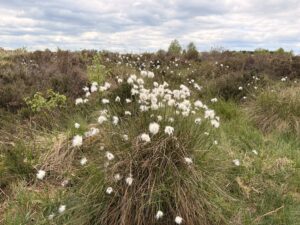
the wind
in every fibre
cottongrass

The white seedheads of the bog cotton, which I noticed in May with Ruairidh, won’t be back for a few months now. There has been a new addition to the bog today, though. A couple of conspicuous sections of fencing have appeared in the centre of the Moss, standing out against the subtle colours of the mire. I wonder whether these are to protect bog rosemary, which is rare and precious here, and could quite easily be snapped up by the resident roes. All three of us feel ambivalent about this intervention and I am sure that there will be others who are strongly opposed. I suspect that they won’t be intact for long.

Having lived in Lenzie for almost three decades and learnt about the history of peat cutting on the Moss, Tony is conscious of the damage that has been done here:

peatland
after fifty years
the scars still show

These scars are there in the striation of the landscape, the fragility of the ground, and the shallowness of the peat. When I walked with Kat, the satellite images that we looked at showed these marks very clearly. Julia and Tony are very supportive of the need to protect a place like this, but they also feel that the right balance has to be found and suggest that it is easy to over-manage the land.

We walk back along the pathway that runs alongside the railway line. Moss grows up the birch trees:

moss…
the quietest
of revolutions

I tell Tony and Julia that I am the chair of the board of trustees for James O’s Humanist charity, which happens to be called A Quiet Revolution. One of their key charitable activities is tree planting, so they are creating more habitats for the birds and the moss:

treecreeper
helter-skelter
        up the mossy trunk

We pass the tree that I noticed with Linsey, which was decorated for Christmas. The tinsel has been dislodged, and nobody has returned to tidy up. But the other visible icon of the festive season still grows strong:

holly leaves
as if this winter
never happened

In haiku, I am told, flora, fauna and seasonal references ‘do the heavy lifting’. But haiku are only complete in the moment of listening or reading. They are the opening of a conversation, an act of co-creation. I have written about performance in similar terms and through this project, have come to think about walking in the same way, too.

We return to our street and spend some time chatting, then Tony and Julia return home and I head back to my desk for the rest of the day. I find it hard to switch back into office mode. Little sparks of verse fire around my head. The Moss has been rendered in a new light for me today. From the shapes and the brightness, something very clear has emerged.

37. Ann

Since Clyde joined my family, I have been out on the Moss most days and have become a part of the disparate community of dog walkers that repeatedly follows its paths. My neighbour-across-the-street, Ann, and her 14-year-old dog, Sophie, are among my most regular encounters. I met Ann in my pre-dog-owning days, shortly after I moved here in 2023. But we hadn’t chatted properly and our exchanges were brief. Now that I take a walk early most mornings, in all sorts of weather, Ann and I have spoken for longer and more often. When I told Ann about this project, she kindly offered to join me for a walk.

The dogs are staying at home today and we set off on a cold and overcast afternoon to the sound of a robin singing its heart out. Ann has lived in Lenzie for over 50 years and says she is the longest resident of our street. She started exploring the Moss when it was overgrown and mostly inaccessible for her children’s prams, and now she is out here with her dog (and occasionally also her son’s, who now lives on the next street) very often – usually twice a day and regularly timed to avoid the school traffic. Ann doesn’t tend to walk all the way round now as it is too far for Sophie. I actually saw them earlier today when I walked with Clyde. Poor Sophie was limping a little, with what the vet later confirmed as an abscess on her paw. Ann also has a 20-year-old cat at home, who no longer ventures outside.

My seven months of dog walking have introduced me to a new kind of connection to this place and to the people who frequent it. I have realised that some – like Ann – are delighted to see energetic puppies bouncing up to them to say hello. Often, dogs run around the paths off their lead and excitedly chase each other when they meet. Ann says that lots of people, and also their dogs, know her well now. In conditions like this, she wears a weather and muddy paw resistant coat, which has dog treats secreted in its deep pockets. Dog walking brings warm smiles of recognition and enthusiastic greetings. Conversely, others are bothered by the unwanted attention and sometimes there are nervous, old or aggressive dogs that have to be avoided. You develop a sense for it.

We pass the grassland by Heather drive and Ann says she is concerned about the pools here, which could be dangerous for children and small dogs. As I saw when I walked with James L, there have been additional ponds dug in key locations around the site. Ann is not convinced about these and wonders what they are meant for. She has been walking here for decades and remembers a time when the mire was left to its own devices. She questions the necessity of the more recent flurry of fences, barriers, banks and ditches. Since the site was designated as a Local Nature Reserve and access was increased with new paths and the board walk, the added footfall perhaps makes more management inevitable. But through these walks, I now understand some of the reasons why the conservation work has not always been well received.

Ann has a lot of memories of this place. She tells me about an occasion when her son and his primary school friend went off to play on the Moss. When the agreed 5pm dinner time passed, Ann set off to find them and came across their abandoned bikes. She says she was never worried and soon found them hanging out up a tree, oblivious to the time. Ann recalls other times when she has had close encounters with the bog. She remembers a walk to the far side of the Moss many years ago, during which her husband momentarily lost a welly; and another when she stepped onto a grassy bank and found that it was far less stable than it appeared.

I tell Ann about one of my very first visits to the Moss, when I made a similar mistake. I remember it vividly. Thinking I would be able to hop between clods of earth, I brought my foot down to test the stability of a tuft of grass. My boot passed through the surface like a stone into water, and I immediately missed my footing. Losing my balance, my right leg swung instinctively forward to brace for the impact and it, too, sunk into the mud without resistance. I managed to quickly turn my full body and lifted my right leg up and out of the ground again. I ended up on all fours, covered in mud with my heart racing. Ann and I remember the feeling of embarrassment and the hard-earned lesson that this place can be treacherous for those who underestimate it.

We pass the old benches in the south woods path – one broken and the other removed. Ann says that the missing bench used to have a plaque in memory of a regular Moss visitor, David Lee. When I walked with Paul, I learnt that the newer benches were paid for with a bequest left by David. Ann remembers him and says that he used to enthusiastically predict the next train to pass, sharing his knowledge about the engine and the carriages. On cue, a train passes by on its way to Glasgow. Ann tells me that her father was a railway policeman and inspector, and that her childhood in Fife was enhanced by free first-class travel around the country and beyond.

As we arrive back on our street, Ann tells me about my house. Like Steve, she also remembers the wedding that took place in our garden. She also mentions an old stable block at the back of the property. The large pile of bricks in the corner of my garden is all that is left of this now. Ann also backs Clare’s theory that the corridor of land beyond was originally where the railway line transported cut peat from the bog to the town. My upstairs neighbour told me that they have seen the deer using this land as a passageway behind the gardens.

My walk with Ann has taught me about the ways in which the Moss has changed over the last decades. It is a marvellous thing: to have a long connection to a place and to have lived in the same area for so long. As a new member of this community, I am grateful to have learned more about what was here before me. Today’s walk and conversation have made me feel more connected to these memories and histories, and I am now creating my own. Perhaps I will still be living here in 50 years, still walking around the Moss.

css.php

Report this page

To report inappropriate content on this page, please use the form below. Upon receiving your report, we will be in touch as per the Take Down Policy of the service.

Please note that personal data collected through this form is used and stored for the purposes of processing this report and communication with you.

If you are unable to report a concern about content via this form please contact the Service Owner.

Please enter an email address you wish to be contacted on. Please describe the unacceptable content in sufficient detail to allow us to locate it, and why you consider it to be unacceptable.
By submitting this report, you accept that it is accurate and that fraudulent or nuisance complaints may result in action by the University.

  Cancel