Although my friend Ese has often visited me in Lenzie, this is his first time at the Moss. We meet on a Friday evening after work and it looks like we will be out in the rain, but just as his train arrives, the clouds part and the pathway at the end of the car park is framed in quivering sunlight. Ese lives in the West End of Glasgow, but he is drawn to places like this – close enough to the city but with a gentler, slower pace of life. Lenzie is on Ese’s list of towns where he would be happy to live one day.
This afternoon Ese has been working in his studio, where he makes ceramic sculptures, including ‘light sources’ (not lamps) and ‘vessels’ (not vases). He is one of the most creative people I know – always cooking, making and designing. When I moved to Lenzie, Ese was building a portfolio as an interior designer (he even enjoyed an ill-fated appearance on Alan Carr’s Interior Design Masters!), and he helped me create my new home. I now have lots of purple walls and a striking geometric bookshelf, thanks to his vision.
Ese grew up at the bucolic edges of Lagos, Nigeria – a city with a population of 20 million. His family grew plantain, almond and apple trees, and Ese’s childhood was spent amongst nature – quite different to the urban upbringing I had assumed. We pass the many silver birch, and I tell Ese that these are the trees of my own formative years in the English countryside.
Since living here, Ese has enjoyed exploring rural Scotland. He has bagged a few Munros (but not nearly as many as Steve), some with our mutual friend Gary and a couple with the Black Scottish Adventurers – a community of outdoor enthusiasts with the motto ‘This is living!’. Ese has also climbed Ben A’an, a smaller hill that I last walked up six years ago, for Iona’s sixth birthday (the age Ruairidh is now). The ‘mountain in miniature’, as it is known, rewards a manageable hike with stunning views of Loch Katrine. While Ese has found a new home among the arts crowd in the city, the lochs and the mountains give him a much-needed sense of belonging, too.
Sadly, as a gay man, Ese had to leave Nigeria, where homosexuality is strictly illegal. He arrived six years ago seeking asylum and has since been here on a refugee visa. Soon, he will apply for indefinite leave to remain (Nigeria’s government isn’t likely to change its position any time soon). This will make it easier for him to buy a house and lay down even stronger roots here. I can easily imagine Ese settling happily in a rustic cottage in the hills, sculpting vessels as he looks out over the valley.
Ese’s experiences of exclusion and migration have shaped his arts practice and influenced his way of working. He has said that as a designer, his objective is ‘to offer an insight into a way of living that blends cultures and identities rather than supress[ing] or supplant[ing] them’:
As a Nigerian-born gay man, identity for me was always confusing and belonging felt like a dream I will never be able to achieve. Losing my sense of self before life even properly began meant living false personas, always having to bend myself into the shape of whatever others or society wanted me to be, all to protect and conceal my real self. Now living in Glasgow, I explore the concepts of Identity and Culture through ceramics, interior design and art.
These concerns have also informed Ese’s work outside the studio. As Development Manager for Minority Ethnic Health at Waverley Care, Ese works with people living with, or at risk of, HIV and hepatitis and he supports minority ethnic communities across Scotland. These are issues that are of great interest to some of the students on my courses, who will be exploring questions about public health later this year. So I have an ulterior motive for inviting Ese to Lenzie today – I want to invite him to deliver a guest lecture for us!
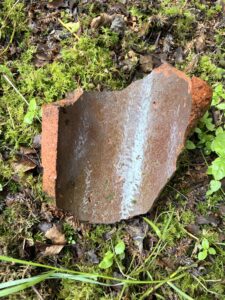
Talk of health and education can wait til after our walk. For now we focus on the bog and consider how this place might lend itself to artistic processes like Ese’s. We find a broken piece of ceramic pipe – a reminder that the Moss has been shaped by crafting and curating, as well as wildness and biology. I wonder what this found object could be used for and appreciate its deep orange hue and its glossy curve. Today, there is so much bog cotton on the Moss that it looks as though a great snow drift is melting away. We wonder how many of these seed heads would be needed to make a garment. It certainly wouldn’t be commercially viable, but there are examples of experimental fashion collaborations with bogs. I wonder whether Ese’s ceramics practice could find inspiration and materials in a place like this. I remember my walk with Eilidh, who looks to the landscape for natural materials as she strives for a sustainable arts practice.
The rain has returned, so we hurry back to my house briefly and then head to Billington’s for a drink. We sit in the window and enjoy a Lenzie gin (made with ingredients such as cranberry and bilberry that grow on the Moss), and there is just time for a beer as well, before Ese rushes to catch his train to meet his badminton friends back in the city. We talk about Lenzie and the Moss, about culture and race and belonging, and about health work in minority communities. And then Ese weaves all this together into an eloquent reflection on the value of working together across boundaries and disciplines. It is exactly what our students need to hear, so I am delighted when Ese accepts my invitation to give a talk at the university.
Ese has to rush off before I have finished my drink, so I sit watching the world go by for a while. I reflect on the last couple of hours. While I have seen Ese many times over the last few years, we have never really had a chance to talk about the things we have explored today. I am thankful for the opportunity to learn more about Ese’s upbringing and his transition between countries, and to know how art and place are now integral to his sense of belonging in Scotland. Walking round the Moss together has been an excuse to spend a different quality of time together and to find out more about my friend. Ese has an inspiring story, a meaningful creative practice, and an important and impactful career. I am sure that my students will be hugely grateful for the chance to meet him.