Any views expressed within media held on this service are those of the contributors, should not be taken as approved or endorsed by the University, and do not necessarily reflect the views of the University in respect of any particular issue.
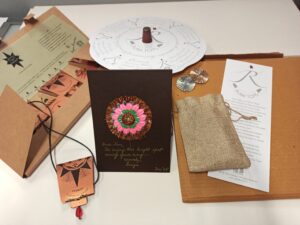
We were delighted to receive a beautiful Raksha Bandhan card from artist’s book maker Priya Pereira of Pixie Books, (Mumbai), this Christmas, and have added it to our collection of works by Priya, held in the ECA Library Artists’ Books collection.
You can find out more about the library’s collection of artists’ books and zines, at the subject guide here. All the books are listed on the library online catalogue DiscoverEd and there is an FAQ here to explain how to search for them!
All ECA students and staff can ask to see up to 3 artists’ books or zines at a time, at the ECA Library Helpdesk, at Evolution House level 1. Please note that all our artists’ books are Reference Only and cannot be borrowed or removed from ECA Library. If you are not sure what to ask for, ask library staff for our artists’ books Samples Box!
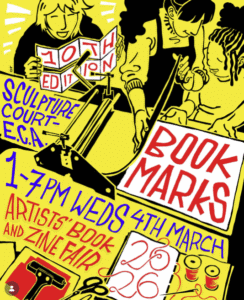
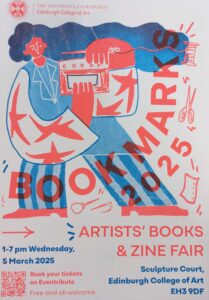
Coming up in March, on Wednesday 4th, from 1.00pm to 7.00pm, will be the 10th annual ECA Bookmarks Bookfair at ECA Sculpture Court, another fantastic opportunity to buy artists’ books, zines and prints from ECA students and artists from further afield.
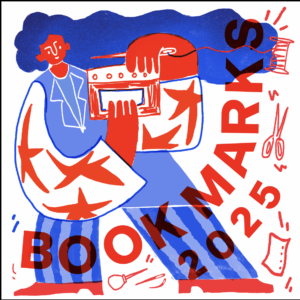
Above illustration by Luce Gutsche, third year BA (Hons) Illustration.
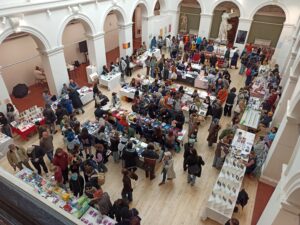
A view of the Sculpture Court during Bookmarks 2024. Photograph by Jane Furness.
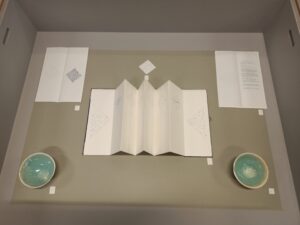
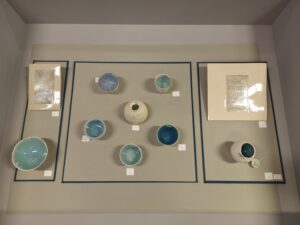
Our new display at ECA Library, Evolution House, features bookworks by Barbara A. Morton of Entropie Books.
The discipline of the blue-ochre envelope explores poetry, book-making, drawing and design. The bookwork is accompanied by hand-made ceramic pieces, some with text imprinted, emphasising the importance of the haptic, and exploring a new site for poetry to reside.
The display continues at Evolution House, West Port, until Thursday 5 March 2026.
Asemic writing, an intriguing form of expression devoid of specific semantic content, offers a universal language that transcends linguistic barriers. Emerging in the late 20th century, it has captivated artists seeking to explore the boundaries between text and visual art. Asemic writing’s abstract, calligraphic strokes evoke the appearance of writing without conveying explicit meaning, inviting viewers to engage with the work in a purely intuitive and emotional manner. Artists like Tim Gaze and Mirtha Dermisache have pioneered this genre, using its open-ended nature to provoke imagination and personal interpretation. This form challenges the traditional purposes of writing, emphasizing aesthetic experience over literal comprehension.
In contrast, pansemic writing encompasses the notion of universal meaning, striving to convey concepts that resonate across languages and cultures. This approach often employs symbols and signs understood globally, emphasizing shared human experiences. Artists utilizing pansemic writing aim to create connections through universally recognizable elements, bridging gaps that language may otherwise leave. Both asemic and pansemic writings disrupt conventional communication, encouraging a fresh dialogue about how we perceive and interpret written forms. As these art forms continue to evolve, they underscore the rich potential for writing to engage on a visual and emotive level, transcending the confines of traditional reading and inviting a more inclusive, imaginative interaction.
Books in this display, from our lending collection:
Beginning in the late 1960s, the Argentinian conceptual artist Mirtha Dermisache (1940–2012) produced publications that consist of asemic writing: marks that resemble language but lack semantic content. Her artist’s books, letters and postcards challenge habitual responses to both art and literature, leading us to re-evaluate how language works, how we perceive it, and how it might be distinguished from drawing.
Mirtha Dermisache wrote dozens of books, hundreds of letters and postcards, and countless texts. Not a single one was legible, yet, in their promixity to language, they all resonate with a mysterious potential for meaning. Using ink on paper, Dermisache invented an array of graphic languages, each with their own unique lexical and syntactic structure.
Fluency: A Collection of Asemic Writing, Karla Van Vliet, Shanti Arts Publishing, 2021
In Fluency, we see a union of Karla Van Vliet’s lifelong practices of art and poetry, each dissolving into the other and resurfacing as asemic writing. In her words: “There are times when I do not have words. Yet I have the need and desire to write. It is to asemic writing that I turn in these moments. To the gesture of writing… In the branching tree limbs, in the waves, in my hand’s scratching across paper, we each read the feeling that rises in us.”
Asemic: The Art of Writing, Peter Schwenger, University of Minnesota, 2019
Codex Seraphinianus, Luigi Serafini, Rizzoli, 2013
An illustrated encyclopedia of an imaginary world, created by Luigi Serafini, and first published in 1981, using an invented asemic language to convey the way children look at books before they can understand the printed word.
Mountains and Triangles, Michael Dean, Forma Arts and Media, 2006
In this bookwork, Michael Dean uses the barest language and starkly minimal typography to create an almost physical linguistic space that becomes charged with an unexpected emotional impact.
The last vispo anthology: visual poetry 1988-2008, Crag Hill & Nico Vassilakis, Fantagraphics, 2012
Spotlights the intersection of art and language gathering the work of visual poets from around the world.
After words: visual and experimental poetry in little magazines and small presses, 1960-2025, Steven Clay and MC Kinniburgh, Granary Books, 2025
Artists’ Books:
Asemic sibyls, Marco Giovenale, C’est mon Dada series, number 80, Redfoxpress, 2013
Now leaves, Michael Dean, Bookworks, 2015
Little black book, Jenny Smith, Edinburgh, 2009
Untitled, Jenny Smith, Edinburgh, 2011
The display opens on 1st December 2025 and continues to 11th January 2026 at ECA Library, Evolution House.
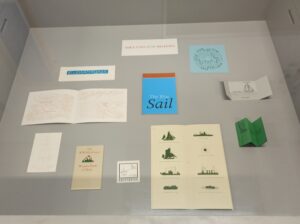
The works of Ian Hamilton Finlay (1925 – 2006) are the focus of our new display at ECA Library, Evolution House, “Evening will come…”, marking the centenary of this renowned artist, poet and garden-maker.
The display features book-works, cards and ephemera by Finlay and artists with whom he collaborated, with his imprint the Wild Hawthorn Press, which Finlay set up in 1961.
Finlay’s works explore themes such as boats, sailing and shipping, the French Revolution, concrete poetry, the pastoral, Classicism, and the Enlightenment, and have not been without controversy. Over his long lifetime he had fallings out with local government, arts funding organisations, and European cultural organisations, and even now causes some critics to become enraged.
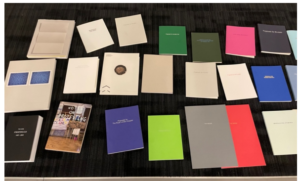
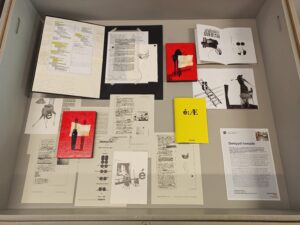
As the Ingleby Gallery curators explain: “Every element in an exhibition of work by Peter Liversidge begins at the artist’s kitchen table with Liversidge sitting alone writing proposals on an old manual typewriter. These hand-typed pages, present an array of possible and impossible ideas for performances and artworks in almost every conceivable medium. In a sense the first realisation of every work is in Liversidge’s head, then on the page, then in the mind of the reader, and finally (perhaps) as a physical object or happening. In every case, the first ‘artwork’ from any series of proposals is the bookwork that presents the collected ideas.”
The books include:
Proposals for Printed Matter Inc.
Proposals for Reykjavik
Proposals for the Flag Club
Proposals for East Quay
Proposals for Lancaster Arts
Proposals for Frome
Proposals for Hong Kong
Proposals for Huntly
Proposals for Kiasma
Proposals for Brussels
Proposals for Town Hall Hotel and Apartments
Proposals for the Berggruen Institute
Proposals for Basis
Proposals for CGP London
Proposals for Santarcangelo
Proposals for Liverpool
Proposals for Sean Kelly Gallery
Proposals for Antarctica
Proposals for SNGMA
Proposals for Barcelona
Proposals for Bonniers Konsthall
Proposals for Royal London Hospital
Liversidge has himself said: “In a sense they are all possible and the bookwork that collates the proposals allows the reader to curate their own show, and because of its size and scale the bookwork allows an individual to interact with each of the proposals on their own terms, one to one.” [Cell Project Space, 2005].
Our display in ECA Library, Evolution House, on the archive of Fluxus artist Takako Saitō, closed on 25th August 2025. Following that, our next display will explore the work of Ian Hamilton Finlay in his centenary year. This display will open on 1st September and will continue until 30th November 2025.
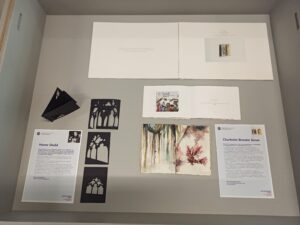
The Bookmarks Prize is awarded to selected graduates for high quality and innovative use of the book form shown at the Edinburgh College of Art Graduate Shows. It is open to all students across the Schools of Art and Design.
Jane Hyslop, Lecturer in Painting & Illustration at ECA, who curated this display says “In 2024 it was a pleasure to select three graduates to receive the award: Daniyyel Ironside (School of Art, Intermedia), Charlotte Brooke Simm (School of Design, Textiles) and Honor Dodd (School of Design, Jewellery).
The prize itself offered the opportunity to showcase work at BOOKMARKS 2025 which was held at Edinburgh College of Art in March 2025.”
Make your way to the ECA Sculpture Court at Lauriston campus Main Building from 1.00pm to 7.00pm to enjoy the annual ECA Bookmarks Bookfair! Your opportunity to buy prints, zines, artists’ books, cards, pin badges, t-shirts and other wonders made by our ECA Art and Design students, and friends from Scottish colleges and arts organisations.
Poster art by Rosie Wang, ECA Illustration student, rosieee_art on Insta…
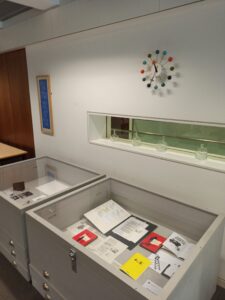
We wish all our students and staff a very productive semester 2, and invite you to come along to ECA Library to enjoy our new display of book works by artist and print maker Susie Wilson.
We are fortunate to have several artists’ books in our collection by Susie, in addition to the major boxed work she created in response to her residency at ECA library in 2016.
The works featured are:
Cabinet on left:
1: Flutter, Edinburgh, 2011
2: Inside Outside, Edinburgh, 2011
3: Hidden Inside, Edinburgh, 2011
4: Tunnel, Edinburgh, 2011
5: Insect Life, Edinburgh, 2011
Cabinet on right:
6: Untitled, Edinburgh, 2016
For more information about Susie’s work click here. [This display has now closed.]