

I admit I used to have some misconceptions about accessibility. After reading this week’s pre-class reading, Means Without Ends: Learning How to Live Otherwise Through Access-centered Practice, I’ve gained a new understanding of accessibility.
Originally, I had planned to create a QR code using Padlet and add an audio tour, as other galleries at Summer Hall had done. As the gallery is on the ground floor, I didn’t need to provide wheelchair access or ramps, nor a virtual exhibition for visitors who might be unable to enter the gallery.
However, after reading the article, I learned that accessible facilities include the built environment, human access, and assistive technologies[1]. I also learned that accessibility shouldn’t be viewed merely as a simple convenience measure[2]. In other words, I need to establish a platform where people with disabilities can experience exhibitions, advocate for their rights, and offer suggestions. I have also come to realize that my focus on addressing the living problems of residents in peripheral areas and seeking appropriate methods for rural development is, in fact, a form of intersectional disability justice activism[3]. Thus, I decided to redesign my QR code into a discussion and advocacy platform where all audiences can participate, breaking down barriers to disability rights and advocating for improved living conditions for people with disabilities, women, the elderly, and diverse communities in rural areas.
I can imitate the art curation organisation mentioned in the book and set up a public programme to help city residents support rural residents[4]. This idea of establishing direct connections between Edinburgh residents and rural communities around the world is the first step toward enhancing local residents’ access to welfare, services, and accommodations [5]. These small but powerful steps can begin in Edinburgh and spread via the internet to relatively wealthy rural areas—that is, those with internet access—and spark change starting from these places[6]. The public program goes beyond the physical space of the exhibition itself, transforming into a cross-regional online activism experiment. It will be an action revealing urban hegemony and the exploitation of rural communities by power holders such as local governments. Moreover, it is an attempt to help local people recognize acts of oppression and courageously resist them by fostering cultural exchange among residents from different regions[7]. This allows audiences who have never met to form a collaborative and interdependent community through the internet. As a result, this program enables visitors who view my exhibition and scan the QR code to experience a sense of “access intimacy.”[8].
Below is the QR code for the Padlet I created. I got the idea for creating QR code from the accessibility infrastructure at Summerhall. It includes an audio tour guide, Easy Read documents featuring more accessible versions of the works created based on the course, and the statement of my public project[9].
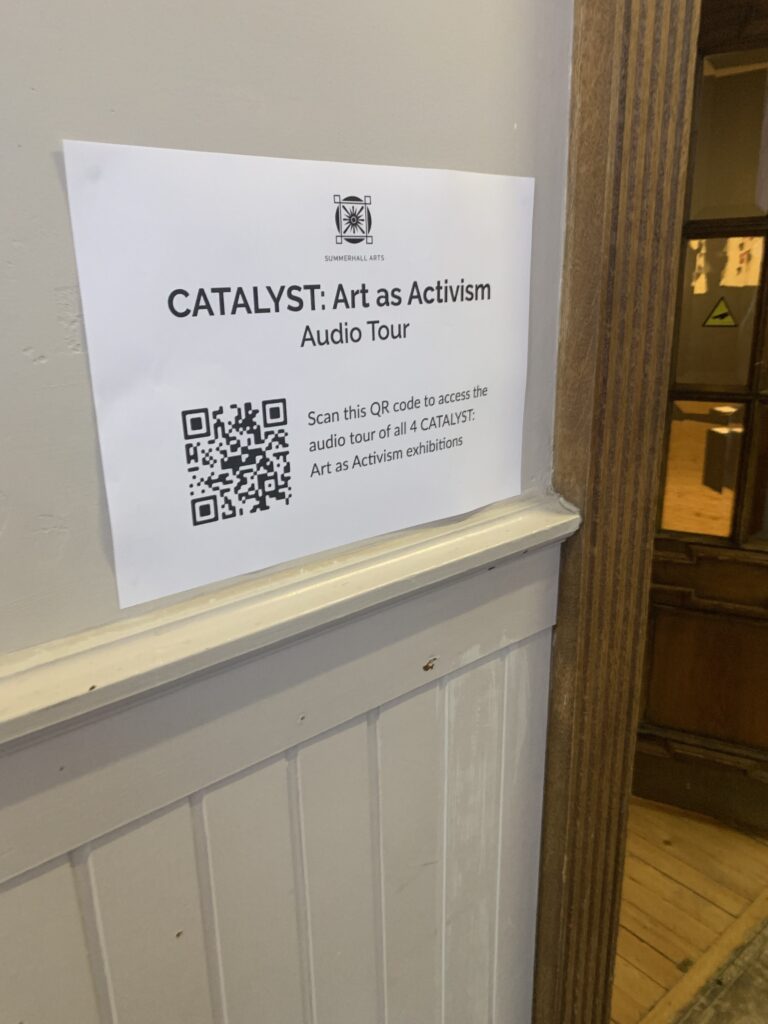
This is a photo I took at Summerhall of the QR code for the audio tour displayed at the gallery entrance.
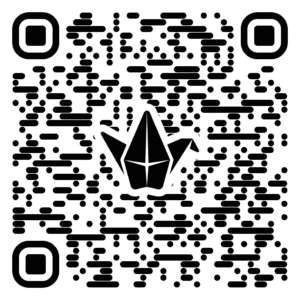
The Padlet QR code I created includes an online audio tour, an EasyRead text, and a communication platform where users can upload audio.
[1] Fazeli, Taraneh, and Cannach MacBride. “Means Without Ends: Learning How to Live Otherwise Through Access-centered Practice.” In As for Protocols, edited by Re’al Christian, Carin Kuoni, and Eriola Pira, 136. Amherst College Press, 2025. Access online through Discover.ed: https://discovered.ed.ac.uk/permalink/44UOE_INST/19p9fo8/cdi_jstor_books_10_3998_mpub_14526504_12.
……inclusion can be overcome via (ADA-mandated) accommodations—often 136 retrofit adjustments, adaptations, or supplements—provided by public and private institutions and employers.25 These include adaptations to the built environment such as elevators, curb cuts, and wayfinding; human access such as interpreters and access support workers; and assistive technologies like hearing loop systems.
[2] Fazeli, Taraneh, and Cannach MacBride. “Means Without Ends: Learning How to Live Otherwise Through Access-centered Practice.”, 136.
This access cannot witness or heal the harm and violence that disabled people have experienced historically through forms of segregation, and still experience. Access as accommodation cannot truly value disability culture, joy, and knowledge of ways to live otherwise, as it is fundamentally a project of normalization that neutralizes the political world-building potential of access as it is and has been practiced between humans unmediated by vast organizational bodies. The ableist world is just fine as it is and surely everybody wants in, right?
[3] Fazeli, Taraneh, and Cannach MacBride. “Means Without Ends: Learning How to Live Otherwise Through Access-centered Practice.”, 140.
The intersectional disability justice movement, with origins in San Francisco Bay Area organizing broadly and the collective Sins Invalid specifically, takes up the limits of disability rights.39 This framework addresses the intersection of oppressions according to identities and experiences of race, ethnicity, gender, class, sexuality, citizenship, housing status, and more.40 It is led by those most impacted (disabled LGBTQIA+ and BIPOC people), centers non-hypothetical body minds, focuses on immediate access formations and relationship building, and seeks to dismantle institutions while investing in community-focused solutions.
[4] Fazeli, Taraneh, and Cannach MacBride. “Means Without Ends: Learning How to Live Otherwise Through Access-centered Practice.”, 133.
They have been building relationships with communities with disability experience (even if not named as such) through cross-disability, unhoused veteran, and environmental justice organizations for the past two years.
In sharing plans to maintain ethical collaboration with the partners longer term, you understand how they approach their commitments to specific communities across differences and the land they work with and on through the lens of their family’s displacement as settler-refugees.
[5] Fazeli, Taraneh, and Cannach MacBride. “Means Without Ends: Learning How to Live Otherwise Through Access-centered Practice.”, 136.
Access to welfare, services, and accommodations still relies on being legally categorized as disabled (enough), regardless of how one experiences one’s disability.
[6] Kathrin Bohm & Wapke Feenstra, “Introduction” in MyVillages (eds.), The Rural (Whitechapel Gallery, 2019), pp. 12. MyVillages, “Introduction” in MyVillages (eds.), The Rural (Whitechapel Gallery, 2019), pp. 12-19.
The rural and the urban are interdependent, and the current dichotomy has always been false but was maintained because power could be gained from playing down and denying the actual relationship between city and countryside.
[7] Ronald Kolb, Camille Regli, and Dorothee Richter, “Centres ⁄ Peripheries– Complex Constellations,” Notes on Curating 41 (June 2019): 6.
Nevertheless, art and culture have the possibility to produce “truth,” to reveal and to comment, and they are able to act to a certain extent as a counter-hegemony or, as Adorno and Horkheimer have unmasked so-called cultural industry, art and culture are able to confuse and affectively involve people in false ideas about their conditions.
[8] Fazeli, Taraneh, and Cannach MacBride. “Means Without Ends: Learning How to Live Otherwise Through Access-centered Practice.”, 144.
Mingus emphasizes the possibility for access intimacy to occur instantaneously between people without shared experience or political identity. This intimacy need not be communicated linguistically, offering an intuitive, non-identity based, affective lens onto modes of relation beyond policy.
[9] I need to be more than a lesson you learned 2 – Disability Arts Online Virtual Gallery



Leave a Reply