1) Project Title, Time, Description of the Lead Image
Project title: When Animals Speak the Language of Power
Time and duration: 11 June – 18 June 2026, open to the public)
Lead Image:
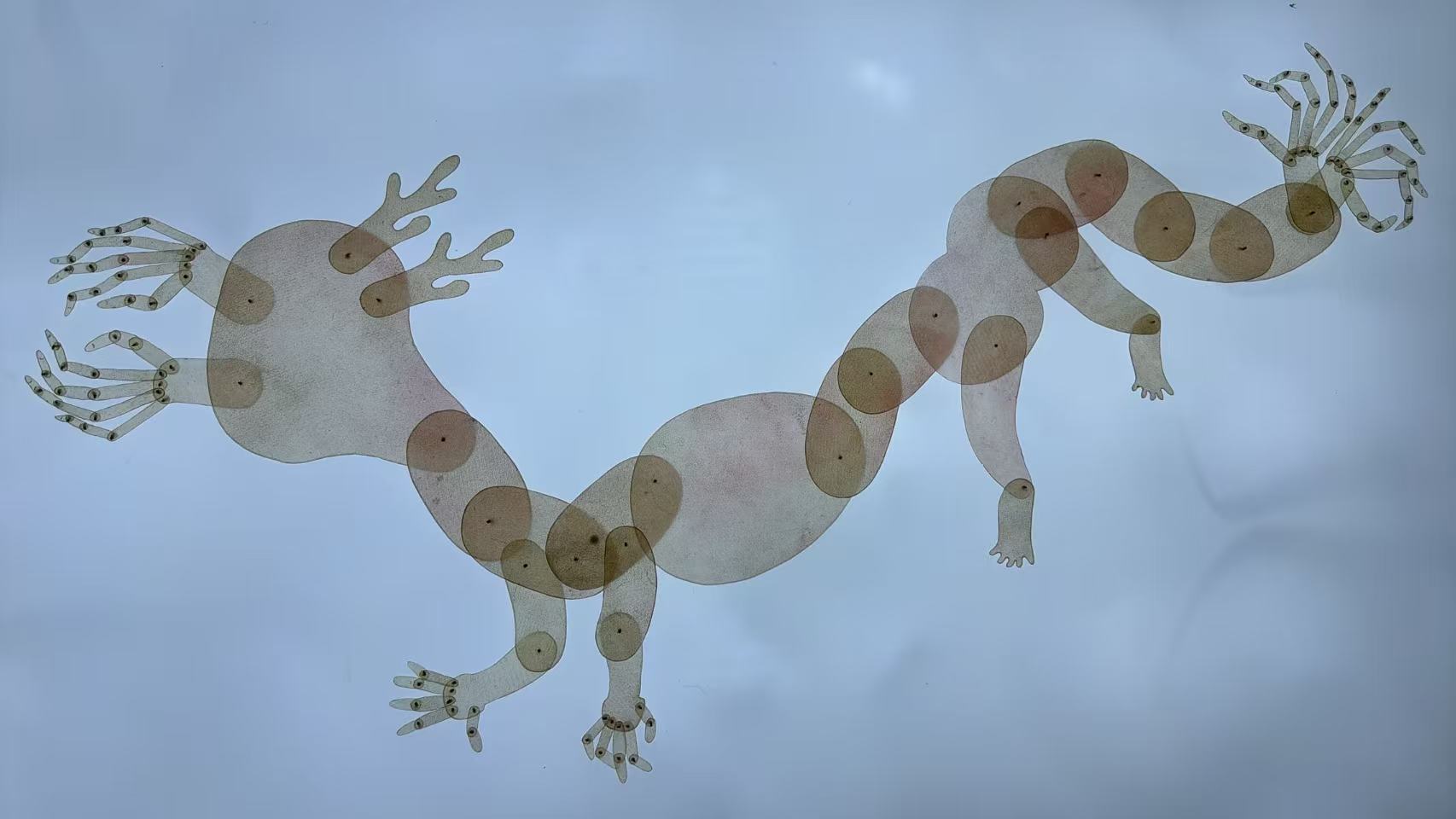
The main drawing of this project selects the image fragment form in the artist Eryao’s work “Wishing Your Child Becomes a Dragon”: the dragon spliced by shadow puppetry materials keeps breaking, recombining, and moving in the picture. Its body presents an unstable and mechanical repetitive state, which not only retains the visual characteristics of traditional movies, but also transforms into the time structure in dynamic images. This circular and non-starting movement makes myth no longer exist as a fixed narrative, but as a power structure that is constantly copied and internalized in contemporary society.
2) Curating Narrative Texts
There is a moment, perhaps too small to notice, let a story stops being just a story.
This exhibition begins from such a moment.
A dragon that never quite stabilises. A constellation brought down to the ground. Microscopic life imagined as gods.
Rather than approaching mythical animals as cultural heritage or visual symbols, this exhibition considers how they continue to operate as invisible structures that shape perception, behaviour, and belief in contemporary society.
Drawing on Roland Barthes¹ ’ understanding of myth as a system of communication, the exhibition takes the phrase “wishing your child becomes a dragon” as its point of departure.
Here, the dragon is no longer simply an image of success or authority, but a social mechanism— that is repeated across generations, shaping how identity, body, and future are understood.
Focusing on the stop-motion animation and installations of Eryao, the exhibition shifts myth from something to be observed into something to be experienced.
From touchable shadow-puppet materials to a gradually narrowing corridor, and finally into a looping black box space, the audience moves through a sequence where images repeat, fragment, and reassemble.
Rather than presenting tradition as something complete or fixed, this exhibition invites you to encounter it as something in motion—fragmented, reassembled, and lived in the present.
Myth, here, is not retold. It unfolds over time.
This temporal structure echoes Erika Balsom²’s idea of the exhibition as a time-based form, where meaning emerges through duration, repetition, and movement.
As you move through the space, light shifts, images repeat, and time loops without a clear beginning or end.
You may enter at any point. You may leave without resolution.
If these animals seem unfamiliar, stay with them.
If they feel strangely close, stay a little longer.
The exhibition does not offer a conclusion, but an invitation:
Are the myths we inherit still shaping how we imagine success—and how we imagine ourselves?
Perhaps somewhere in between, something begins to speak.
3) Artists and Works
-
Eryao
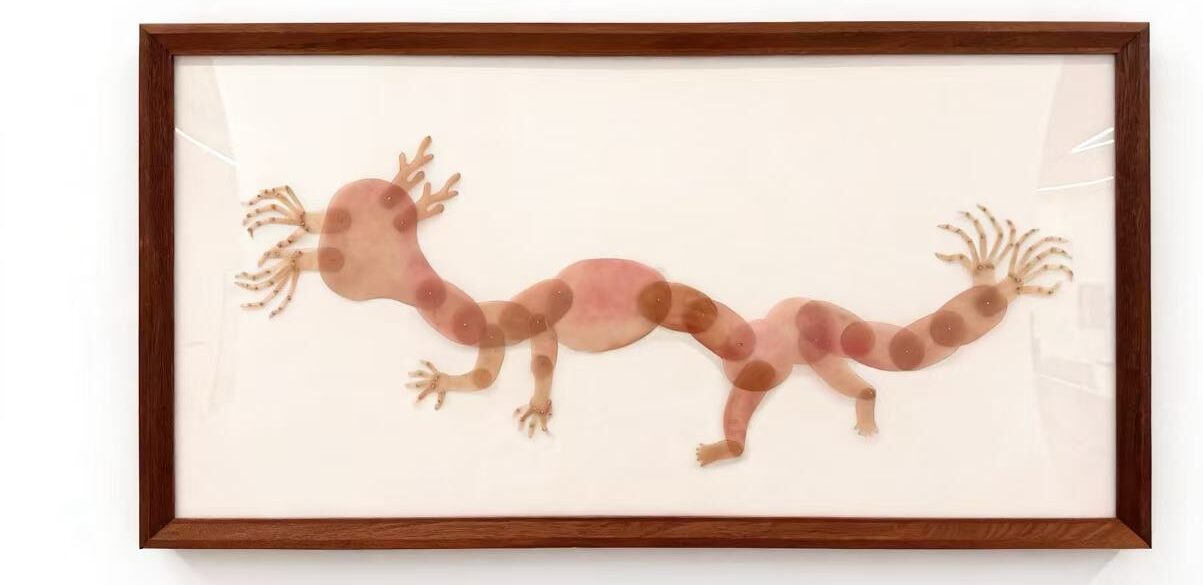
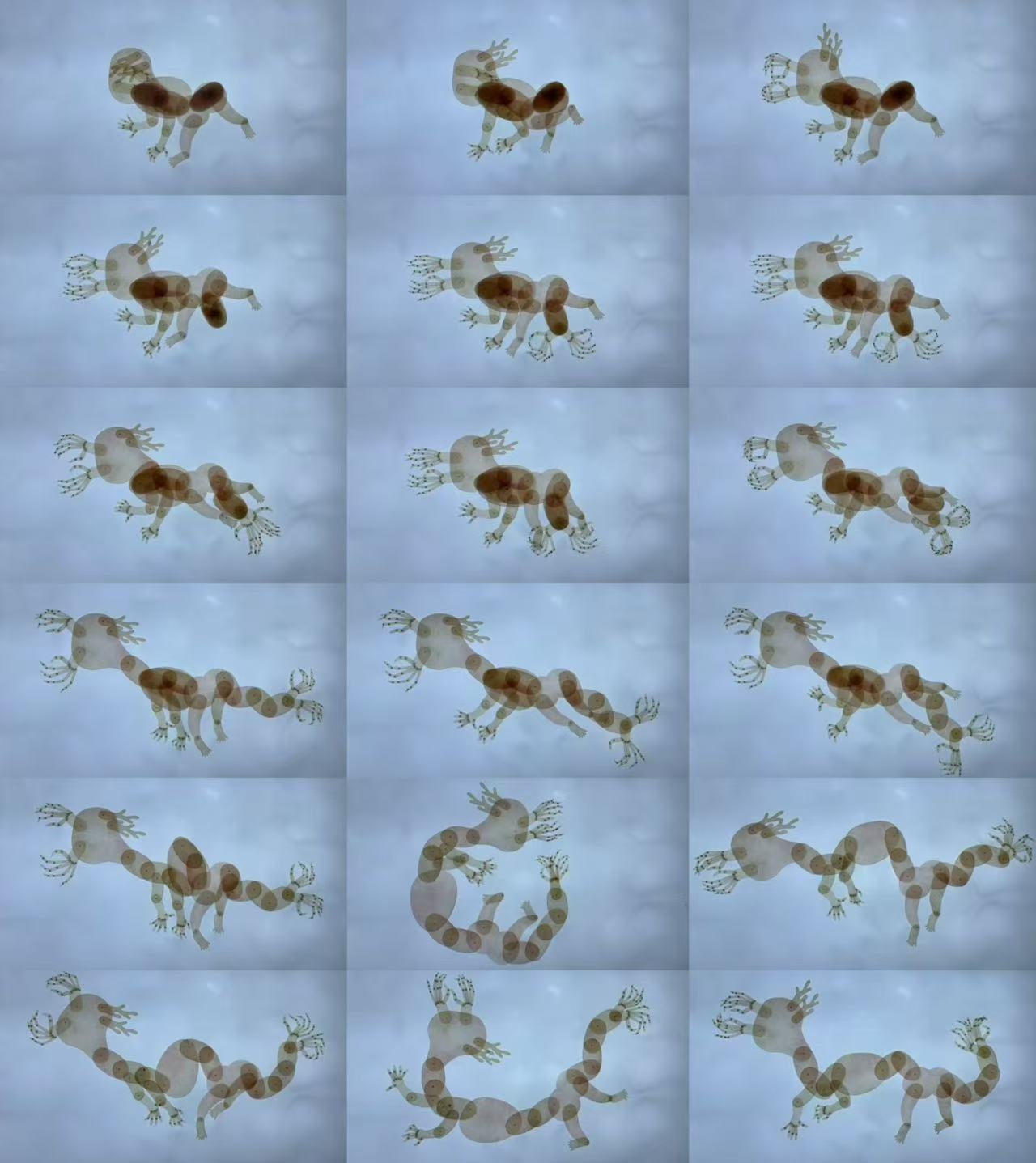
Eryao is a young contemporary artist who pays attention to traditional media; her works often combine traditional materials with contemporary social issues. By reconstructing the traditional narrative, she transformed the myth into a contemporary expression about identity, family and social pressure.
The work reveals how the cultural expectation of “success” is repeatedly given a new context in the family structure through the continuously spliced and broken dragon-shaped images.
-
Kiki Smith
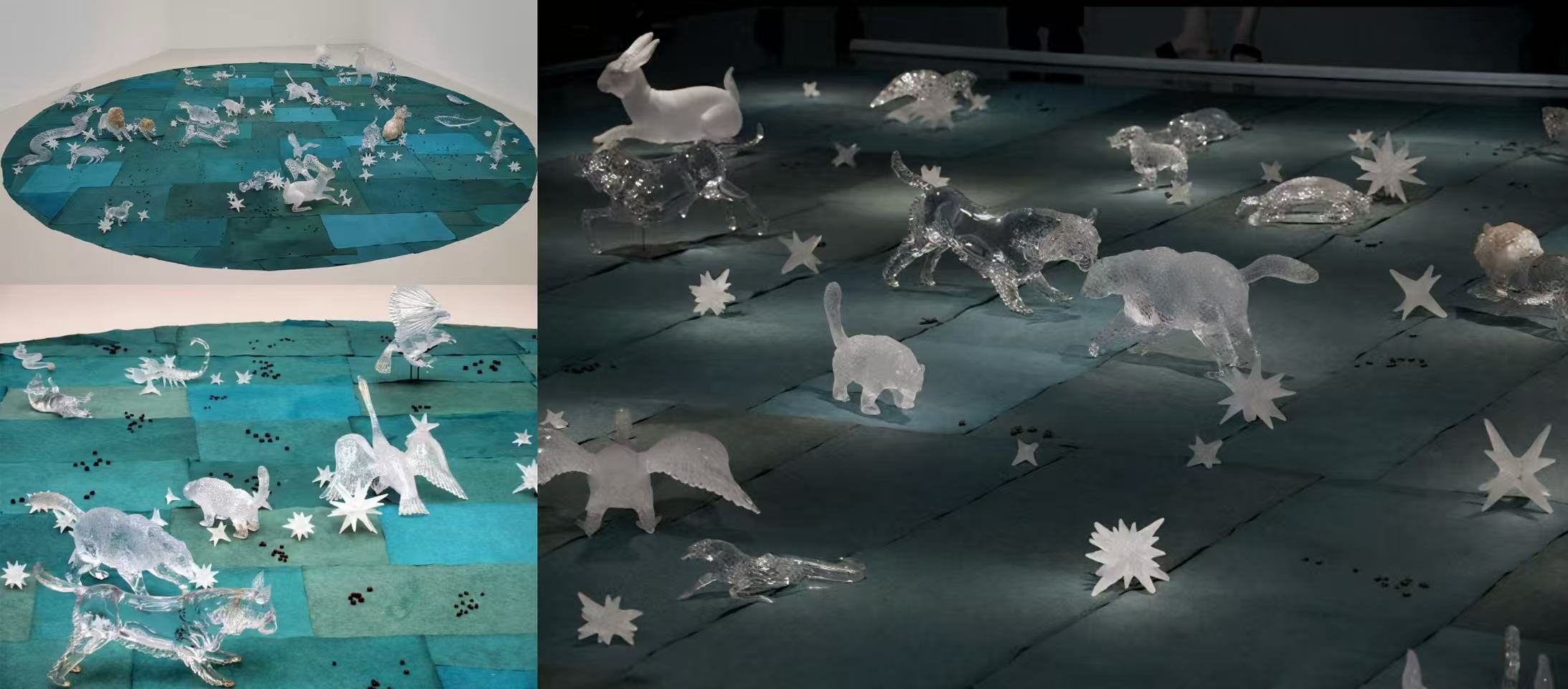
Kiki Smith is an American contemporary artist. She has long been concerned about the relationship between body, nature and universe, and her works span sculptures, paintings and installations.
Placing the stars idling on the ground makes the audience overlook the “universe” and reveals that human beings construct cognitive order through naming and classification.
-
Raeyen Song
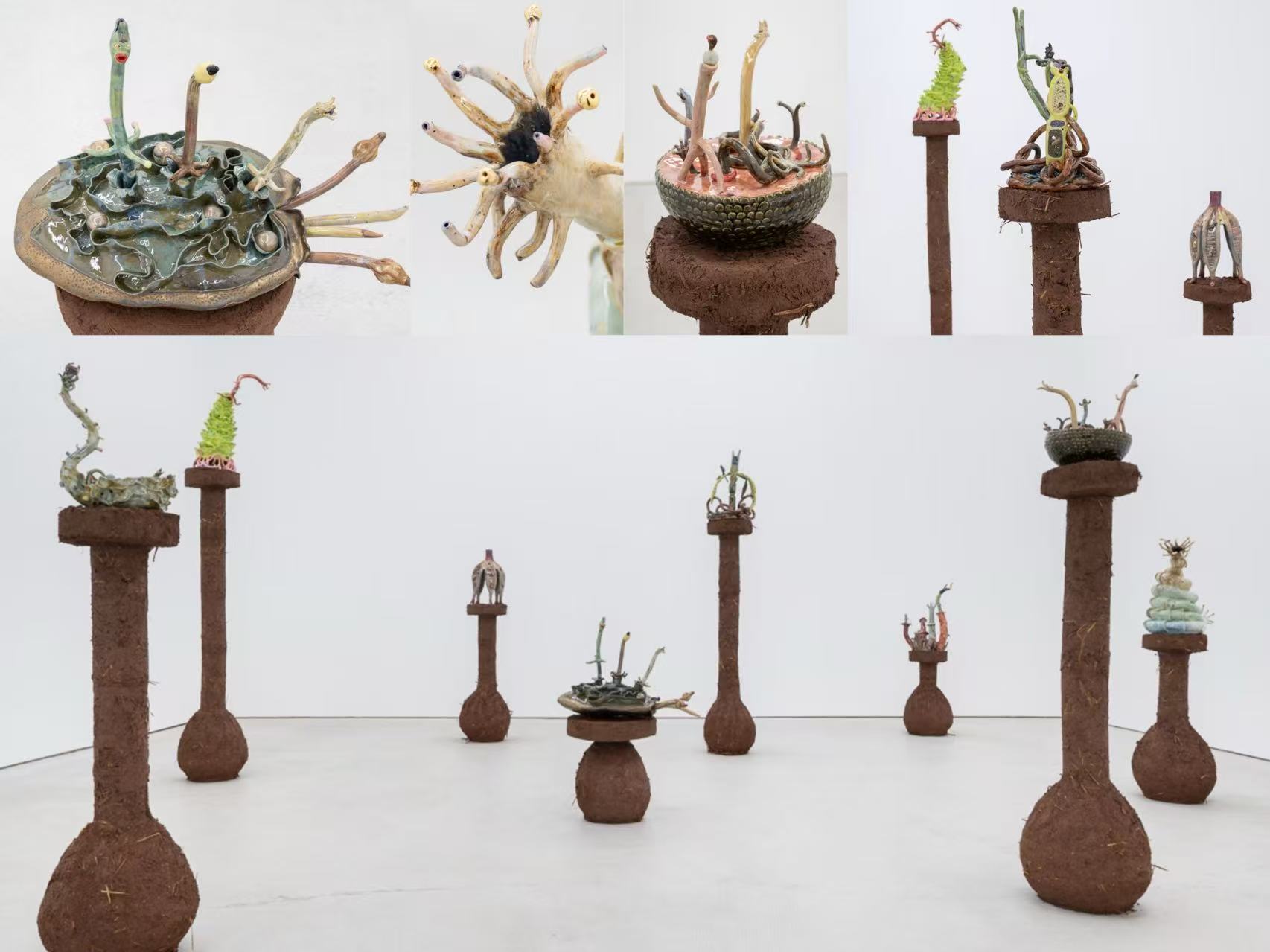
Raeyen Song’s practice pays attention to the ecosystem and micro-life, and constructs dynamic devices through organic materials and ceramics.
Take microorganisms as “gods”, construct a myth system of non-human scale, and show that power is generated as a relationship network.
The publications and archives in this project are presented as part of the exhibition structure, not as supplementary materials. Its contents include curatorial texts, summaries of interviews with artists, excerpts of mythological research documents and image materials, which form a “research interface” for reading and staying.
The exhibition will combine Chinese and Western theoretical frameworks, such as Roland Barthes’ exposition on “myth as a symbolic system” and Yuan Ke, Mao Dun and Ye Shuxian’s research on China’s mythological structure, and at the same time, it will be interspersed with North Island poems as a linguistic response.
These materials are presented in the form of pages, excerpts and images, so that the audience can not only watch the works, but also enter the knowledge and narrative process generated by them.
4) Space and Location
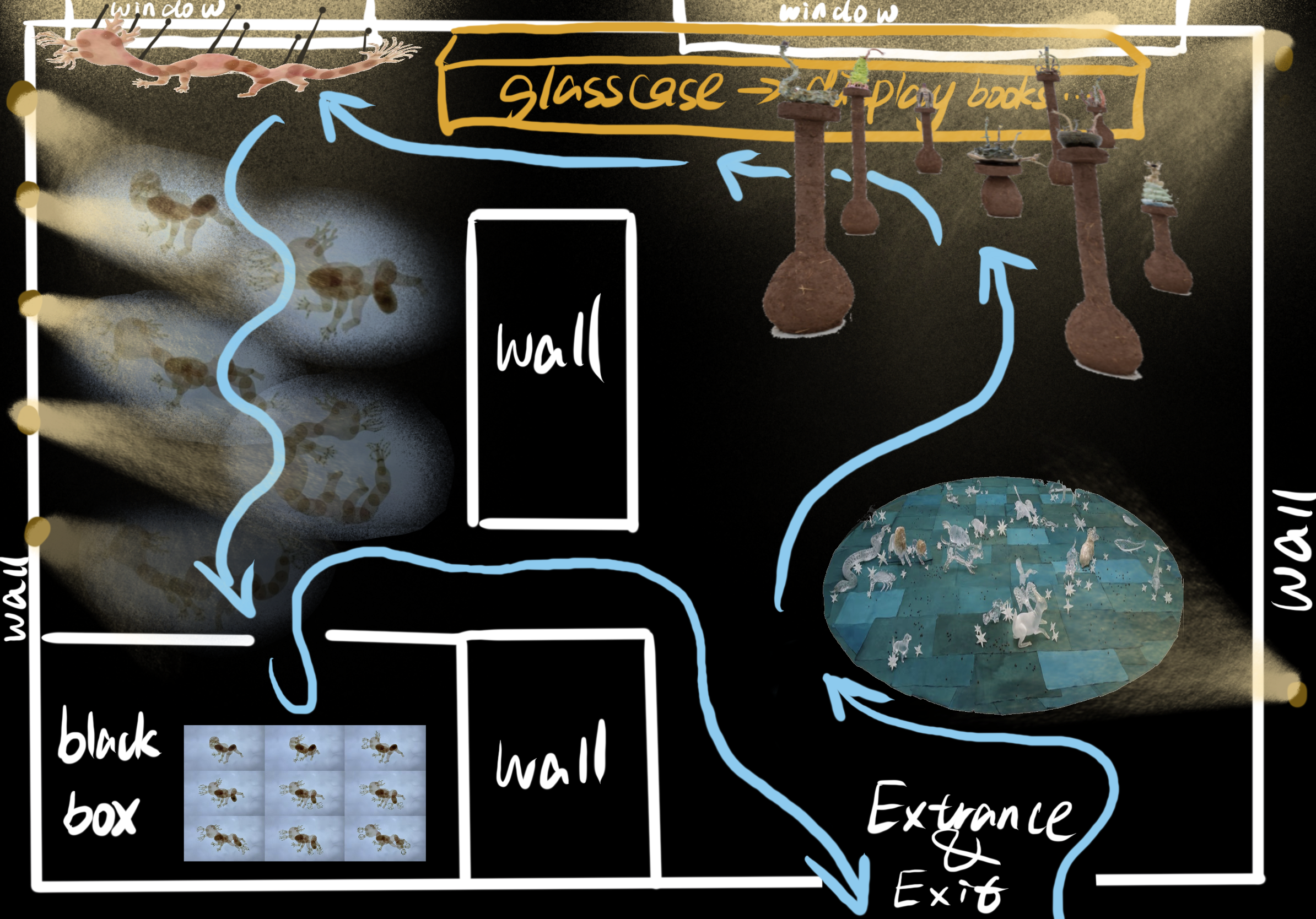
Venue: Summer Hall Sciennes Gallery (including black box)
Spatial structure:
- The installation works of Kiki Smith and Waeyen Song are placed in the right half.
- A big glass showcase is placed between the two huge windows at the junction of the left and right halves to display relevant books and materials.
- The left half is a three-stage path:
- Spot A (entrance): It is a natural light environment, how the shadow play dragon installation and text, the audience can touch and interact → “readable tradition”
- Corridor (transition area): It is with fading light. Single-frequency images are projected to the ground, and there are related words and sentences on the wall. As we get farther and farther away from the window, the natural light becomes less and less, so the space feels compressed. → “myth in generation”
- Spot B (black box): The stop-motion animation is played in a loop, and there is no clear beginning. The audience can watch from any frame at any time, which is very similar to the structure of myth.
The whole space adopts a semi-black box: combining natural light with artificial light, emphasizing time change.
5) Public Programme
- Artist Talk
Theme: Contemporary Translation of Traditional Myths
Time: Day 2 of Opening Week, 60 minutes.
Venue: Summerhall Red Lecture Theatre
Target audience: Art students and the public.
Content: Artist Eryao shares movies and fairy tales, and discusses the cross-cultural context with the audience.
Person in charge: co-chaired by the artist and the curator.
- Shadow Play Workshop
Theme: Body experience of light and shadow.
Time: 90 minutes on the weekend of the second week of the extension.
Venue: Summer Hall Anatomy Lecture Theatre
Target audience: family, children, and the public
Content: Participants make and operate movie devices and experience the relationship between “manipulation” and narration.
Person in charge: Artist Eryao leads and the curator assists.
- Reading Seminar
Theme: myth and curatorial theory
Time: the third week of the exhibition, 60 minutes.
Venue: Summerhall Deans Office
Target audience: researchers (8 people)
Content: Discuss Barthes and other texts, and explore myth as a curatorial method.
Person in charge: hosted by the curator.
Note: the artist’s remuneration and venue fees will be listed in detail in the budget part, so I won’t repeat them here.
6) Curatorial Rationale
This project adopts the curatorial method of interdisciplinary and field response, and understands “myth” as a continuous cultural mechanism rather than a static narrative structure. Based on Roland Barthes³ ‘ mythological semiotics and the study of China’s mythology, the exhibition transforms “Dragon” from a traditional cultural symbol into a structural framework for analyzing power, identity and social expectations.
The curatorial practice is based on the space conditions of Summerhall. It has the structure of a black box environment and natural light intervention, so that the exhibition can generate a temporal viewing experience between “controllable” and “uncontrollable”.
The audience experiences the process of myth generation while moving, rather than passively accepting the established narrative. Image circulation and nonlinear time structure strengthen the social mechanism of “expected repetition.”
This project transforms the curatorial process itself into one of the exhibition contents⁴, makes the knowledge production process visible through archives display and publications, and constructs a multi-level understanding path. Public projects (lectures, workshops and reading groups) further transform the audience from viewers to participants, and jointly generate meaning in discussion and practice.
On the ethical level, by introducing the research framework of local myths in China, the exhibition avoids a single interpretation of other cultures with Western theories. At the same time, responding to the cognitive differences of different audiences through multilingual texts, audio descriptions and Easy Read materials, and transforming “accessibility” from a technical supplement to a part of curatorial methods⁵ ⁶. The project thus formed an open, critical and socially responsive curatorial practice.
7) Basic Budget
Expenditure
| Item | Amount (£) |
| Venue hire (7 days per £200, Summerhall) | 1400 |
| Artist fees (3 artists per £1436, based on Scottish Artists Union rates) | 4308 |
| Artist travel and accommodation | 900 |
| Artwork transport and logistics (packing, shipping, local handling) | 500 |
| Installation costs (materials + technical support) | 500 |
| Equipment hire (projection/lighting) | venue support |
| Invigilation staff (2 staff × 7 days × £100) | 1400 |
| Publicity (printing, posters, etc.) | 200 |
| Publication (booklet, printed materials) | 300 |
| Public programme (workshops + talks) | 300 |
| Sub-total | 9808 |
| Contingency | 192 |
| TOTAL | £10,000 |
Income
| Item | Amount (£) |
| Creative Scotland Open Fund | 4000 |
| City of Edinburgh Council Community Grant | 3000 |
| University support (cash or in-kind) | 1500 |
| Partner support (in-kind contribution) | 1000 |
| Fundraising | 500 |
| TOTAL | £10,000 |
The budget of this project is set within 10,000 yuan, taking into account industry standards, curatorial ethics and practical feasibility.
The artist fee is calculated according to the suggested standard of the Scottish Artists Union. Although the three artists have different experiences (Eryao is less than five years, and the other two have more than five years), they are paid according to a higher standard to avoid hierarchical differences based on seniority or curatorial importance and embody the principle of fair remuneration.
The exhibition is located in Summerhall and arranged in June (during the non-art festival), which effectively reduces the venue cost and is more in line with the immersive viewing environment required by the project. The budget includes the transportation cost of the works (about 500 yuan), which is used for packaging, transportation and local handling to ensure the safety and realization of the devices and video works.
In-kind support is provided by the site to reduce the expenditure pressure. Other expenses, such as installation, personnel, publicity and public projects, ensure the smooth implementation of the exhibition and promote audience participation. The income is mainly funded by Creative Scotland and the City of Edinburgh Council, and the amount is set within a reasonable range. The overall budget structure is clear and enforceable, and includes reserve funds to deal with uncertain expenditures.
8) Publications
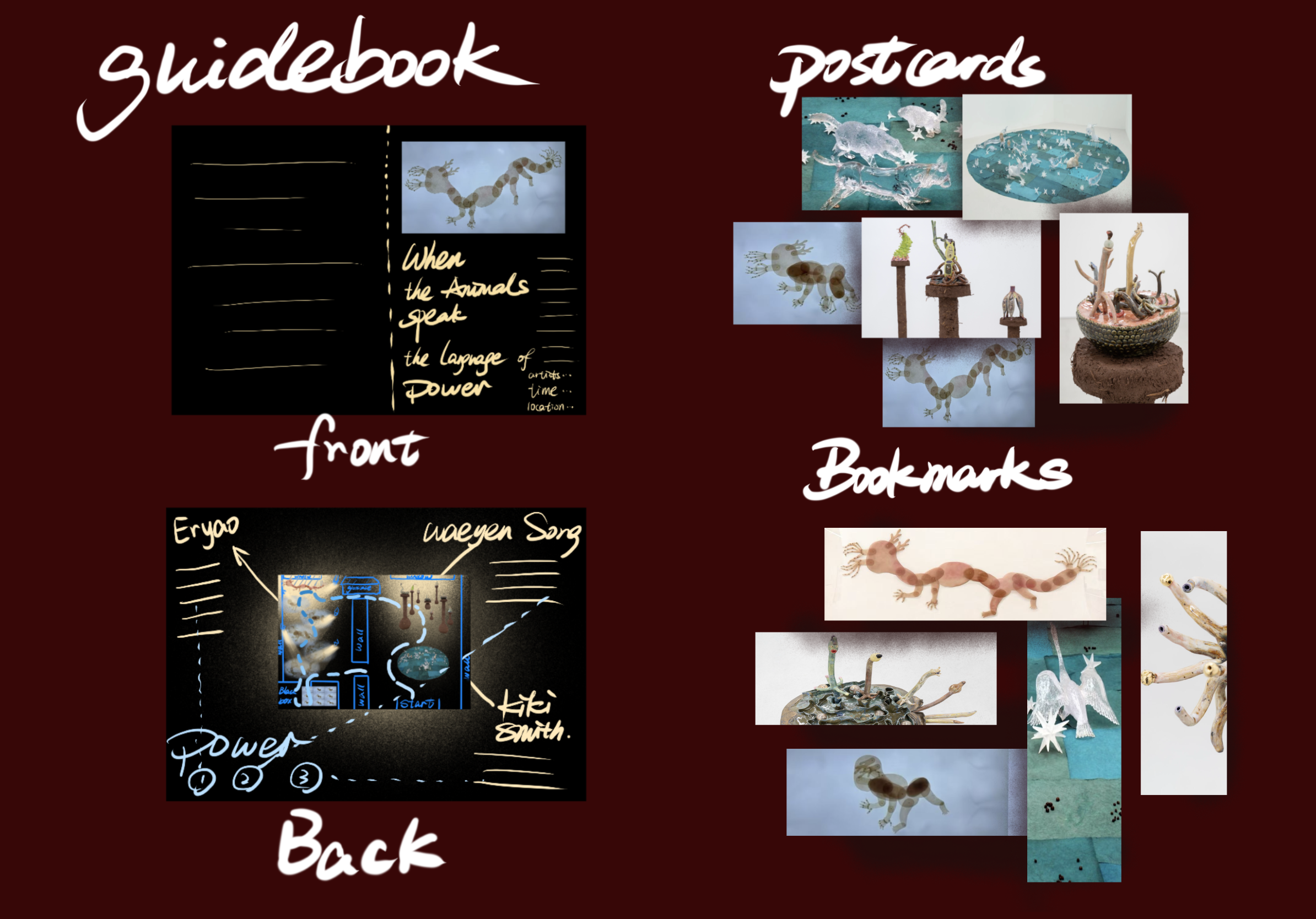
In this exhibition, publications are regarded as an extension of curatorial practice, not as an ancillary achievement⁷. Before entering the exhibition, the audience will get a guidebook as an entrance to help them understand the space and its conceptual structure. The manual is available in both standard and large formats to respond to the reading needs and accessibility of different audiences. Its contents include the exhibition plan, the location of the works and three kinds of “power structure” labels corresponding to the three core works, and are accompanied by curatorial texts, artist introductions, works images and public project information.
On this basis, the exhibition further developed a series of extended publications with the concept of “portable exhibition”, including postcards, bookmarks and related souvenirs derived from the images of the works, combined with curatorial texts, interviews with artists and excerpts from myth research. These materials enable the exhibition to continue outside the space, so that the audience can re-enter its narrative and thinking path after leaving the exhibition hall, thus transforming curation into a continuous process of cultural communication.
Summary
When Animals Speak The Language of Power is a contemporary curatorial project with mythical animals as the breakthrough point, aiming to explore how mythology can continue to operate in contemporary society and shape individual identity cognition and social expectation as a hidden power mechanism.
The curatorial logic of the project gradually deepened: from “the translation of traditional media” to “myth as a structure” and finally implemented as an immersive image plus space curatorial project with “how mythical animals operate as a power mechanism” as the core. Under this framework, myth is no longer regarded as a static cultural heritage, but is understood as a system that continuously generates meaning.
Focusing on the puppets and stop-motion animation works of contemporary artist Eryao, the exhibition transforms “dragon” into an expectation mechanism that is constantly copied in the family and social structure through the cultural context of “looking forward to success”. At the same time, the works of Kiki Smith and Raeyen Song are introduced to build a multi-level power network that spans human and non-human scales, from body cognition, ecological relationships, to micro-generation.
On the spatial level, the project relies on the Sciennes Gallery in Summerhall to construct a temporal path consisting of natural light, a transitional corridor and a black box space. The audience enters from the touchable traditional materials, gradually experiences the process of image generation, and finally finds themselves in a circular image without a starting point, thus transforming the myth from “the observed object” to “the experienced structure”.
In addition, the project will expand the exhibition into an open knowledge production platform through file display, publications and public projects (lectures, workshops and reading groups), so that the audience will change from passive viewers to participants.
On the ethical and methodological level, the project emphasizes the responsibility of curation in the cross-cultural context and avoids cultural simplification and single interpretation by combining Western critical theory with Chinese myth research. At the same time, through multilingual texts, Easy Read materials and multi-sensory paths, “accessibility” is transformed from an auxiliary strategy into a part of the curatorial structure.
References
¹ Roland Barthes, Mythologies (Paris: Éditions du Seuil, 1970).
² Erika Balsom, Exhibiting Cinema in Contemporary Art (Amsterdam: Amsterdam University Press, 2013).
³ Roland Barthes, Mythologies (Paris: Éditions du Seuil, 1970).
⁴ Paul O’Neill and Mick Wilson, “Curatorial Counter-Rhetorics and the Educational Turn,” Journal of Visual Art Practice9, no. 2 (2010): 177–193.
⁵ Jean-Paul Martinon, Curating as Ethics (Minneapolis: University of Minnesota Press, 2020).
⁶ Maura Reilly, Curatorial Activism (London: Thames & Hudson, 2018).
⁷ Carolee Thea, On Curating (New York: D.A.P., 2009).
Art Works
Eryao. Wishing Your Child Becomes a Dragon. 2024.
Kiki Smith. Constellation. 1996.
Raeyen Song. song~xian. 2025.
Sources and Archives Referenced in Developing When Animals Speak the Language of Power
UCCA Center for Contemporary Art. “Xu Bing Exhibition Audio Guide.”
Museum of Modern Art. “Woven Histories.”
Metropolitan Museum of Art. “Sleeping Beauties.”
Summerhall. “Sciennes Gallery.”
Zhejiang Provincial Museum. “Shadow Puppets.”
Cincinnati Art Museum. “Accessibility & Audio Tours.”
Henry Moore Foundation. “Beyond the Visual.”
Disability Arts Online. “Dis_place Exhibition.”
REF Impact Case Studies.
Exhibitions Referenced in Developing When Animals Speak the Language of Power
Woven Histories: Textiles and Modern Abstraction — MoMA
Sleeping Beauties: Reawakening Fashion — The Met
The Children Are Now — Talbot Rice Gallery
The Dead Don’t Go Until We Do — Talbot Rice Gallery
Disappearance at Sea: Mare Nostrum — Baltic Centre
Our Shell Exhibition Project — JIJU Collective
Beyond the Visual — Henry Moore Foundation
Dis_place Online Exhibition — Disability Arts Online