From three-tier structure to generation mechanism
In the previous curatorial research, I set the core issue of the exhibition as “How mythical animals operate as a power system”. This framework is mainly divided into three levels: family, country and cosmic cognition. At the country level, represented by Ai Weiwei’s works, mythical animals are placed in the historical and political context. As Roland Barthes put it, myth is not a simple story but a meaningful production system, which operates continuously in different scales and shapes the way we understand the world.
However, when I further promoted the project, I began to rethink what I really valued in Ai Weiwei’s works was not a specific work itself but several core features: scale, material power, and symbolic transformation of visual symbols. Under the constraints of realistic curatorial conditions (such as budget and implementation), simply replacing the works or replacing the original works with images cannot really respond to these core issues. Therefore, instead of focusing on “reproducing a certain work”, it is better to go back to these features and reconstruct the logic of exhibition.
Song Weiran’s turn
Under this consideration, I chose to replace the original case of Ai Weiwei with Song Weiran’s installation works. This change is not a simple replacement but introduces a new understanding path in the structure. In Song’s works, the microorganisms in the pond are re-imagined as “gods”, while the traditional medium of ceramics is extended to a form similar to the Taoist “golden body”.
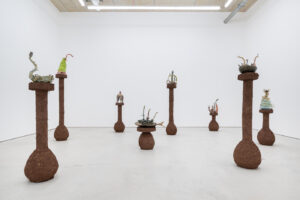
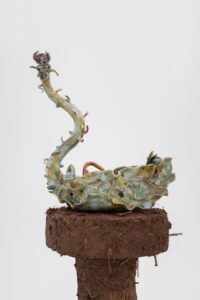
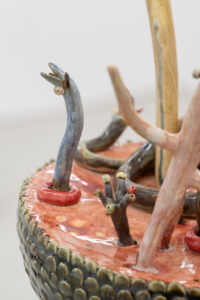
This transformation makes the myth no longer attached to the established history or national narrative but regenerated at the micro level. Compared with the original framework, this work has changed the presentation of “power”. Here, power is no longer a grand oppressive structure but exists in the form of circulation, symbiosis and generation. The relationship among microorganisms, soil, and ceramics constitutes a constantly changing ecosystem, which also transforms “mythical animals” into an ecological entanglement. This echoes Barthes’ view that “myth is the production system of meaning”: meaning is not established but generated in constant transformation and relationship.
The change from Ai Weiwei to Song Weiran does not mean the weakening of politics but the deepening of the understanding of “power”. Power is no longer directly presented through commemorative sculptures or national narratives but turned to a more hidden operation mechanism: growth, dependence and transformation. In this context, myth is no longer a fixed symbol but a continuous operating system, which flows between different scales, constantly generating new meanings and body forms and spanning the relationship network between human and non-human.