I have heard a lot about the Moss’ population of endangered fossorial water voles, but as yet I haven’t seen one. Unusually, these animals don’t live in water, but as Friends of Lenzie Moss explain, can be found in the grass-covered areas of the site:
The term “fossorial” means “adapted for digging”. Fossorial voles have moved away from water and established their burrows in open grassland. They construct a network of tunnels where they breed and sleep and spend most of their time. They prefer territory that has long grass on the surface to give them cover from predators when they come out of their burrows to feed. Their main diet is grass roots, leaves and seeds. They don’t hibernate, so can be seen throughout the year if you’re lucky.
I always keep an eye out as I pass the places where I know the voles are living, but luck is still to come my way.
It is thanks to the voles that I am meeting Colin today. On a recent walk, as he turned the corner from Bea’s Path to the north woods – at the exact spot where Tony shared his haiku about midsummer – there on a log sat a fat brown rodent. The vole seemed unfazed by human presence (Colin calls it nonchalant). Colin watched it for a while, then went on his way. Later, searching for information about the voles, he stumbled across my blog and my request for willing walkers to get in touch, which he did.
I meet Colin outside Billington’s, and we are prepared for the rain. When I walked with Sandro just yesterday, I wore shorts and a t-shirt after several days of glorious May sunshine. But alas, the spell of pleasant weather is over. But Colin and I are also aware that the Moss needs the water. It was becoming very dry and there is always the risk of fires. As we walk onto the Moss, we can smell the moisture in the air and it feels like the bog is breathing a sigh of relief.
Colin is a naturalist and forager and has been exploring the Moss his whole life. He grew up in Lenzie in the 1970s and 80s and after living elsewhere for several years (the same pattern I noted when I walked with Eloise earlier this week), he returned in 2006 to set up his own business as a computer engineer. He says that it was never the plan to stay here long term.
Colin says that the Moss is a completely different place today. Almost half a century ago, it was an abandoned and unloved place. As a child, Colin remembers searching through the historic dump for intact bottles buried beneath the grassland to the north of the site. There was a network of informal paths crisscrossing the bog, which was causing serious damage. He remembers exposed peat, birch growing all over the site, and a patchy and unhealthy layer of moss. For Colin, it is unquestionably the case that the modern conservation works have saved this place. With well-made, designated paths that keep foot traffic off the sensitive wetlands, the bog has been able to rewet, and all manner of life has returned.
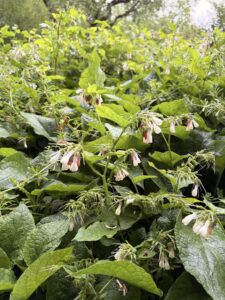
For many decades and through all seasons, Colin has visited the Moss to forage. He is enthusiastic about the fungi that grow here, but says that at this time of year, we are between the last of the scarlet elf cup mushrooms (which I photographed with Kate) and his favourite, the wonderfully named yellow swamp russula. Other favourites include the shaggy ink cap (which can be made into a very useable ink) and the birch polypore (which I saw with my mum). Colin also comes here for leaves and herbs – dock leaves, clover, and nettle have all made their way into his kitchen. And like Kay, who I happened to spot on yesterday’s walk with Sandro, he recommends the blaeberries, which appear later in the summer. We stop to identify a dense patch of comfrey with its pink bell-shaped flowers. Colin tastes some and is unimpressed.
I ask Colin about the fauna of the Moss and he is equally as knowledgeable. He has seen buzzards hunting in the northern part of the moss, kestrels hovering over the bog, and a sparrowhawk being ratted out by a noisy bluetit by Bea’s Path. He tells me that he has often seen birdwatchers in a hide to the north woods, who told him of a pair of snowy owls who spent a few days here before they decided to move elsewhere. It seems that everyone moves away from Lenzie at some point!
As we walk, we examine the remnants of the wooden railway sleepers. The nails that still hold them down are possibly a century old. Colin suggests that this was probably a rickety wooden cart pulled by a pony, rather than a self-powered train, but I later confirm that two Lister petrol locomotives were used here. We talk about the routes along which the peat left the site, and I show Colin the Google Maps satellite image of my street, with the corridor of land linking the Moss to Kirkintilloch Road. Both Clare and Ann believe this to have been the location of the railway line. Looking at this image triggers a long-buried memory for Colin. He recalls exploring this pathway between the gardens with his childhood friends.
On our way back to the main path, we climb up onto the ruined peat plant. Colin remembers that the centre used to be filled with branches and a pond had formed, which was filled with frog spawn. He took some back to his parents’ house and to this day, there is a healthy frog population in their garden pond. I am reminded of Paul’s story about the birch sapling seeding from the brooms propped up beside his garage. There are many different routes that reach out beyond the Moss.
We follow our own route off the site, exiting the way we came in – through the station car park. A huge yellow machine has been parked in the entrance to the Moss. It has ‘RAIL-BOSS’ emblazoned on the front. The smell of diesel lingers, but the driver has gone. This vehicle is clearly part of the modern railway maintenance fleet. It is lucky that the peatworks closed down in the 1960s, before this scale of industry had reached it. The Moss is protected from all this, now. And that means that the peat, the fungus, the comfrey, and the water voles all have a chance to thrive.