For the grain of the tree consists of lines of growth rather than particles of matter, and it is held together by knots rather than by the equilibrating force of gravity. (Tim Ingold, Correspondences)
My colleague Jimmy is the only person I know who describes themselves as both a woodworker and an anthropologist. Maybe there are many others who combine these disciplines, but I suspect this is a bit of a niche job. For several years now, Jimmy has been working with the Binks Hub – ‘a network of academics researchers, community members, practitioners and policy-makers using creativity and the arts to co-create research that makes a difference to people’s lives’. I have often wondered how a co-creation process might benefit the Moss so I’m looking forward to introducing Jimmy to the stories that I have encountered here.
Jimmy tells me that despite working with wood (they make sculptures and furniture) they don’t know much about trees. But we are walking through birchwood now and the silver birches are easy to identify. Neither does Jimmy know much about peat. I tell them a little of what I have learnt: how the peat is formed as the slowly decaying sphagnum moss accumulates beneath the living layer – a phenomenon that can happen because this moss is alive and dead at the same time.
Jimmy is intrigued by this alive-deadness of sphagnum, particularly since they recently worked on a project that creatively explored death and dying. With the Utopia Lab, Jimmy and the other participants undertook a series of ‘imaginative experiments’. These included writing exercises and a group walk to Greyfriars Kirkyard in Edinburgh. Using the small makers kit that they always carry, Jimmy made a sculptural response to the site, using materials that they gathered there. They reflect on the connections these items had with death – including the earth itself, which is formed through myriad decomposing flora and fauna, including the dead people buried there historically.
I wonder what materials the Moss could offer, and show Jimmy the fungal growths on the branches above us – the ‘witches brooms’ that I saw with Iona, along with the unusual bulges protruding from the trunks. Woodworkers are often keen to work with these tumorous woody growths on trees, known as burrs, due to the unique patterns of the grain. I have been reading the anthropologist Tim Ingold’s ‘correspondences’ with trees recently and I mention his discussion of grain to Jimmy. ‘Lines of growth’ are important, but Jimmy tells me that grain is not held together by knots, as such. Rather, it is bound by a natural glue-like substance called lignum and also various processes of ‘interlocking’, wherein it wraps around itself. There are rich metaphors in the wood. In Jimmy’s sculpting and furniture making, they find and work with the shapes that are already there in their materials, rather than imposing a predetermined form. They are far less interested in the kind of design that prioritises silhouettes over surfaces, preferring work that responds to the irregularity and textures of wood.
We discuss the methodology of my work at the Moss, and Jimmy suggests that these are ‘research walks’ rather than interviews, but accepts my suggestion that they are ‘radically open interviews’. Although I sometimes have an instinct about what we might discuss – in Jimmy’s case, co-creative work with communities – I never prepare questions or suggest a particular agenda. The invitation is simply to walk and chat and see what happens.
The connection between woodworking and anthropology is becoming clearer to me. Could an analogy be made between the trees and the walkers? While Jimmy would take time to feel their way into the shapes and grains of the wood that they create new things with, during my walks round the Moss, I am taking time to feel my way into the stories and perspectives that different people bring to the site. When Jimmy makes a sculpture, it is a collaboration – or to use Ingold’s term, a correspondence – between the tree, the wood and the maker. My accounts of these walks on this blog are correspondences between the Moss, the walker and the writer. In both cases, we are establishing a process of emergence rather than deciding in advance what we want to create.
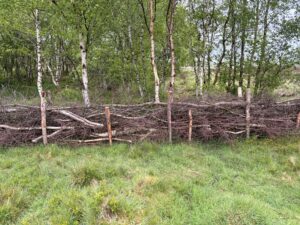
We pass the deadwood hedge and Jimmy admires the craft and aesthetic. I use this opportunity to explain some of the relational dynamics of this site. I have sometimes seen an opening appear in this barrier, as it blocks a pathway onto the bog so has been kicked down. These are swiftly repaired and today it is intact. Jimmy is surprised by this behaviour and has limited and ambiguous sympathy for those who feel entitled enough to impose their own preferences in this way. Jimmy, as a person made anxious by unleashed dogs, is critical of ‘some dog walkers’ and even though I consider myself respectful and sensitive to the places I am walking with Clyde, I bristle at the association.
Our walk down the boardwalk is accompanied by birds: stonechats and meadow pipits, and swallows overhead. Since I learnt the call of the willow warbler from Julia, I have been taking pride in telling others about them and I point them out to Jimmy now. I have realised recently how my way of being here has changed over the last year. When I walked with Nalini on the second walk, I felt ‘underinformed and unsure’. A year later, I have learnt so much about this place.
The final section of our walk takes us past the controversial fencing (which seems to have been accepted now, after the previous version was destroyed). I tell Jimmy about the tensions and conflicting viewpoints that I have encountered here, and suggest that a co-creative process with the community would be valuable. Jimmy doesn’t disagree with this, but does offer a new perspective. They are also clear about the difference between participatory research as a knowledge production methodology (which is mainly what they do) and community engagement and consensus building practices, which they don’t claim expertise in. This is a helpful distinction for me, and it explains why there is no clear route from my participatory research walks round the Moss, to the community-engaged initiatives that might be valuable here. There is overlap, of course. But some more careful thinking is required about how and whether this project has the seeds of something more impactful.
For those who engage openly and constructively, the workshops and creative methods that Jimmy uses can be powerful methods that increase engagement and provide a sense of ownership and agency. But there will always be those who don’t choose to engage, perhaps because they are unable to do so, and often those who claim to speak for others and assert their opinions without listening to alternative ideas. This is not to assign blame – Jimmy recognises that the material conditions of someone’s life may prevent them from being able to engage. But Jimmy suggests that community engagement workshops would offer no guarantees that barriers would remain standing.
Every time I think I have this place worked out, a new walking partner disrupts my direction of travel. I welcome this. The lesson I have taken from today’s walk is that we need to enter into correspondence with the site itself – the birchwood and the stonechats, the burrs and the willow warblers, as well as the people who visit. If we spent time with this place, we can get a sense of its grain and start to work with it without preconceptions. If we can do this, then the right form will emerge.