Isabella is a first year PhD student in my research centre at the University of Edinburgh. She is interested in research and writing spaces and has started to explore the ‘knowledge-making and meaning-making experiences’ of history students. She is wondering how to use walking methods as part of this work and we recently met to discuss this aspect of her project, when I invited her to walk with me here. One of Isabella’s supervisors is my colleague James, who joined me for a walk round the Moss back in November. It is no surprise, then, that Isabella is thinking about postdigital education: recognising the entanglement of digital technologies in our research and writing practices. As I found with James, there is no reason to discount a walk round a peat bog.
Isabella has not been to Lenzie before. She has only recently moved to Scotland for her PhD and is enjoying living in Edinburgh and exploring the nearby towns and cities. Isabella is from South Africa and has been studying history at the University of Cape Town. This is her first time living in another country. After our walk, Isabella will take the train to Glasgow and wander round the west end. As I lived there for two decades, I fully endorse her plans to visit the Botanic Gardens and the Kelvingrove Museum. I suggest stopping for a coffee on Ashton Lane. I am feeling nostalgic for this part of the city at the moment and I am excited for Isabella, discovering new places.
As we walk, we talk more about Isabella’s research plans. At a recent meeting with her supervisors, they discussed the possibility of expanding the scope of the project. Isabella is now thinking through the implications of working with other types of learners in different contexts. She feels that walking methods would be a good way of expanding the field of her studies. Could she accompany participants on their routes to work? Perhaps mapping and creative writing exercises would bring journeys into the project. Perhaps, like Brian, Isabella will start to explore learning spaces outside the academy.
When I walked with Ruby, she told me about a recent fieldtrip to Fala Moor in Midlothian, where a group of students worked with singer and composer duo, Karine Polwart and Pippa Murphy. It turns out that Isabella was also there. Isabella was inspired by their collaboration and the openness and responsiveness of their creative process. It prompted her to listen more to her environments and showed how a connection to place can be enhanced through creative methods like songwriting, composing, or poetry. Isabella wonders whether her own research methods could move in that direction.
Isabella asks me about my project and the approach I have taken here. I return to the conversation I had yesterday with Jimmy. We discussed the ‘openness’ of the conversations and encounters that comprise this project and noted how loosely they might be defined as interviews. I agree that there can be huge value in the insights that writing prompts and artistic methods can provide. But last week in Spain, working with the Walking Assembly, I realised how the lightest of frameworks and plans can effectively hold space for unexpected experiences and outcomes to emerge. The theme of that gathering was ‘learning without teaching’ and I think that is what I am experiencing here.
Halfway round the route, I realise that we have been talking about place-based research, rather than doing the work (however that might be understood). Of course, talking is part of fieldwork, but sometimes the conversation can delay a connection with the site. I have walked with a lot of researchers, including several PhD students (Ada, Ali, Ellie, Deirdre, Kyriaki, Brian and Eilidh), and with many of them, also, there has been a careful discussion about their research before we have settled into the environment. It is hard for me to avoid falling into supervisor mode. But it has also been important to understand the specific interest that my co-walkers bring to the Moss: the questions that they are asking and the methods they are using to find answers.
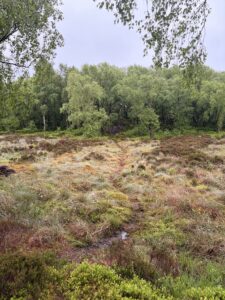
But there is a point on this route when conversation gives way to something else. This happens on leaving the birchwood, when the route joins the boardwalk. As the vista opens up and the bog reveals itself, with all its muted colours and shifting scales, there is a moment of change in pace and purpose. Isabella and I pause our walk and take in the atmosphere of this place. We watch a great black corvid swooping down into the heather. I am sure it is a crow, but it seems way bigger than I expect it to be. Sometimes scale is hard to gauge here. As I attempt to verify my assumption with the Merlin app, I record a skylark – the first time I have encountered one here, although others I have walked with have told me they have seen them.
We walk along the southern pathway across the bog and encounter another chapter in the war of attrition that I have been monitoring here. I review the stages of this story:
First, a desire line emerged leading to the tree swing.
Second, a section of fence was rolled out over the boggy ground, as a makeshift boardwalk.
Third, the fence was moved aside, and contractors dug a series of ponds across the path.
Fourth, the fencing returned and was placed in a meandering route around the new pools.
Fifth, the fencing was removed from the site.
The sixth stage, which we encounter today, is the appearance of a brand-new desire line to the right of the original. This new route takes a completely different path to the wood. Check. I wonder what the council’s next move will be? Surely, we won’t see more barriers and ponds in this area? The oneupmanship seems unhelpful.
This part of the Moss, which I have studied for over a year now, is the best example of the contested relationship between the users and managers of this site. I have learnt about the context by speaking with both dog walkers and council officers, but I have only understood its implications by being here so often and observing the changes and developments over a long period of time. For me, walking methods have been an effective way to build a connection with Lenzie Moss as a more-than-human environment, of which I am a part. I am pleased to know that younger researchers see the value in this way of working as well, and I look forward to finding out what new pathways Isabella will follow.