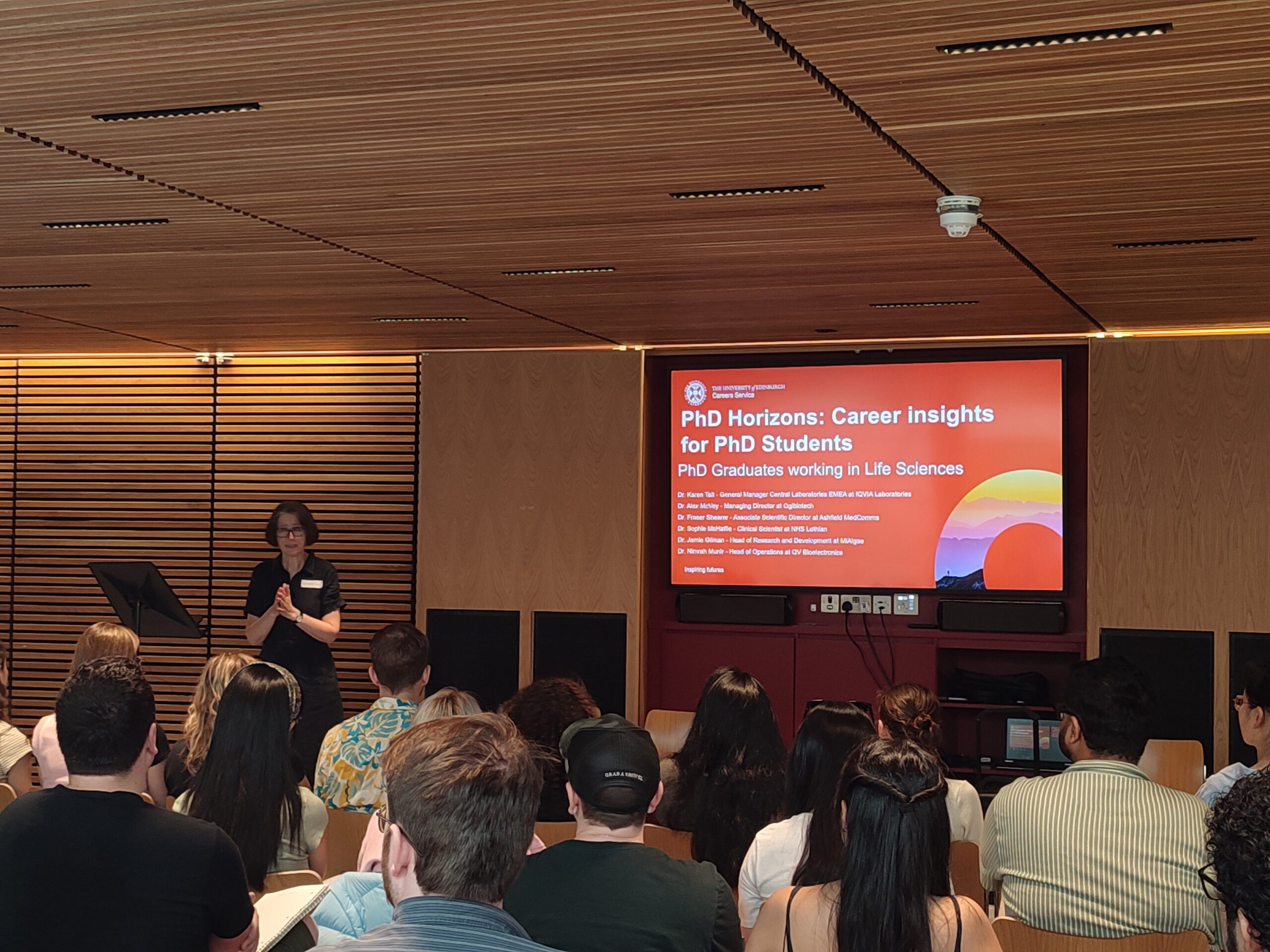
On 17 June, the Careers Service ran PhD Horizons, our annual event where Edinburgh PhD graduates return to talk about where their careers have taken them since finishing their PhDs. The speakers had gone into tech and data, policy, life sciences, entrepreneurship, non-academic science, and the heritage and creative sectors, and few of their routes there were straight lines. What struck us was how much they agreed, across different fields, about what actually matters when you are building your career. Here are our top takeaways from the day.
Your skills travel further than your subject
Your PhD makes you an expert in a particular subject, and it is tempting to think that subject is what gets you hired. In practice, the speakers said, employers were far more interested in how they worked than in what they had worked on.
Dr Stephanie Earp, on the Tech and Data panel, completed a PhD in Geophysics and is now Head of Machine Learning at Bolt6, a sports tracking company, having worked on satellite carbon mapping in between. As she described it, the subject was never the thing that moved with her across those three fields; what moved was the ability to take an unfamiliar problem, work out how to solve it, and see it through.
Professor Laura Bradley, who opened the event as Dean of Postgraduate Research for the College of Arts, Humanities and Social Sciences, recast her own PhD, on the staging history of one play, in terms any employer would recognise. She had designed a multi-year project, analysed vast amounts of material for the details that matter, managed stakeholders, and learned to pitch herself convincingly.
The lesson the speakers kept returning to was to describe yourself by what you can do rather than by the title of your thesis.
You don’t need to have it all figured out
Several speakers pushed back on the idea that you should already know where you are heading. Dr Abi Whitefield-Stevens, on the Policy panel, has had three jobs in three years, moving through a small transport consultancy and marine social research before her current role as a Senior Policy Adviser on just transition at the Scottish Government. She described the path as something that developed naturally rather than anything she planned.
Dr Dave Blackbell, a co-director at the Scottish Policy and Research Exchange, was open about often feeling lost at the time. It took him a fair way into the PhD, he said, to even have the language for the skills he was building, and longer to see that the steps had made sense.
Rejection came up more than once. Dr Zoe Gidden, who moved from a Biophysics PhD into a statistician role at the Scottish Government, was turned down for a promotion and at the application stage elsewhere, and was clear that this is normal, and not a verdict on your worth.
Networking can be less daunting than it sounds
Networking is the part most people dread, but the speakers had a smaller, less daunting idea of it than the word suggests. Abi Whitefield-Stevens said she hates networking, and has built her useful connections online instead, through LinkedIn rather than at events.
Dr Andrea Coates, now a Senior Scientist at Charles River, described making herself approach a stall as an underconfident PhD student, falling into conversation about her research with the person she took for a recruiter, who turned out to be the director of the department she now works in.
The point both were making is that you already have a network. Your supervisor will usually know where their former students ended up, and the people a year or two ahead of you are easy enough to approach. Most people are glad to spend time talking about what they do and how they got there.
Write your application with the recruiter in mind
Several speakers had done a good deal of recruiting and were candid about how shortlisting works. Dr Katy Jack, a Quality Advisor at the Association of Scottish Visitor Attractions, described essential skills going into a spreadsheet, with a tick against your name for each one your application mentions and nothing for the ones it doesn’t. The highest score takes the interview. The advice that follows is to use the same words the job description uses, since that is what the person shortlisting is scanning for, to keep a copy of everything you send so you can see which skills keep recurring, and to recast the long academic CV into something a recruiter outside academia can read quickly.
Dr Laura Harrison, a Senior Heritage Engagement Officer at Historic Environment Scotland, made the point that a list of seven essential criteria is closer to a wish list than a gate, so do not be put off if you meet only four of them, and name the ones you do meet clearly.
Curiosity is what gets judged in interviews
Asked what makes the difference in an interview, several speakers landed on curiosity. Stephanie Earp, who now hires people herself, said it is the thing she looks for. She does not expect a candidate to have the right answer; she expects them to ask clarifying questions and to show genuine interest in the problem in front of them. Her own habit, she said, was to always have more questions ready at the end of an interview than there was time to ask.
Dr Philip Ginsbach-Chen, also on the Tech and Data panel, a Compiler Engineer who moved from a PhD in Informatics through GitHub to a startup, made the same point from the technical side. In a coding interview, what is being assessed is how you reason through the problem aloud, not whether you silently produce a perfect answer. Talk through your approach and treat the interview as a conversation rather than a test.
The speakers had taken very different routes, but they agreed on the essentials. The path rarely runs straight, the work itself teaches you more than you realise, and the people around you are always worth talking to. With thanks to all our speakers for coming back to share how they got where they are.