Our Careers in Sustainability blog series comes to a close with a special contribution from Zbigniew Kanabrodzki and Dono Abdurahmanova, Green Digital Design Interns at the Information Services Group at the University of Edinburgh. They explain what Green Digital Design is and share their internship experience.
Zbigniew’s experience:
What I have been up to before this internship
Sustainable practice has been constantly emphasised across all the years of my Product Design degree, just like staying open to new opportunities in unfamiliar contexts. So, by the summer before my final year, I did things including:
- copywriting and marketing for a small business
- successfully solving a UI design challenge for Revolut
- completing an internship as an analyst in the tech-savvy part of the Scottish Government
- getting rejected from at least a couple hundred internships over those three years.
Seems disjointed, doesn’t it? Over time I realised one important thing: skills gained in even unrelated settings still have value, especially when communicated well.
And, though rejected in the previous year, those experiences, a better sense of what makes a good application and a bit of luck led to an internship offer within the Information Services Group.
Career advice: Give opportunities a try without stressing over details, especially when just starting to build work experience. A lot of things make sense only in retrospect.
The organisation
While Information Services Group might not sound familiar, there’s a 99% chance that you’ve used MyEd or Blackboard Learn. The team is responsible for keeping the entirety of the University’s web estate up and running, while looking for improvements through faster navigation and accessibility features. But there are many more metrics and websites encompassing the University – teaching is just one of the facets. Part of my interest in joining them for the summer – beyond a friend’s positive experience – was the opportunity to see the entire thing from a non-student perspective.
Green Digital Design: what even is that?
We are increasingly becoming aware of the aspect of tangible environmental impact of digital architecture. A good example is the ongoing discussion on data centres’ water consumption required to run and develop Large Language Models. However, there are other matters within the topic – specifically the websites.
You see, every page you visit has a certain size stemming from media files used and the code length. This makes various web designs more or less energy efficient, especially if you consider less obvious things like the colour scheme used – certain colours like white are noticeably more power-hungry on displays than darker tones.
Green Digital Design is an approach that tries to create pages with as low resource usage as possible, while ensuring that they are useful for the target audience as much as, if not more than, existing designs. It’s a balancing act, with case-by-case challenges and the whole field at a relatively early state – making it quite exciting to get involved.
Leading the way forward
The University of Edinburgh is one of the leading organisations experimenting with practically applying the digital sustainability principles within their web estates. Last year, interns built a theoretical foundation constituting applicable web design principles. My internship built on that, aiming to practically apply those to existing websites. Over the course of three months, I have worked with two ‘clients’ – the Careers Service and Edinburgh Innovations – consulting them on viable ways they could improve their websites based on needs covering multiple stakeholders.
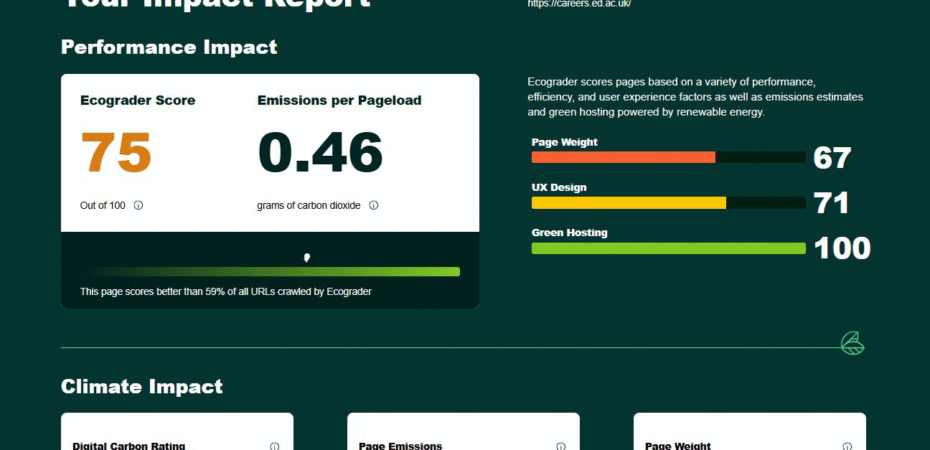
Despite the different initial situation of both sites, the entire process followed similar design principles with a thorough review of existing materials, interviews, diagram mapping and analysis using proprietary tools at the forefront. It is the framing of the problem and developing a relation that takes time – rather than devising the actual solution.
Part of this stems from the early stage of the field, with analytics tools not being very reliable at scraping data from multiple websites at once, making the necessary audit time-consuming from a data entry perspective. At the same time, people involved in the field from inside and outside of my team were very open to any suggestions for later improvement. I felt that my work had value and could lead to the eventual revamp of both departments’ websites, proving a satisfying conclusion to my time there.
The next step
If things align, I would like to further engage in digital sustainability work; but right now, I am working on a quite different project as part of my final year, though the practical experience during my internship will not be lost. I really appreciate being able to develop my designer skillset, especially user testing and a sense of autonomy, while being held accountable for my decisions, which is especially valuable given the structure of my fourth year.
On top of that, the aspect of sustainability in digital design is an example of a niche field at an early stage, opening my eyes to how you can’t really know what is possible until one’s perspective develops enough. Lastly, my contacts within the University proved very helpful in my ongoing independent research.
Career advice: Stay open and flexible. Once you know enough, things will make sense. You don’t need to be fully certain to take another step.
Dono’s experience:
I have been thoroughly enjoying my internship as a Green Digital Design Intern. The experience has been engaging and rewarding, deepening my interest in environmental and digital responsibility. My experience exploring the real-world impact of digital practices has motivated me to pursue a career in Environmental, Social, and Governance (ESG), as well as a master’s degree to deepen my expertise in this area. I have also enjoyed developing a range of skills, from technical knowledge around carbon measurement and the environmental footprint of digital products, to a deeper understanding of user experience design.
It was fascinating to see how much thought and testing go into every element of a website, from usability testing to details such as wording and punctuation. I was particularly surprised to learn how much images and videos contribute to a website’s carbon emissions, as I had always assumed they simply made a page more appealing. These details may seem minor, but they are crucial in creating an effective, high-quality and environmentally responsible web estate.
In this role, I engage with colleagues from diverse backgrounds, including highly technical experts. This experience has made me realise how much I value professionalism and a healthy work–life balance, which are clearly prioritised within the Information Services Group, and has shaped the kind of supportive working environment I hope to seek in the future.
At the beginning of the internship, an initial learning curve involved understanding my role and the impact of my work, as digital sustainability is not always immediately visible or tangible and remains a relatively new area across universities, with no specific guidelines. However, by engaging with the available literature and becoming more involved in projects, I developed a clearer understanding of how digital systems contribute to environmental outcomes. This process turned the early uncertainty into a motivating and rewarding learning experience.
Thank you, Zbigniew and Dono.
Zbigniew and Dono stressed the importance of seeking out opportunities by being open and taking the next step. To find out how you can do that, visit our Build Experience and our Finding internships and work experience pages.
To learn how to seek and create your own opportunity, check out our Creating your own opportunity page.
For opportunities relating to sustainability, search #EdSustainabilityCareers on MyCareerHub.