image_pdfimage_print

Week 4 – Making the Normalisation of Invisible Boundaries Visible in Edinburgh’s Public Space

This week, after our group discussion, I began to think more carefully about how invisible boundaries in Edinburgh become normalized. This is not a sudden act of exclusion. It is a slow process. These boundaries are difficult to notice because they are repeated through everyday movement, timing, and habits of use until they begin to feel ordinary.

I started to notice this process through everyday spatial behavior. In areas such as the Royal Mile and Princes Street, where tourism pressure is especially strong, local residents often avoid the busiest times and move their daily leisure activities to less pressured parts of the city. During the festival season, some city-centre squares and routes are reorganised by performances, visitor flows, and temporary infrastructure, which further changes how local people move through and remain in these spaces. What interests me most is that, once these patterns are repeated often enough, unequal use of space can begin to look like a matter of personal choice. In that sense, invisible boundaries are not invisible because they do not exist, but because they have become part of everyday life.

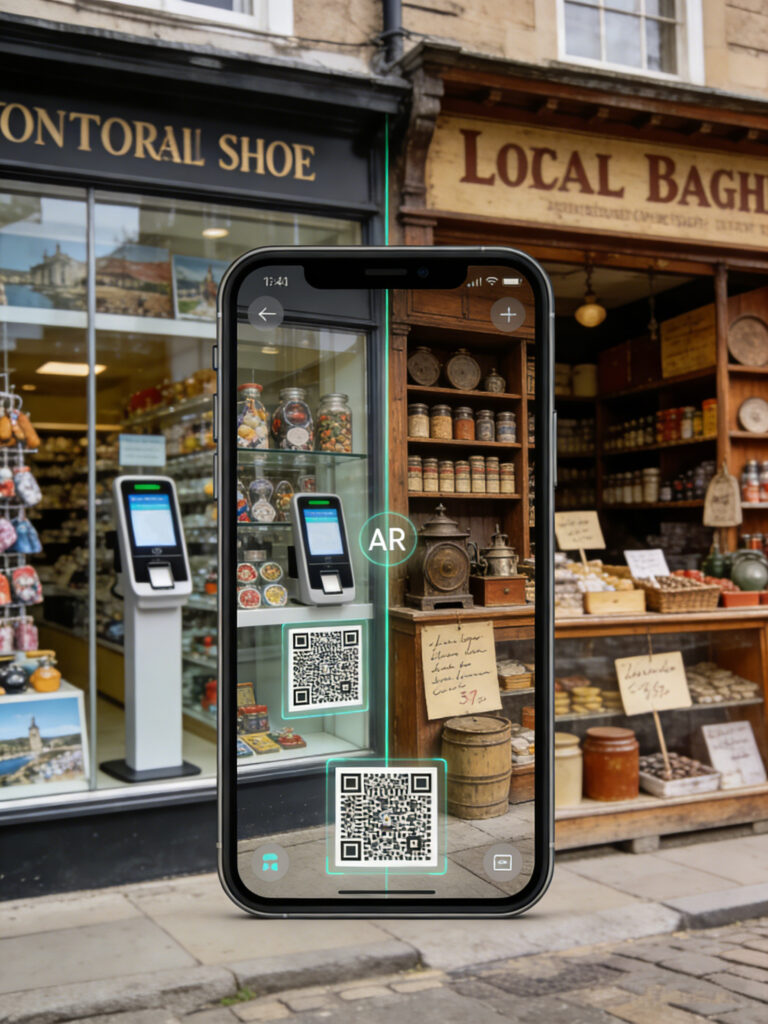
This line of thought also helped me define the curatorial method of the project more clearly. In our collective discussion, I began to consider introducing a lightweight AR element into the exhibition. The main aim is to make different historical layers of the same site visible again through an AR reconstruction. At the same time, the novelty of the technology may also help attract the viewer’s attention. For example, when a viewer scans a particular street scene, they might see the present-day tourist retail frontage alongside an earlier form of local everyday use. In this way, a space that now appears stable and natural can be re-read as something produced through displacement, reorganization, and selective visibility. Used in this way, AR can help recover spatial memories that have been covered over.

Lightweight AR Visualizations for Edinburgh
AI-generated mock-up for Lightweight AR Visualisations for Edinburgh. Produced as a speculative visualisation for project development.


At the same time, because our collective was discussing a declaration, I also began to think in advance about the kind of public effect I want this exhibition to have. A declaration should not remain at the level of a general statement of values. It should be translated into working principles for the project. First, I do not want the project to equate commercial visibility with public value. A space may have high spending power within the visitor economy, but that does not mean it is more important in public life. Discussions around the management of public space in Edinburgh already suggest that such spaces should be understood through public need and principles of use, rather than through commercial attraction alone. Second, I want viewers to recognize that unequal patterns of use based on time, season, and peak visitor flow should not be accepted as the normal condition of public space. When some groups repeatedly adapt to spatial pressure by changing their routes, avoiding busy times, or temporarily withdrawing, that inequality can easily be mistaken for a natural choice rather than a structural result. Third, I want the project to reveal how capital, management systems, and patterns of movement work together to produce spatial hierarchy, rather than simply creating an opposition between residents and visitors. I am more interested in the structural logic behind the distribution of space than in reducing a complex issue to a conflict between two groups. Only on that basis can the exhibition remain critical without reproducing the very exclusions it seeks to expose.


References

City of Edinburgh Council. City Centre Public Spaces Manifesto Update Report. 2 June 2015. https://democracy.edinburgh.gov.uk/Data/Transport%20and%20Environment%20Committee/20150602/Agenda/item_77_-_city_centre_public_spaces_manifesto_update.pdf.

Kester, Grant H. “Dialogical Aesthetics: A Critical Framework for Littoral Art.” Variant 2, no. 9 (Winter 1999/2000).
McGillivray, David, Alba Colombo, and Xavier Villanueva. “Tensions and Disputes over Public Space in Festival Cities: Insights from Barcelona and Edinburgh.” Journal of Policy Research in Tourism, Leisure and Events (Abingdon) 14, no. 3 (September 2022): 229–41. https://doi.org/10.1080/19407963.2022.2032109.

Week 2 – The Early Formation of a Non-Linear Viewing Structure

This week, I reconsidered the meaning of curating. Curating is far more than placing works in a space. It is, in fact, a practice of reshaping narrative and actively guiding how audiences understand what they see. The classroom discussion of dematerialisation, contemporaneity, decolonisation, and intersectionality made me realise that curating takes place within a reality structured by inequality. For that reason, it cannot pretend to be neutral or entirely objective.

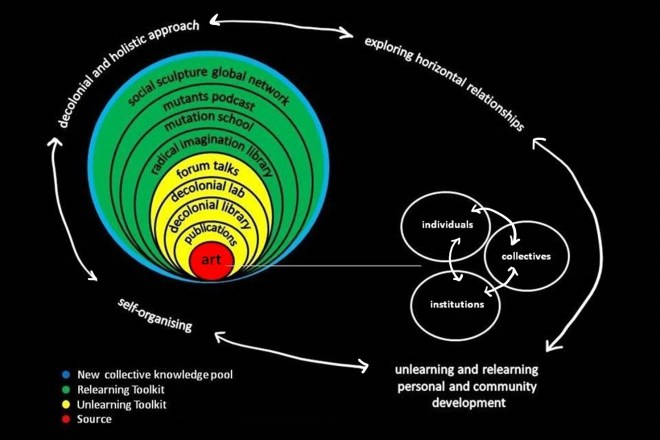
The case that affected me most directly this week was Counterspace. What interested me was its clear attempt to build an ongoing structure of interaction and exchange between individuals, groups, and institutions. This led me to rethink curating as a continuous process of building relationships rather than a simple act of display. More importantly, the case also brought out a contradiction worth taking seriously: once critical curatorial methods enter a large institutional framework, how can they avoid being absorbed by that system, or even repackaged as a consumable form of “difference”? Documenta 15 exposed this problem further and pushed me to think seriously about whether critical curating can still retain any real power to challenge structures of authority once it enters an institution.

Counterspace This is a diagram on a black background. At its center is a red "art"—this is the starting point. Around it are layered sections (like rings) with things like publications, decolonial libraries, and forum talks. Arrows and text show: This project uses a "decolonial, holistic approach." It connects three groups—individuals, collectives, and institutions—through those layered sections. Its goals are to let the project organize itself, build equal "horizontal" relationships, and help people unlearn old ideas and relearn new ones. In the end, it aims to create a new shared knowledge pool.
Counterspace diagram, Cultural Strategy, London, 2021. Commissioned by Cristina Morales. Source: Counterspace website.

Because this contradiction had a real effect on my own project, I began to think more systematically about whether modes of viewing are themselves already arranged in advance by institutional logic. Does institutional power not only shape space and organisation, but also determine the order in which audiences encounter works and the ways in which those works are understood? I began to see clearly that route design is itself part of how narrative authority is distributed. I discussed this further with my tutor and group members during our collective discussion. This then led me to the question that increasingly concerns me: how do audiences move within an exhibition, and can that movement itself become an organic part of the exhibition’s structure?

My initial idea was to connect several outdoor sites through a map, offering a suggested route while also allowing audiences to choose their own path. But I quickly realised that the real issue was not simply to provide one more route option. What mattered was whether route design itself could change how audiences enter the works. If a fixed route often corresponds to a relatively fixed interpretive logic, then multiple routes and audience choice leave more room for participation, judgment, and understanding. I therefore developed a strong and lasting interest in a non-linear viewing structure. Such a structure does not require the audience to move in a single sequence, but instead treats the act of viewing itself as part of the exhibition narrative.

References

Counterspace. Cultural Strategy. London, 2021. Commissioned by Cristina Morales. Counterspace website. https://counterspace.zone/about/. 

documenta fifteen. “lumbung.” documenta fifteen website. https://documenta-fifteen.de/en/lumbung/.

Week 1 – From Description to Structure

The Anthropocene, the Capitalocene, and A Billion Black Anthropocenes together provided a layered critical framework for the ecological crisis I am concerned with this week. The Anthropocene shows that human activity has shaped a global crisis. The Capitalocene challenges the idea of “humanity as a whole” and instead treats capitalism itself as a major historical structure of ecological destruction. Yusoff then powerfully connects geological extraction, colonialism, and racial violence. A clear and important insight follows from this: curating cannot operate on only one level.

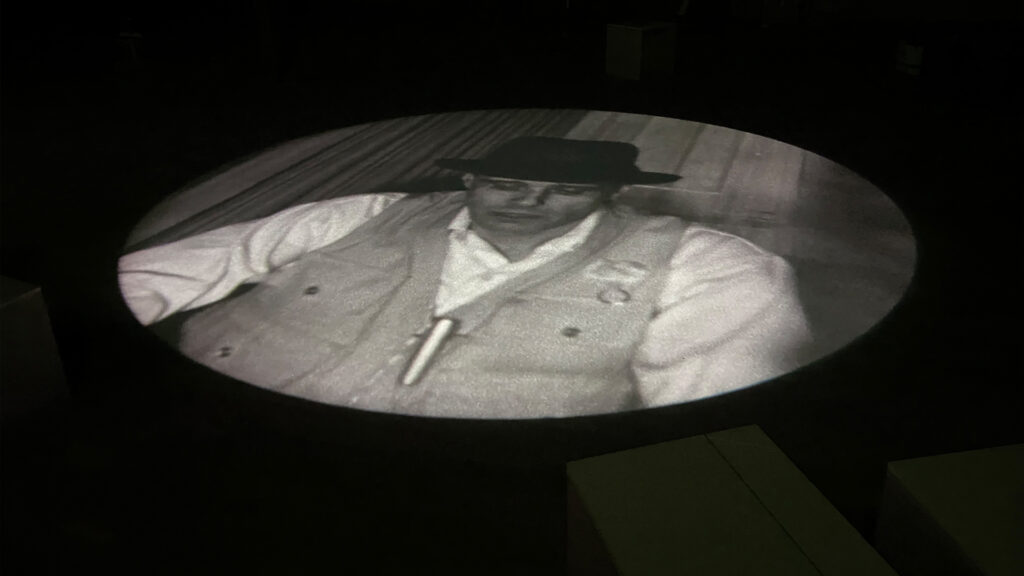
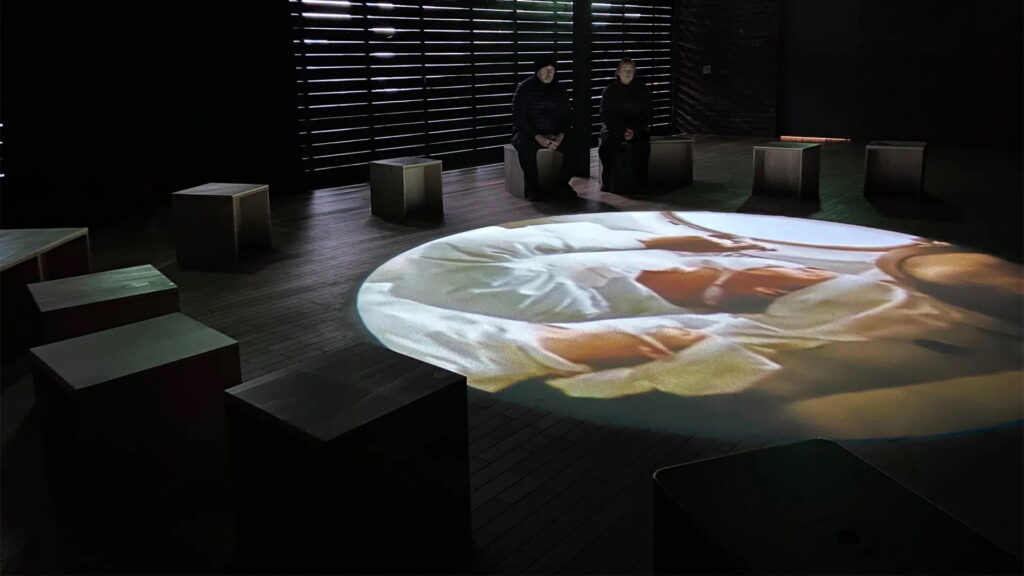
Because of this line of thinking, my way of viewing Sarah Wood’s Project Paradise changed. What now seemed especially important to me was not only the content of the work, but also its mode of presentation. The work takes the form of a floor projection, and viewers enter it from an overhead angle into a space composed of archival images, drone footage, history, and memory. From this, I drew the conclusion that exhibition form is not simply a support for content. It actively shapes how content is experienced and understood.

The film is projected onto the floor, featuring archival footage and drone shots that weave together historical fragments and nature-related scenes. Audience seats are arranged in a circular formation around the projection area. You can sit anywhere in the circle, facing the floor to focus on the visuals—like gazing through a "portal" in the ground into the world of the film, and immersively feeling the interplay of history and memory.
Installation view of Sarah Wood, Project Paradise, Fruitmarket, Edinburgh, 2023–24. Source: Fruitmarket website.

Using these three concepts, I was also able to reread the exhibition more critically. Fruitmarket introduces Project Paradise mainly through ecology, landscape, memory, and extraction. This is a useful point of entry, but it also naturally leads to more fundamental questions: which histories are made visible, and which structural or racialised dimensions remain underdeveloped? This was the first time I understood very clearly that the same curatorial work can open into different layers of meaning depending on the theoretical lens through which it is read. From this, I gradually began to understand that curating is not only about displaying material, but also about organising how that material is read.

Figure 2. Film still from Sarah Wood, Project Paradise, Fruitmarket, Edinburgh, 2023–24. Source: Fruitmarket website.

During the first collective discussion, everyone introduced their own background and areas of strength. I could see that group members had different kinds of experience in installation, editing, communication, and modeling, and many of these were areas in which I am not yet strong. This helped me understand the purpose of the collective. Learning in this course will not develop through theory alone, but also through collaboration. For me, the collective is therefore an excellent site for building practical experience.

References

PAUL J. CRUTZEN, EUGENE F. STOERMER and WILL STEFFEN. “‘The “Anthropocene”’ (2000).” In The Future of Nature, edited by Libby Robin, Sverker Sörlin, and Paul Warde, 483. Yale University Press, 2013.

Fruitmarket Gallery. “Sarah Wood: Project Paradise.” Edinburgh, December 9, 2023–January 21, 2024. https://www.fruitmarket.co.uk/archive/sarah-wood-project-paradise/.

Moore, Jason W. “The Capitalocene, Part I: On the Nature and Origins of Our Ecological Crisis.” The Journal of Peasant Studies (London) 44, no. 3 (May 2017): 594–630. https://doi.org/10.1080/03066150.2016.1235036.
Yusoff, Kathryn. A Billion Black Anthropocenes or None. Minneapolis: University of Minnesota Press, 2018.