

This week, I reconsidered the meaning of curating. Curating is far more than placing works in a space. It is, in fact, a practice of reshaping narrative and actively guiding how audiences understand what they see. The classroom discussion of dematerialisation, contemporaneity, decolonisation, and intersectionality made me realise that curating takes place within a reality structured by inequality. For that reason, it cannot pretend to be neutral or entirely objective.
The case that affected me most directly this week was Counterspace. What interested me was its clear attempt to build an ongoing structure of interaction and exchange between individuals, groups, and institutions. This led me to rethink curating as a continuous process of building relationships rather than a simple act of display. More importantly, the case also brought out a contradiction worth taking seriously: once critical curatorial methods enter a large institutional framework, how can they avoid being absorbed by that system, or even repackaged as a consumable form of “difference”? Documenta 15 exposed this problem further and pushed me to think seriously about whether critical curating can still retain any real power to challenge structures of authority once it enters an institution.
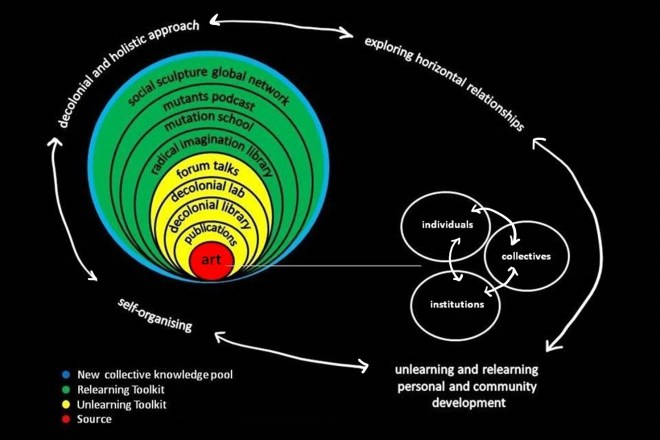
Because this contradiction had a real effect on my own project, I began to think more systematically about whether modes of viewing are themselves already arranged in advance by institutional logic. Does institutional power not only shape space and organisation, but also determine the order in which audiences encounter works and the ways in which those works are understood? I began to see clearly that route design is itself part of how narrative authority is distributed. I discussed this further with my tutor and group members during our collective discussion. This then led me to the question that increasingly concerns me: how do audiences move within an exhibition, and can that movement itself become an organic part of the exhibition’s structure?
My initial idea was to connect several outdoor sites through a map, offering a suggested route while also allowing audiences to choose their own path. But I quickly realised that the real issue was not simply to provide one more route option. What mattered was whether route design itself could change how audiences enter the works. If a fixed route often corresponds to a relatively fixed interpretive logic, then multiple routes and audience choice leave more room for participation, judgment, and understanding. I therefore developed a strong and lasting interest in a non-linear viewing structure. Such a structure does not require the audience to move in a single sequence, but instead treats the act of viewing itself as part of the exhibition narrative.
References
Counterspace. Cultural Strategy. London, 2021. Commissioned by Cristina Morales. Counterspace website. https://counterspace.zone/about/.
documenta fifteen. “lumbung.” documenta fifteen website. https://documenta-fifteen.de/en/lumbung/.
