image_pdfimage_print

Week 10 – Urban Conditions, Mobility Strategies, and Degrees of Intervention

image_pdfimage_print

This week, I began to test the viewing structure developed in previous weeks against real urban conditions. An exhibition strategy in public space cannot rely on a single route alone. It has to respond to differences in density, management, and circulation pressure across specific sites. What needed revision here was not the theme of the project, but the conditions under which the exhibition could actually operate in different parts of the city.

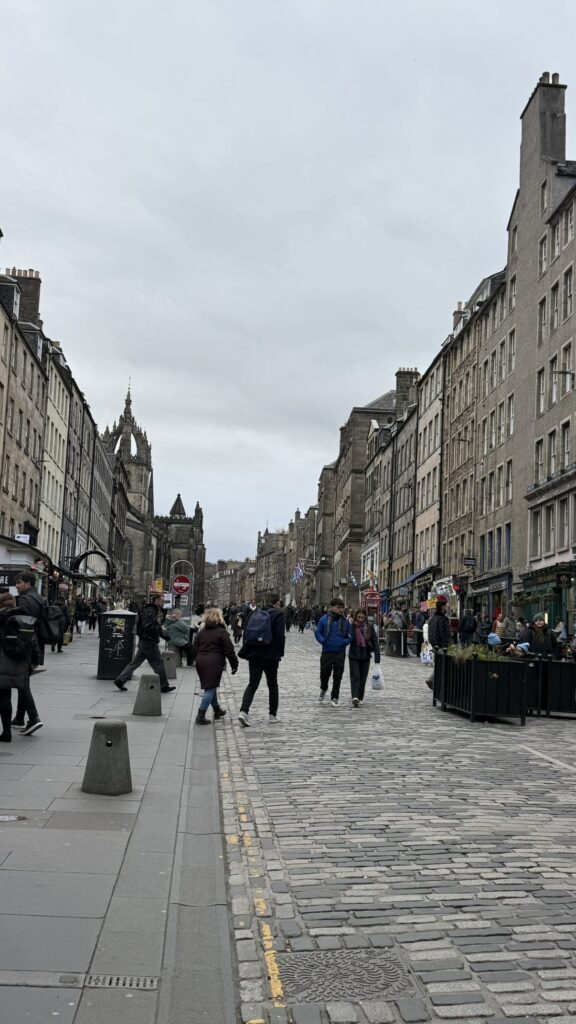
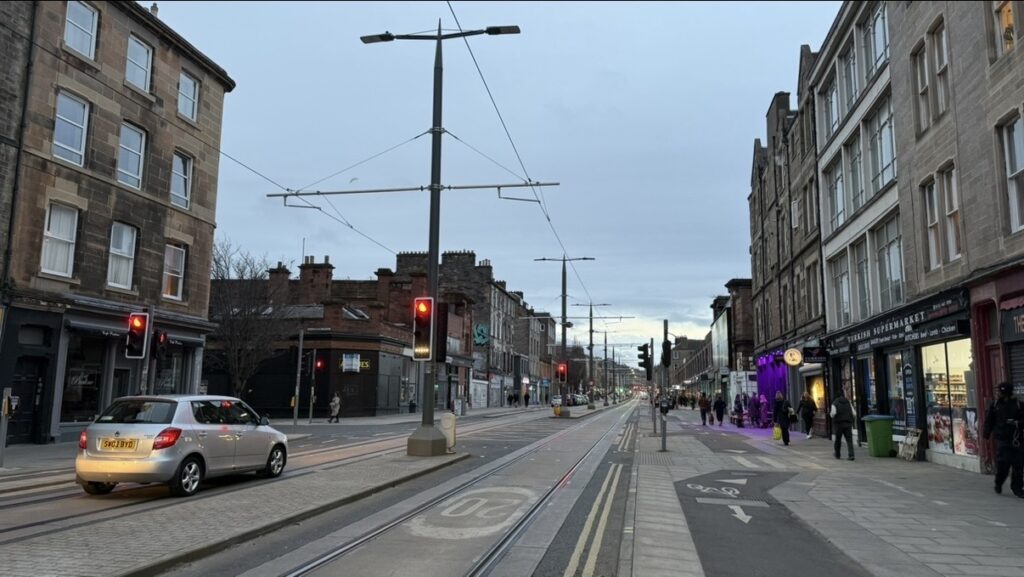
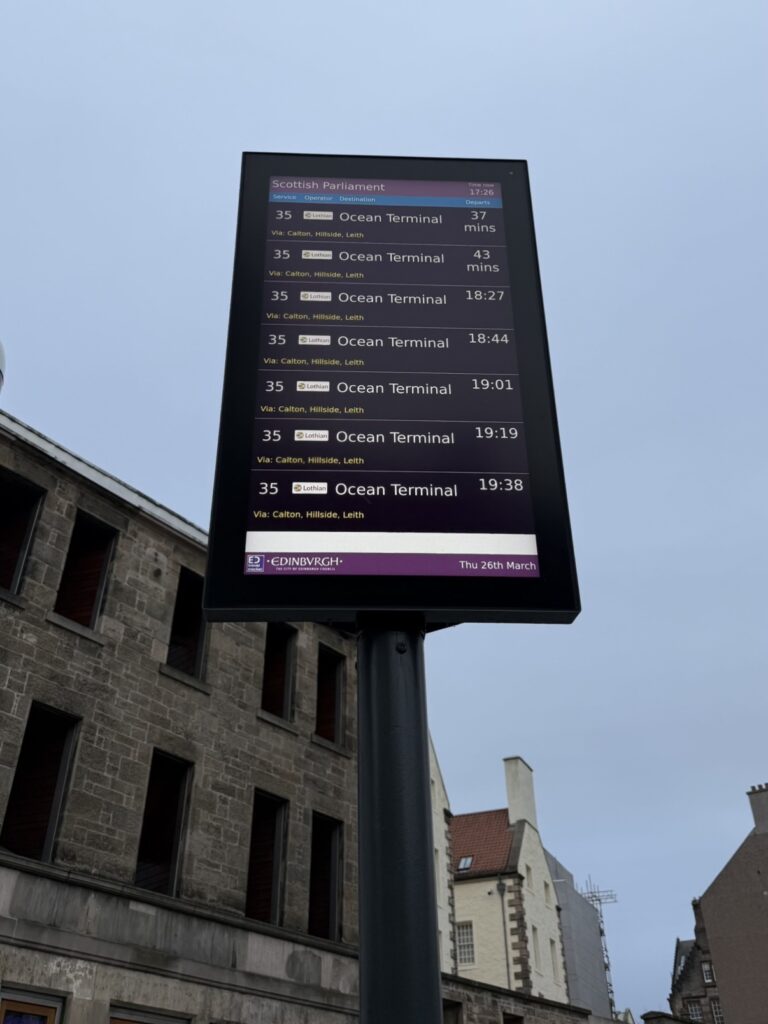
On that basis, I reworked the mobility strategy. Princes Street, the Royal Mile, and Waverley Bridge are all high-density sites, so these three points are now approached on foot only. This is because they are already shaped by heavy flows, high visibility, and strong commercial pressure. To insert the project back into the logic of public transport in these areas would place extra pressure on the bus system and, at the same time, weaken the project’s critical position on spatial congestion. By contrast, lower-density areas such as Holyrood, Leith Walk, and Ocean Terminal can still retain Bus 35 as a linking method during off-peak hours. Data published by Lothian Buses in 2026 shows that annual passenger journeys reached 119 million, which makes it clear that the transport system is already carrying an extremely high level of everyday movement. For that reason, limiting the project to the 10am–4pm off-peak period is not just a practical arrangement. It is also a methodological decision, intended to avoid reproducing the very pressure that the project is trying to expose.

Street view of the Royal Mile, documenting the high-density pedestrian environment of the city centre during route testing. Photograph by Hazel Ren, March 2026.
Street and tramline view of Leith Walk, documenting a lower-density urban condition and transport-linked route connection. Photograph by Hazel Ren, March 2026.
Bus 35 digital stop display, documenting route timing and off-peak public transport conditions during fieldwork. Photograph by Hazel Ren, March 2026.

This adjustment also made the role of mobility within the project more precise. It is no longer simply a matter of transporting viewers between sites. Different modes of movement become part of how urban difference is understood. Through this graded approach, walking in the city centre exposes the overlap between crowding, commercial frontages, and tourist circulation. In areas with slower rhythms and lower density, bus connections make it easier to recognize that urban space is not used as a uniform whole. In that sense, this strategy has something in common with the idea of the manoeuvre developed at Le Lieu in Quebec, where action is used to alter an existing relationship between publics and the site.

I also made the question of permission more specific. Earlier ideas about “guerrilla” intervention and formal application needed to be translated into a more workable model. According to the City of Edinburgh Council’s current Public Space Guidance for Event Organizers and the Use of Public Spaces for Events and Filming Policy approved in 2023, activities in public spaces are assessed in relation to crowd size, impact on movement, and pressure on site management. For my project, this means that intervention cannot be treated as one fixed method. Its visibility and intensity have to change depending on the conditions of each site. Lower-pressure locations such as Holyrood, Leith Walk, and Ocean Terminal can still support lighter, temporary interventions that remain close to ordinary use. That continues the low-intensity, guerrilla-style thinking I explored earlier. By contrast, high-density and tightly managed sites such as Princes Street, the Royal Mile, and Waverley Bridge require a more cautious strategy, based on walking, limited guidance, or, where necessary, preparation for formal permission.

Local precedents also support this reasoning. Since 2017, the Edinburgh Festival Fringe Society’s Fringe Days Out programme has offered free tickets and bus passes to local charities and community groups, showing that transport support can widen access to the public. Traveling Treasures, meanwhile, suggests that the travel route itself can carry cultural narrative. For my project, the value of these examples lies in confirming that links between transport and cultural activity already exist in Edinburgh. Even so, whether transport should be used, and how, still has to be decided in relation to the conditions of each site.


References

City of Edinburgh Council. “Use of Public Spaces for Events and Filming Policy.” October 5, 2023. https://democracy.edinburgh.gov.uk/documents/s61901/Item%207.3%20-%20Use%20of%20Public%20Spaces%20for%20Events%20and%20Filming.pdf.

City of Edinburgh Council. “Use of Public Spaces for Events and Filming: Final Report.” May 11, 2023. https://democracy.edinburgh.gov.uk/documents/s57266/8.3%20-%20Use%20of%20Public%20Spaces%20for%20Events%20and%20Filming_Final.pdf.

Edinburgh Festival Fringe Society. “Fringe Days Out.” Accessed April 16, 2026. https://www.edfringe.com/experience/school-and-community-engagement/school-and-community-projects/fringe-days-out/.

Edinburgh Festival Fringe Society. “Fringe Days Out Returns in 2024 to Help Edinburgh Communities Engage with the Fringe.” April 30, 2024. https://www.edfringe.com/about-us/news-and-blog/fringe-days-out-returns-in-2024-to-help-edinburgh-communities-engage-with-the-fringe/.

Le Lieu, centre en art actuel. Manœuvres – Le Lieu, centre en art actuel. Edited by Richard Martel. Dijon: Les presses du réel, 1992. Accessed April 16, 2026. https://www.lespressesdureel.com/EN/ouvrage.php?id=2298&menu=0.

Lothian Buses. “Public Transport Use in the Capital Continues to Grow.” January 9, 2026. https://www.lothianbuses.com/news/2026/01/public-transport-use-in-the-capital-continues-to-grow/.

Lothian Buses. “Lothian City Buses: Service 35.” Accessed April 16, 2026. https://www.lothianbuses.com/our-services/lothian-city-buses/.
Week 9 – Testing Non-Linear Viewing and Rethinking Publics

image_pdfimage_print

This week, after walking the full route myself, I began to reassess the project’s viewing structure. Although the original six-site model had already tried to move away from the control of a single path, in practice, it still relied too heavily on the assumption that viewers would be able to complete all the sites in a continuous and stable way. Walking and transferring between the sites for four hours exposed two problems quite clearly: the route was too long, and the earlier model still held too strongly to the idea of a complete path.

For that reason, I did not abandon the full route, but I changed its position within the project. The complete route still remains, but only as the most in-depth option available to viewers. At the same time, I introduced shorter routes covering two or three nearby sites, as well as fragmentary forms of participation in which viewers can enter the project through the map and build their own way through it. This does more than reduce the total viewing time. It also makes the viewing structure closer to the way urban space is actually used: entry is often incomplete, stopping is often accidental, and movement is constantly shaped by time, energy, interest, and transport conditions. In my project, the importance of this adjustment is that it allows viewing to reflect the interruptions, shifts, and unevenness already present in the city. Non-linearity here is not simply a matter of convenience. It is a methodological revision, because the viewer’s own choices become part of the project’s argument.

This also led me to rethink guidance. The project cannot leave viewers entirely on their own, because the critical framework would become too weak. At the same time, it cannot regulate every step too closely, because that would reproduce the same logic of spatial control that the project is trying to question. I therefore adopted a structure that is partly guided and partly open: key points provide the necessary prompts and critical framing, while other moments leave space for viewers to connect experiences for themselves. More useful points of reference here are dérive, psychogeography, and discussions of walking as critical curating. Walking matters not because it represents free movement in itself, but because it structures perception and allows participants to form judgements as they move. The idea of the manoeuvre, developed at Le Lieu in Quebec, is also relevant, since it does not treat intervention as simply placing art in the city, but as an action that changes the existing relationship between publics and place. In that sense, the route in my project is no longer just a tool that links sites together. It becomes a curatorial structure for perception.

This week also pushed me to deepen the question of publics by turning attention towards modes of spatial use. In this project, the more important difference is not which fixed category a viewer belongs to, but how they enter the route, how long they can remain, at what pace they move, and whether they are able to organize dispersed site experiences into a coherent understanding. The public, therefore, cannot be treated as pre-existing groups. They are better understood as positions that are continuously produced through the act of viewing. This shift gives the non-linear structure a clearer methodological role. It responds not only to differences in social identity, but also to the ways time, mobility, and habits of spatial use shape how a public can enter the work.


References

Brauner, Maren, and Irene Grillo. “Walking as a Form of Critical Curating.” OnCurating, no. 8. Accessed April 16, 2026. https://www.on-curating.org/issue-8-reader/walking-as-a-form-of-critical-curating-1132.html.

Le Lieu, centre en art actuel. Manœuvres – Le Lieu, centre en art actuel. Edited by Richard Martel. Dijon: Les presses du réel, 1992. Overview accessed April 16, 2026. https://www.lespressesdureel.com/EN/ouvrage.php?id=2298&menu=0.

Lippard, Lucy R. The Lure of the Local: Senses of Place in a Multicentered Society. New York: New Press, 1997.

VisitScotland. “Edinburgh and the Lothians.” Accessed April 16, 2026. https://www.visitscotland.org/research-insights/regions/edinburgh-lothians.

Week 8-From Proposal to Production

image_pdfimage_print

This week, the project started to feel less like a collection of separate ideas and more like a question of structure. What needed attention was whether the existing parts could be organised into a sequence that others could read. In this project, that means the six sites, the route, the interpretive tools, and the public materials can no longer remain as parallel elements. They need to begin working as one reading system.

This week’s discussions on archives and exhibition histories helped me think about this more clearly. In her writing on “remembering exhibitions”, Reesa Greenberg argues that exhibitions are not brought back by simply restoring the past in full. They are re-presented through different approaches such as replica, riff, and reprise. What is most useful for me in this theory is that it offers a way of thinking about how experience can be reordered. My project is dealing with a social structure that has already been repeated many times in the city. Routes, pauses, ways of entering, and patterns of use have slowly settled into a spatial logic through everyday practice. What curating can do here is to rearrange those repeated traces, so they no longer remain invisible as part of the ordinary background.

This also forced me to adjust my language. The phrase “outdoor wandering” is too vague. My project is closer to an organised critical route than to wandering itself. The discussion of walking as critical curating offers a more precise reference point. Walking matters here not because it suggests free movement, but because it structures perception and allows participants to form judgements in public space. For me, that is important because the route is not something added onto the exhibition from outside. It is one way the project makes its argument. Viewers do not first see the works and only then understand the route. The route is already shaping how they understand both the works and the city.

The collective work at Summerhall also made another issue clearer. Entry into a project does not begin only in front of the work itself. What matters is not only placement, but also entry. Posters, booklets, and layout all influence how the public first approaches a project. The course material on artist-run spaces describes these spaces as collaborative and experimental, while also being shaped by tensions around inclusivity, accessibility, and fair representation. This reminded me that discussions in the collective about publicity, spatial organization, and viewing order should not be treated as secondary matters. They are part of a central question: how publics are brought into a project in the first place.

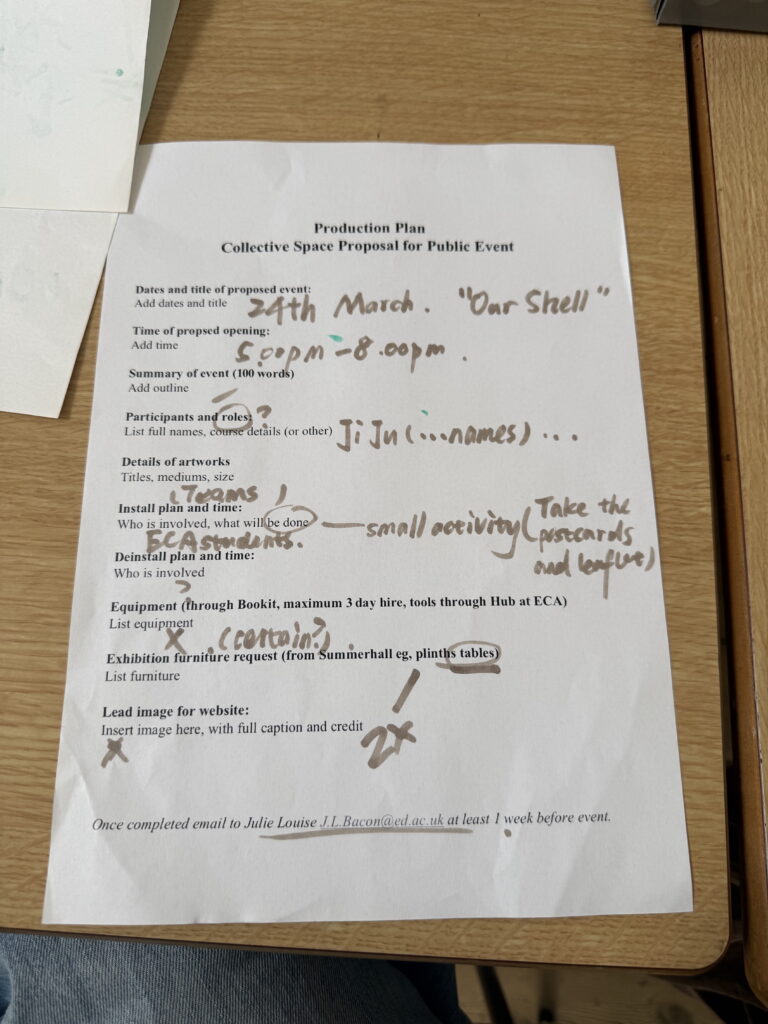
Production checklist and early booklet sketch for the Summerhall collective event. Photograph by Hazel Ren, March 2026.


This is especially important for my own project. The relationship between the six sites cannot be held together by thematic similarity alone. It also has to be organised through a map, site texts, a booklet, and other mediation tools, so that the project can be read as a continuous structure. By this point, I had become more certain that the next step for the proposal was not to add more separate parts, but to build a clearer order of entry and reading.


References

Brauner, Maren, and Irene Grillo. “Walking as a Form of Critical Curating.” OnCurating, no. 8. Accessed April 16, 2026. https://www.on-curating.org/issue-8-reader/walking-as-a-form-of-critical-curating-1132.html.

Greenberg, Reesa. “Archival Remembering Exhibitions.” Journal of Curatorial Studies (BRISTOL) 1, no. 2 (June 2012): 159–78. https://doi.org/10.1386/jcs.1.2.159_1.

Lewis Jacob, Adam. Underground, Overground, Inside and Out: Exploring the Dynamics of Artist-Run Spaces. MA Contemporary Art Theory: Curating course presentation, University of Edinburgh, 2026.

Week 7 – Finalizing the Title and Revising the Funding Logic

image_pdfimage_print

This week, I returned to two issues that are more decisive for whether the project can actually work: how the title can express the main argument clearly, and how the budget can move from a set of idealized numbers to a funding logic that feels realistic, applicable, and trustworthy.

After discussion with my tutor and group members, I finally confirmed the title Whose Space? Invisible Boundaries in Edinburgh’s Public Life. The class discussion on regional curatorial practice also reminded me that place itself is shaped by political and economic forces, and that curatorial work needs to connect specific sites to wider systems. This helped to correct the direction of my project.

The part that needed more careful work was the budget. For me, the value of the budget lies in showing the real scale of the project. A provisional limit of around £10,000 forced me to reconsider which parts are essential and which still remain at the level of conceptual ambition. Three artist residencies, multiple commissions, fuller AR development, public activities, security, and documentation all seem reasonable when considered separately. Once they are placed together inside an emerging curator’s speculative proposal, however, the scale becomes clearly excessive. After reviewing the plan, I concluded that the project must retain the artist commissions that support the argument most directly: site-specific interpretation, basic accessibility provision, necessary documentation, and AR as a key interpretive tool. At the same time, AR should not be designed as a complete development across the whole route. Within the six sites, Princes Street and Waverley Bridge are the places where AR matters most, because they reveal most clearly how commercial visibility and infrastructural flows shape the use of space. The other sites can be addressed through performance, rhythm-based intervention, or participatory methods. With this adjustment, AR still remains central to the project’s method, but it serves spatial interpretation rather than technical expansion. Some participatory activities, higher staffing and residency costs, and over-ambitious technical plans therefore need to be reduced or postponed.

In researching funding routes, I currently see the City of Edinburgh Council Local Events Open Fund as the strongest and most realistic main option. The Council’s 2026/27 overview shows three levels of support—£20,000, £12,000, and £5,000—and gives priority to commitment to communities, environmental responsibility, fair work, and equality, diversity, and inclusion, while supporting activities with public cultural value in Edinburgh. For my project, this route is the strongest because its criteria overlap closely with the structure of the proposal: it is Edinburgh-specific, public-facing, community-oriented, and centred on access and local publics. As a secondary route, Creative Scotland’s Open Fund for Individuals also seems possible, since it supports research, development, and project delivery, with grants from £500 to £50,000. By contrast, the Culture & Business Scotland Fund requires prior business sponsorship and then matched funding, so it is more suitable as a future supplement than as the most secure basis for the current proposal.

I also looked for precedents related to public-space projects in Edinburgh. The Council’s grant register specifically mentions the Edinburgh Art Festival – New Waverley Commission 2017 project, which aimed to create a work responding directly to the New Waverley environment. The Edinburgh Art Festival 2017 Commissions Programe also described its public commissions as a way of opening up overlooked spaces in the city through publicly sited works. This at least shows that, in Edinburgh, site-responsive and public-facing commissions connected to specific urban conditions are not unusual or unimaginable cases. They already have clear precedents of funding support.


References

City of Edinburgh Council. “Local Events Open Fund 2026/27.” Accessed April 16, 2026. https://consultationhub.edinburgh.gov.uk/sfc/local-events-open-fund-2026-27/.

City of Edinburgh Council. Local Events Open Fund Overview. Accessed April 16, 2026. https://consultationhub.edinburgh.gov.uk/sfc/local-events-open-fund-2026-27/supporting_documents/local-events-open-fund-overviewpdf.

City of Edinburgh Council. “Live Grant Register.” Accessed April 16, 2026. https://www.edinburgh.gov.uk/downloads/file/38021/grant-register.

Creative Scotland. “Open Fund for Individuals.” Accessed April 16, 2026. https://www.creativescotland.com/funding/funding-programmes/open-funding/open-fund-for-individuals.

Culture & Business Scotland. “C&BS Fund.” Accessed April 16, 2026. https://cultureandbusiness.scot/cbs-fund/.

Edinburgh Art Festival. “Edinburgh Art Festival 2017 Commissions Programme.” Accessed April 16, 2026. https://www.edinburghartfestival.com/edinburgh-art-festival-2017-commissions-programme/.

University of Edinburgh. Week 7 SICP Toolkit. MA Contemporary Art Theory: Curating course document, 2026.


Week 6 – From Proposal to Spatial Testing

image_pdfimage_print

After the Curatorial Pitch, the project entered a stage where it had to be tested. The key question was whether this structure could still hold once the exhibition moved into real urban space. Public space is not a neutral container for display. Its use is always shaped by management systems, circulation, spatial control, and the built environment. Once a site becomes part of the project, the curatorial form is no longer shaped by concept alone. It is also reshaped by real conditions on the ground. For that reason, my focus this week shifted to testing. For a project that depends on six public sites, permission had to be treated as a priority. It is not an extra technical procedure. It is a direct expression of spatial power, because it reveals how a place is organized, how it is restricted, and what kinds of access are allowed. The SICP Toolkit also makes this clear: in outdoor or non-art spaces, permission, realism, and accessibility need to be part of the curatorial rationale from the beginning.

This also pushed me to rethink the place of intervention in the project. Bringing work into the city is not enough to make an intervention meaningful. What matters is whether it can disturb a logic of use that has already been accepted as normal, and make a naturalized order visible again as something constructed. The Situationist International offers an important reference here. Their discussions of dérive and psychogeography show how the city organises perception and movement through routes, functions, and rhythms. Marcus Jack’s course material, which quotes Debord’s statement that “all that was once directly lived has become mere representation”, was especially helpful for me. My project is dealing with a similar spatial condition. Some places appear natural and unquestioned only because the inequalities within them have been repeated for so long. In that sense, the value of intervention does not lie in creating a visual event. Its force lies in disturbing existing spatial relations.

The collective installation at Summerhall made this issue even clearer. During the in-person installation, I began to see that coherence never appears automatically, even when works seem close in theme. Distance between works, the order in which they enter the viewer’s sight, and the sequence of different media all shape how an exhibition is read. We adjusted the placement of multimedia works, allowed a longer viewing distance for larger works, and kept changing the sequence between painting, installation, and photography. These decisions may look like questions of display, but in fact, they all address a deeper issue: how an exhibition builds its internal logic through spacing, pacing, and relation. Adam Lewis Jacob’s presentation on artist-run spaces also argues that artist-led curating often depends on collaborative and experimental strategies, while always carrying tensions around inclusivity, accessibility, and fair representation. This collective experience fed directly back into my individual project. It made me realize more clearly that the six sites cannot remain as six separate statements. They have to form a rhythm of encounter.

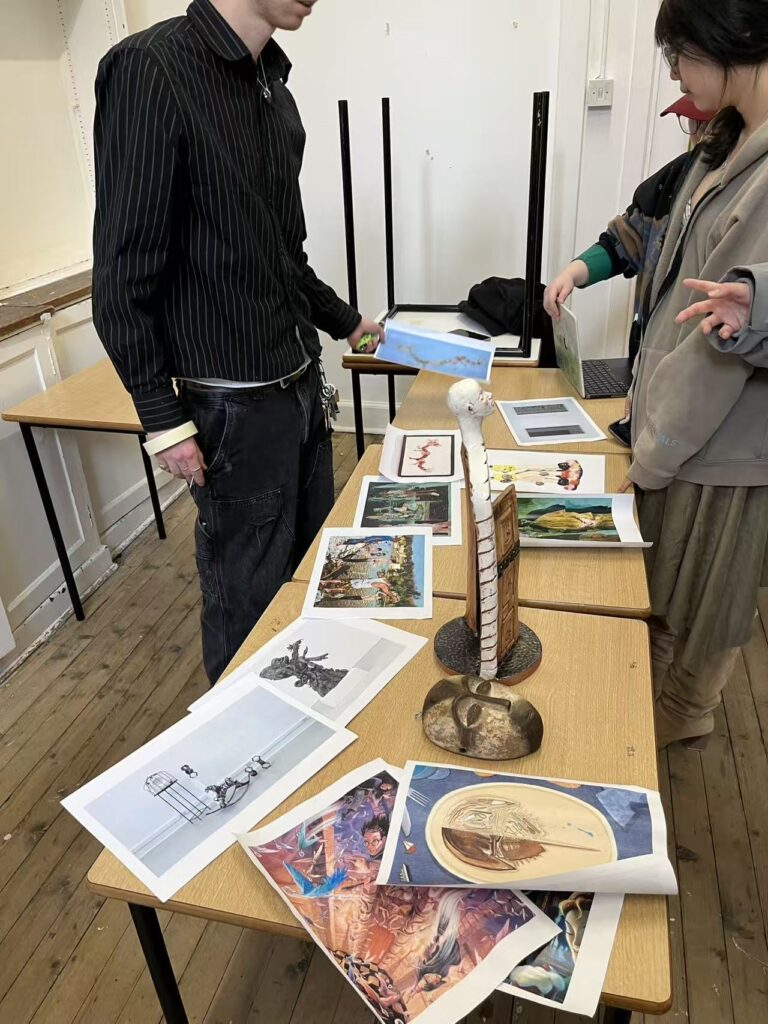
Collective discussion and artwork grouping during the first offline setup at Summerhall, March 2026. Photograph by Hazel Ren.


Early wall arrangement test during the collective setup at Summerhall, March 2026. Photograph by Hazel Ren.


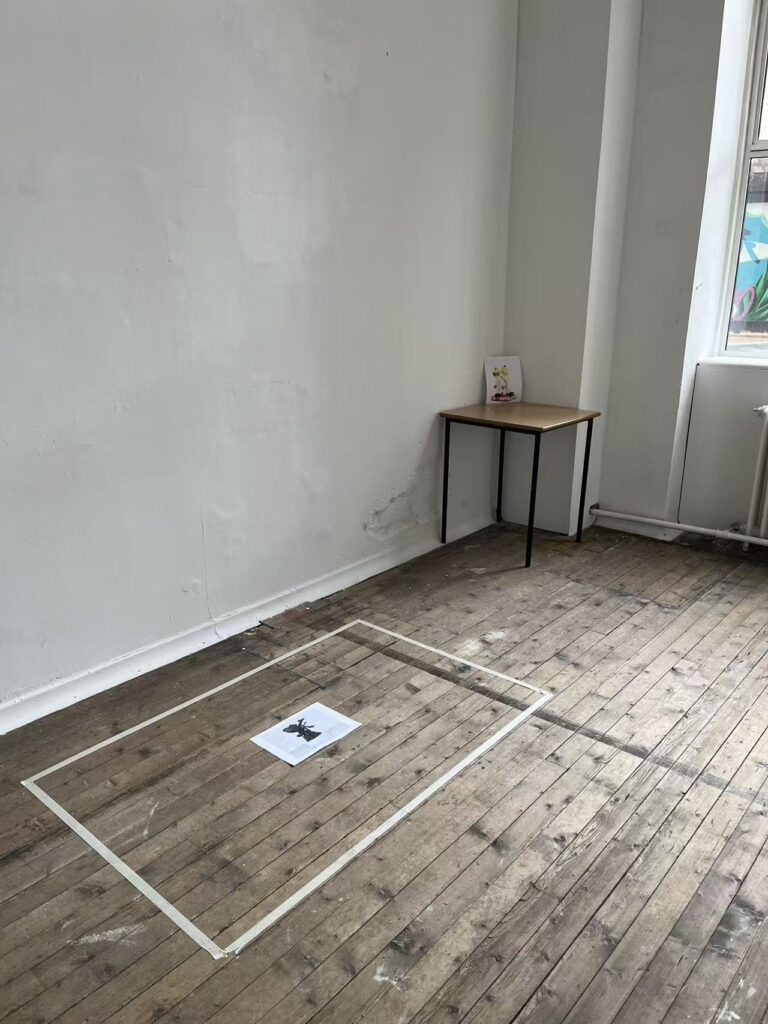
Initial spatial test during the first offline collective setup at Summerhall, March 2026. Photograph by Hazel Ren.


References

Han, Shuyan, Dexuan Song, Leiqing Xu, Yu Ye, Shurui Yan, Feng Shi, Yuhao Zhang, Xiaodong Liu, and Hu Du. “Behaviour in Public Open Spaces: A Systematic Review of Studies with Quantitative Research Methods.” Building and Environment 223 (September 2022): 109444. https://doi.org/10.1016/j.buildenv.2022.109444.
Chitrakar, Rajjan M, Douglas C Baker, and Mirko Guaralda. “How Accessible Are Neighbourhood Open Spaces? Control of Public Space and Its Management in Contemporary Cities.” Cities 131 (December 2022): 103948. https://doi.org/10.1016/j.cities.2022.103948.

Lewis Jacob, Adam. Underground, Overground, Inside and Out: Exploring the Dynamics of Artist-Run Spaces. MA Contemporary Art Theory: Curating course presentation, University of Edinburgh, 2026.

University of Edinburgh. Week 6 SICP Toolkit. MA Contemporary Art Theory: Curating course document, 2026.