Week 2-Preliminary Exploration of the Roaming Outdoor Exhibition

sunflower seeds This is a large-scale immersive art installation in the Turbine Hall of Tate Modern in London. The entire space is a towering, industrial-style building. The entire floor of the exhibition hall is covered with hundreds of millions of handcrafted porcelain sunflower seeds. A person wearing a blue and pink checkered sweater and white pants is lying spread-eagle on the seeds, and in the distance, two other people are sitting and relaxing on this surface.

During the Week 2 course, I noticed several key words. Here, I would like to share with you my thoughts on the deep connection of phrases, some issues I discovered, and some inspirations for my own curatorial ideas.

The first one is “dematerialization”, which marks a shift in artistic practice. Art is no longer confined to physical objects but focuses more on concepts and processes. This transformation has opened up new channels for artists and groups that have been marginalized in the traditional art system to express themselves, and to some extent, has loosened the inherent “central-periphery” model.

Then there is “Contemporaneity”, a theory that precisely depicts the current diverse but unequal global situation. This complex reality has given rise to new forms, such as organized Networks, and some large group exhibitions, especially international ones, respond to the challenges brought by globalization by establishing decentralized connections.

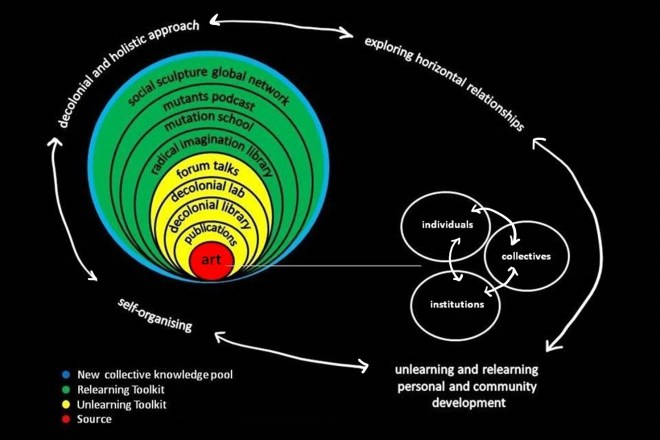
Counterspace This is a diagram on a black background. At its center is a red "art"—this is the starting point. Around it are layered sections (like rings) with things like publications, decolonial libraries, and forum talks. Arrows and text show: This project uses a "decolonial, holistic approach." It connects three groups—individuals, collectives, and institutions—through those layered sections. Its goals are to let the project organize itself, build equal "horizontal" relationships, and help people unlearn old ideas and relearn new ones. In the end, it aims to create a new shared knowledge pool.

Counterspace: Cultural Strategy by Cristina Morales, London, 2021

“Decoloniality” and “Intersectionality” are important tools for implementing ideas. Platforms, such as “Counterspace”, not only build a decolonisation toolkit and resource network, but also want to fundamentally change the power structure of the art world.

Based on these understandings, I also raised a question for further reflection. When to go to a settlement as the core concept of curatorial practice, such as “Documenta Fifteen”, into a large institutional framework, how can such “radical” ideas avoid being diluted by institutionalization? How can one effectively collaborate with mainstream art institutions to expand their influence without losing critical thinking?

In the afternoon group discussion, everyone shared their curatorial ideas. I also shared mine, although it’s still just an unfinished concept. I want to create a new style of exhibition viewing. My initial idea is to hold the exhibition outdoors, create a check-in map and distribute it to the audience, and connect multiple exhibition sites into a route. The audience can experience each recommended route one by one, just like completing a travel list, or they can design their own route. And finally reach the destination, connect the routes to complete your own storyline. This can enhance the audience’s sense of participation and autonomy, and at the same time guide them to think actively rather than passively accept preconceived viewpoints.

sunflower seeds This is a large-scale immersive art installation in the Turbine Hall of Tate Modern in London. The entire space is a towering, industrial-style building. The entire floor of the exhibition hall is covered with hundreds of millions of handcrafted porcelain sunflower seeds. A person wearing a blue and pink checkered sweater and white pants is lying spread-eagle on the seeds, and in the distance, two other people are sitting and relaxing on this surface.

Ai Weiwei, Sunflower Seeds, Tate Modern, London, 2010


Finally, when looking for an artist for the class discussion in week 3, I noticed that Ai Weiwei’s work “Sunflower Seeds“.This work, which was exhibited in theTurbine Hall of the Tate Modern in London in 2010, has greatly inspired me. It explores issues such as the individual and the collective, labor and power, with 100 million handcrafted ceramic sunflower seeds. The artist’s placement of the “sunflower”, a metaphor for the people in Chinese political propaganda, within the context of Western art galleries is itself a critical response to ethics and institutions, fully experiencing the profound thinking beneath the surface of the artwork.


Week 1-Break away from one-sided thinking when looking at problems.

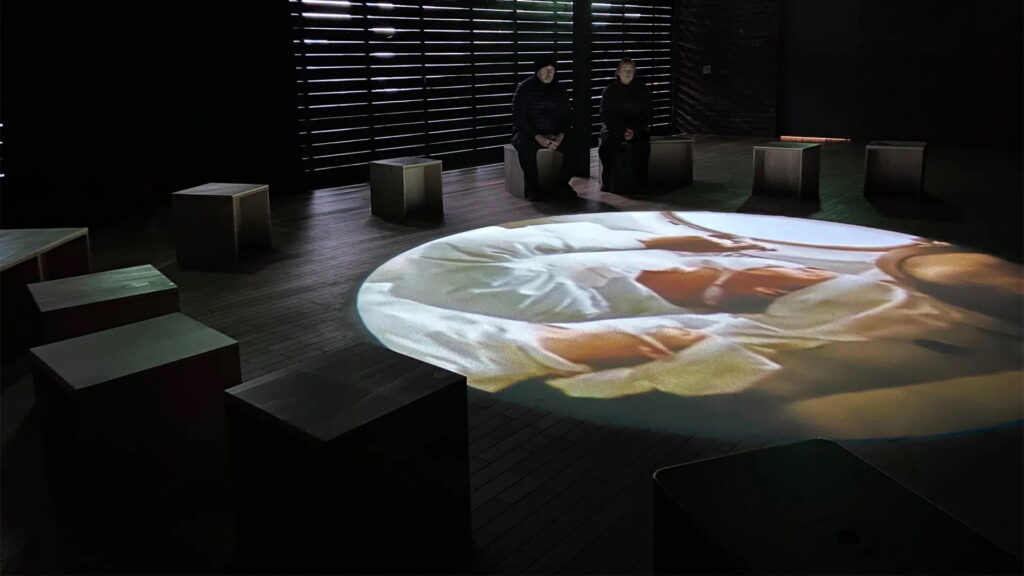
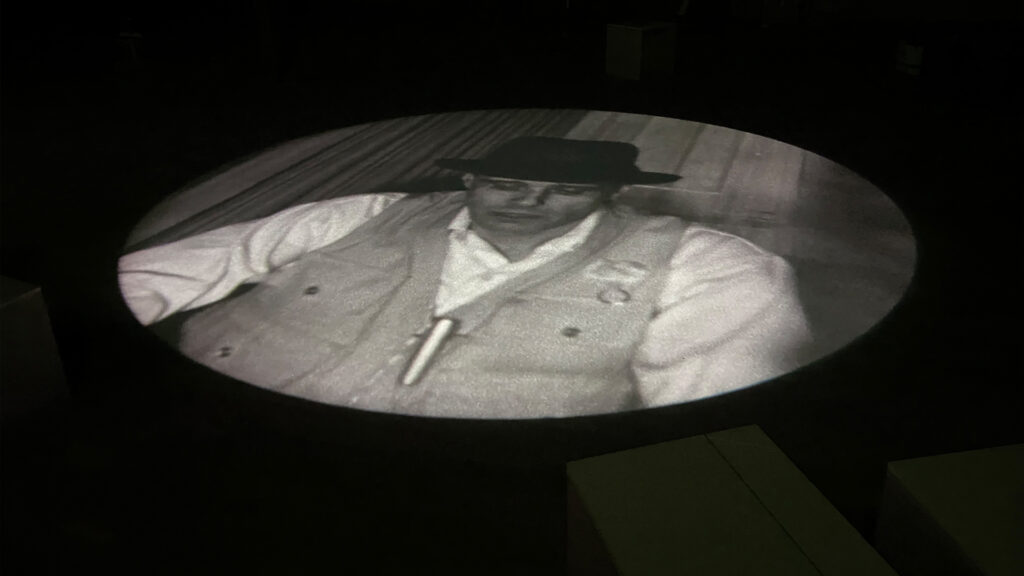
The film is projected onto the floor, featuring archival footage and drone shots that weave together historical fragments and nature-related scenes. Audience seats are arranged in a circular formation around the projection area. You can sit anywhere in the circle, facing the floor to focus on the visuals—like gazing through a "portal" in the ground into the world of the film, and immersively feeling the interplay of history and memory.

To understand issues, we must break free from a one-dimensional perspective.


When I was studying the course, I found that there were three terms that hindered my understanding: Anthropocene, Capitalocene, and The Billion Black Anthropocenes. After establishing a clear understanding, I connected the internal relationships among these three phrases, which form a progressively deepening internal logic.

The concept of the “Anthropocene” (Crutzen and Stoermer 2000) was introduced at the end of the 20th century, in the context of escalating global ecological crises, to address the core issue of who is shaping the future of the Earth. The ecological crisis was attributed to “the human race as a whole”.

 After 2010, with the questioning of the notion that “humans as a whole are guilty”, in 2014, the concept of “Capitalocene” (Moore 2014) was systematically expounded to explain “which human activities and what systems led to the crisis”, clearly identifying the institutional root of the ecological crisis.

 In 2018, people again proposed that the crisis should not be solely attributed to the economic dimension. It is also necessary to consider the relationship between capital accumulation and racial oppression. Subsequently, to clearly define that the crisis is a dual product of capital and racial oppression, the concept of “The Billion Black Anthropocenes” (Yusoff 2018) was proposed.

From “phenomenological description” to “institutional roots” and then to “justice dimension”, it delves deeper layer by layer. This realization led me to understand that for comprehending phenomena, it is necessary to break away from a single dimension.


The film is projected onto the floor, featuring archival footage and drone shots that weave together historical fragments and nature-related scenes. Audience seats are arranged in a circular formation around the projection area. You can sit anywhere in the circle, facing the floor to focus on the visuals—like gazing through a "portal" in the ground into the world of the film, and immersively feeling the interplay of history and memory.

Project Paradise, Edinburgh, 2023–2024

With this mindset, I analyzed the case of Sarah Wood’s “Project Paradise” mentioned in class.

 https://vimeo.com/893289187?fl=pl&fe=sh

I summarized this exhibition as “reconstruction of existing images + presentation from an all-seeing perspective”. The artist used existing images combined with drone perspectives to create a film, highlighting the integration of historical fragments and personal memories.

However, I identified two issues. Firstly, the exhibition failed to take into account the racial power dynamics emphasized by The Billion Black Anthropocenes, so the “Paradise” discussed in this context was not profound enough. Secondly, the selection of films in the exhibition was subjective and fragmented. It relied solely on fragmented archival image collation for narration, without questioning elements such as the filmmaker’s stance or the historical context of image production. These fragments were unable to interpret the complex connotations of “Paradise”, such as ecology, justice, and history.

The innovation and limitations of “Project Paradise” made me reflect: The charm of curating lies in awakening thoughts through unique forms, and depth stems from the respect for diverse perspectives and historical contexts.

Also, as the group discussion for the first week, everyone introduced themselves and their specialties. It was great to hear that the group members have specialties in installation, editing, communication and modeling. We are looking forward to working together in the future.


Reference


Crutzen, Paul J., and Eugene F. Stoermer. “The ‘Anthropocene’.” Global Change Newsletter 41 (2000): 17-18.


Zalasiewicz, Jan, et al. “Are We Now Living in the Anthropocene?” GSA Today 18, no. 2 (2008): 4-8.


Moore, Jason. “The Capitalocene Part I: Origins and Nature of Ecological Crisis.” 2014. Yusoff, Kathryn. Billion Black Anthropocenes.


 Minneapolis: University of Minnesota Press, 2018. Fruitmarket Gallery. “Sarah Wood: Project Paradise.” Edinburgh, December 9, 2023-January 21, 2024. https://www.fruitmarket.co.uk/archive/sarah-wood-project-paradise/.