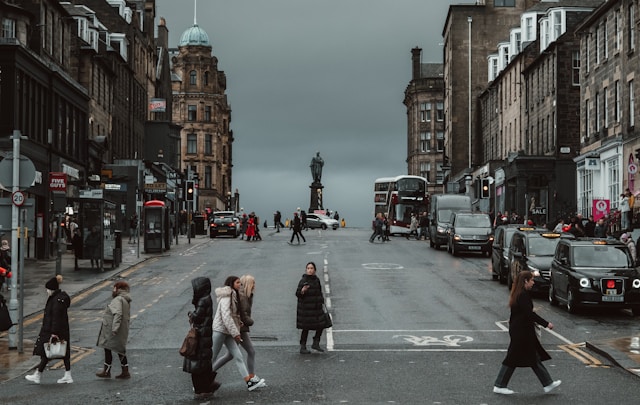


This week I carried out a site visit of the full route and reconsidered the structure. Although the six-site model had already been designed to move away from the control of a single path, in curatorial terms it still depended on the assumption that viewers would be able to complete all the sites in sequence. A viewing process of more than four hours made two issues very clear: the route was too long, and the structure still relied too much on the logic of “complete viewing”.
I therefore had to reposition the role of the full route within the project. My decision was to treat it only as the most intensive mode of entry, while also introducing shorter route combinations and fragmented entry. This would allow viewers to enter through the map, choose their own path, and decide how long to stay. The deeper purpose of this change was to make the viewing structure more consistent with the real use of urban space. Entry is often incomplete, pauses are often accidental, and movement is shaped by time, stamina, interest, and transport. Non-linearity therefore became an explicit methodological judgement: the viewer’s own choice is itself part of the argument of the project.
This also led me to rethink the issue of guidance. The project cannot simply leave viewers to explore at random, otherwise the critical framework becomes too weak. But it also cannot tightly direct every step, otherwise it repeats the very spatial management logic it seeks to question. I therefore began to move towards a structure that is partly guided and partly open. Key sites provide prompts and frameworks, while other parts leave room for viewers to connect experiences themselves. In this model, walking matters because it organises perception and allows judgement to emerge through movement. The route is no longer a simple tool linking sites, but one of the project’s actual curatorial structures.
This week I also clarified my thinking on publics. What matters more in the project is not which fixed identity category a viewer belongs to, but how they enter the route, how long they stay, how quickly they move, and whether they can bring the dispersed site experiences into some kind of coherent understanding. Publics therefore no longer appear as a pre-existing whole, but as positions formed through the interweaving of viewing, entry, and judgement. This gives the non-linear structure a clearer methodological meaning: it responds not only to social identity difference, but also to how time, mobility, and modes of spatial use shape the conditions under which publics enter the work.
References
Brauner, Maren, and Irene Grillo. “Walking as a Form of Critical Curating.” OnCurating, no. 8. Accessed April 16, 2026. https://www.on-curating.org/issue-8-reader/walking-as-a-form-of-critical-curating-1132.html.
Le Lieu, centre en art actuel. Manœuvres – Le Lieu, centre en art actuel. Edited by Richard Martel. Dijon: Les presses du réel, 1992. Overview accessed April 16, 2026. https://www.lespressesdureel.com/EN/ouvrage.php?id=2298&menu=0.
Lippard, Lucy R. The Lure of the Local: Senses of Place in a Multicentered Society. New York: New Press, 1997.
VisitScotland. “Edinburgh and the Lothians.” Accessed April 16, 2026. https://www.visitscotland.org/research-insights/regions/edinburgh-lothians.