Ten years ago, I moved on from my job as a lecturer at the University of the West of Scotland (UWS), where I had worked with Jo for five years in my first academic post. During my time there, I met Sandro – another early career lecturer – who had just moved from his home in São Paulo to the town of Hamilton to the south of Glasgow, where the university has a campus. While I worked in Ayr, our paths crossed several times and we found a shared interest in the performance of place, and embodied learning experiences. Sandro was part of a festival I worked on at the Arches arts centre, and he even saw one of my plays at Glasgow’s lunchtime theatre, A Play, a Pie and a Pint. I left UWS for a new post at Royal Holloway in 2016 and we didn’t stay in touch.
A decade later, Sandro – now a Professor of Tourism and Leisure Studies at UWS – was driving through Lenzie, where he lives with his family, and noticed me walking up Kirkintilloch Road. Shortly afterwards, he was chatting to one of the other parents at his son’s school. Knowing that she also worked in theatre, he mentioned this sighting, in case she happened to know me. This was my next door neighbour, Nalini, who was the first person I walked with for this project. Nalini confirmed that I was now living here too, and told Sandro about my walking project. So he got in touch and here we are meeting again after all these years, ready to walk round the Moss.
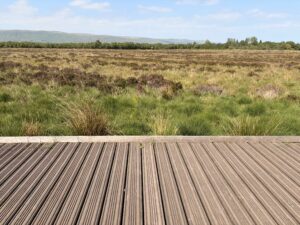
We catch up on major life events as the deer accompany us up Bea’s Path – they are enjoying the sunshine as much as we are. Sandro says this is only the second time he has seen them here. Sandro moved to Lenzie in 2017 between having his first and second child. His youngest is the same age as Ruairidh, having been born in the early weeks of the first COVID-19 lockdown. He is in the same class as both my next door and upstairs neighbours and will soon be attending a birthday party in the garden adjoining mine. The family began visiting the Moss quite regularly during the lockdown, as did many who I have walked with here. Their eldest learnt to ride her bike here – gathering speed and confidence along the boardwalk. Soon after lockdown, that part of the Moss was closed for a long time while maintenance work took place, and as they couldn’t walk round the site, and lockdown restrictions eased, the habit fell away. Since those years, Sandro hasn’t been here much, so he is pleased to have the excuse to return today.
I tell Sandro that over the course of this project so far, I have walked with a disproportionate number of academics: from professors and lecturers to postgraduate students. There are a few reasons for this: these are the people I see every day at work and who are more likely to know about this project; researchers have time to take part in unusual walking projects like this; and as an affluent town with good transport links to the university towns, there are a lot of educated folk living round here. I confess to being a bit uneasy about the ratio, but as I have also walked with plenty of people from different backgrounds and professions, I hope I am gathering enough diverse perspectives on this place, even if my ‘sample group’ is a bit imbalanced.
Sandro tells me a story about another academic and another restriction of access. A couple of years ago, several roads were closed near his home. Little information was shared by the authorities, but there was talk of hazardous substances at a private property. Speculation among the community was that this was the home of a professor of chemistry, who had lived alone and recently died. When his vacated house was valued for the market, an elaborate laboratory was discovered, full of potentially dangerous chemicals. Explosive Ordnance Disposal officers and police were in the area for the day, and the roads were opened again several hours later.
Now that roads and boardwalks are open, and the negative experiences of the lockdown have faded in memory, Sandro is happy to be walking here again. We sit on a bench and look out across the bog to the hills beyond. We discuss how this place is experienced and understood differently by all the people I have walked with and how – regardless of how academic these perspectives might be – the Moss is created and performed through the relationships between them. Sandro has experience in bringing diverse voices into a dialogue about place through his work in tourism.
Sandro’s research concerns the inequalities and injustices that can be created and exacerbated through the tourist industry. He talks about the commercialisation of leisure and the way that time becomes capitalised. While he and his family recently enjoyed a trip to Disneyland, where I also had a wonderful day with Iona back in September, we discuss these hyper commercial places as the antithesis of Lenzie Moss. For Sandro, places like this are vitally important – places that we can come to for connections to nature, relaxation and exercise that are not wholly determined by the commercial systems and structures that define so much of our everyday leisure.
Beyond the university, Sandro has chaired the Renfrewshire Tourism Leadership Group. Working in a wide geographical area with many competing interests and some big players like Glasgow International Airport and Braehead Shopping Centre, the group have ensured that members of the community have a voice, and that the natural environment is considered alongside transport and retail opportunities. The RSPB’s Lochwinnoch Nature Reserve and Castle Semple Loch are important wetland habitats that balance the heavily industrialised side of the council area. As tourists fly into Scotland and locals visit for shopping and entertainment, many others are drawn to the rich birdlife and beautiful landscapes of the parks. Sandro’s group has brought many stakeholders together to deliver Renfrewshire’s tourism plan. I remember my walk with Stewart, when he talked about the value of coordinated approaches to site management, and I wonder whether East Dunbartonshire has an equivalent project that includes Lenzie Moss.
As we complete our circle, it is clear that 60 minutes walking round the Moss is nowhere near enough time to bring each other up to speed on everything that has happened since we last met. So we switch modes and head to Billington’s for a beer, and Sandro also treats himself to an ice-cream. One of the things that I hoped would come from this project is a greater connection to the Lenzie community. I am delighted that my research project has helped me connect with Sandro again. As we chat away in the cafe, I am thankful for the opportunity to spend my leisure time in this way too.