Eli Ferrell
In order to engage with AI as someone immersed in the humanities, the current media landscape asks you to take a stand: What do you believe AI should do? What do you believe AI can’t do? What is your ethical position on the use of AI?
There are many criticisms of the use of AI in humanities spaces. Many center on the idea that AI is ‘bad at writing’ (Jones 41). Anecdotally, that is not always true; just look at how much money can be made by prompting AI romance novels: even if the writing is bad, the readers don’t seem to mind. The question of whether a piece of literature is good or bad is subjective and could result in any kaleidoscope of answers depending on the person. However, even if the idea that AI is ‘bad at writing’ were a true criticism, it is a soon-to-be outdated one. As AI evolves, it will also become better able to emulate human-written literature (Bassett 23). That means that as time goes on, AI-generated literature will become more compelling.
Maybe evolution isn’t necessary; maybe AI has already succeeded at generating literature that is just as compelling as human-written literature. There is a substantial amount of research proving that humans struggle to identify AI materials. Frank et al. illustrate that artificially generated samples of images and text are functionally indistinguishable from media that are not AI-generated (Frank et al. 6). Even people who have been told that their task is to identify AI materials, and therefore are actively looking out for it, struggle to identify AI-generated materials at a rate higher than chance (Cheng et al. 4). This means that the average internet user is often unable to identify AI-generated materials and likely engages with them as though they depict reality.
Reliance on AI has negative impacts on human thinking. For example, AI reliance can result in humans making actively harmful decisions based on AI advice even when they’re familiar with why they shouldn’t make that decision (Klingbeil et al. 7). AI users just don’t think critically enough and instead default to the AI having the right answers even when they know that it doesn’t. However, the logic for how an internet user who is frequently exposed to AI materials online might become reliant on AI tools is perfectly clear: if no one can tell the difference between a presentation created with AI and a presentation created by a human, AI seems like a great labor replacement tool (Mun et al. 1778). Once you know how helpful AI is in your work life, you begin to outsource more and more life decisions to AI. When AI is making your daily life easier by reducing the number of decisions you have to make, it’s hard to stop using it.
Critical engagement does help prevent AI users from falling into the pit of AI reliance (Wang and Fan 17). The challenge is then in determining how you can persuade AI users to engage critically in the first place. Even methods that seem useful in helping online users determine what they should trust in the digital space are often ineffective. For example, labeling content as AI-generated fails to change its persuasiveness (Gallegos et al. 3). That means that internet users can look at an image, know that it is AI-generated because it’s been visibly watermarked as such, and still be persuaded by the message the AI image is trying to convey.
There have been some successful campaigns encouraging people to engage more critically with online material. It seems the solution lies in interactive simulations that illustrate that AI-generated material is risky and hard to identify, but allows readers to come to that conclusion on their own (Zhao et al. 71). This methodology is better at creating readers who think carefully about information that is being presented as fact.
Still, critical engagement with AI is not enough. Thinking critically increases the cognitive load of engaging with AI materials and tools. This increased cognitive load causes fatigue. Increased fatigue causes less critical engagement with AI tools, which then results in the harmful AI reliance that had been originally staved off by critical engagement (Wang and Fan 18). In order to prevent this fatigue cycle, there needs to be some spaces in which people don’t resort to AI use at all. People need to understand exactly what AI can and cannot do.
This is where a more nuanced criticism of AI becomes valuable. The problem with AI-generated creative writing and poetry is not that it is ‘bad writing,’ because that skill can and does improve between successive models. Instead, the problem is AI’s inability to write literature grounded in time and space. Writers write from a bank of life experience. AI does not have life experience, and so its inspiration is always weaker. That’s not to say that AI poetry itself is always less compelling than human poetry; it is a claim that the inspiration behind an AI-generated piece is always hollow. Even hallucinated AI experiences do not weave together to tell the story of an author’s life, and it is that story that brings poetry to life.
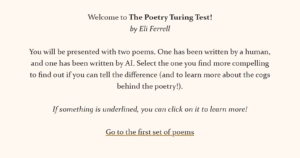
Therefore, ‘The Poetry Turing Test’ uses a variety of models, as recommended in feedback, to illustrate exactly what AI cannot do. ‘The Poetry Turing Test’ asks readers to choose between two pieces. Perhaps you will find the AI piece more compelling at first, but clicking on the AI piece will leave you with very few paths of inspiration to explore. When there are links that take you off the page, they lead to human work and human experiences, because that is the most compelling backdrop to literature. If you begin your journey by clicking on a human-written piece, however, you are offered a near-endless set of pathways and annotations that help you understand the piece on a deeper level. This contrast illustrates precisely where the shortfalls are in AI poetry: not in the product, but in what comes before.
Bibliography
Bassett, Caroline. ‘The Author, Poor Bastard.’ The Routledge Handbook of AI and Literature, edited by Will Slocombe and Genevieve Liveley, Routledge, 2024, pp. 19–26, https://doi.org/10.4324/9781003255789.
Cheng, Adam, et al. ‘Ability of AI Detection Tools and Humans to Accurately Identify Different Forms of AI-Generated Written Content.’ Advances in Simulation, vol. 10, no. 1, Nov. 2025. Springer Link, https://doi.org/10.1186/s41077-025-00396-6.
Frank, Joel, et al. ‘A Representative Study on Human Detection of Artificially Generated Media Across Countries.’ [San Francisco, California], 2023, 2024 IEEE Symposium on Security and Privacy. arXiv.org, https://doi.org/10.48550/arXiv.2312.05976.
Gallegos, Isabel O., et al. ‘Labeling Messages as AI-Generated Does Not Reduce Their Persuasive Effects.’ PNAS Nexus, vol. 5, no. 2, Feb. 2026. Silverchair, https://doi.org/10.1093/pnasnexus/pgag008.
Jones, Nathan. ‘Experiential Literature? Comparing the Work of AI and Human Authors.’ APRIA Journal, vol. 5, no. 5, Dec. 2022, pp. 41–57. IngentaConnect, https://doi.org/10.37198/APRIA.04.05.a5.
Klingbeil, Artur, et al. ‘Trust and Reliance on AI — An Experimental Study on the Extent and Costs of Overreliance on AI.’ Computers in Human Behavior, vol. 160, Nov. 2024, p. 108352. ScienceDirect, https://doi.org/10.1016/j.chb.2024.108352.
Mun, Jimin, et al. ‘Why (Not) Use AI? Analyzing People’s Reasoning and Conditions for AI Acceptability.’ Proceedings of the Eighth AAAI/ACM Conference on AI, Ethics, and Society [Washington, D.C.], vol. 8, no. 2, 2025, pp. 71–84, https://doi.org/10.1609/aies.v8i2.36673.
Wang, Jin, and Wenxiang Fan. ‘The Effect of ChatGPT on Students’ Learning Performance, Learning Perception, and Higher-Order Thinking: Insights from a Meta-Analysis.’ Humanities and Social Sciences Communications, vol. 12, no. 1, May 2025, p. 621. www.nature.com, https://doi.org/10.1057/s41599-025-04787-y.
Zhao, Yiling, et al. ‘Thinking Like a Scientist: Can Interactive Simulations Foster Critical AI Literacy?’ Artificial Intelligence in Education, edited by Alexandra I. Cristea et al., Springer Nature Switzerland, 2025, pp. 60–74. Springer Link, https://doi.org/10.1007/978-3-031-98417-4_5.
Cite this page:
Ferrell, Eli. 'The Poetry Turing Test'. Cream of the Slop. version 1.0, Digital Humanities for Literary Studies 2025-26, University of Edinburgh, 10 Apr. 2026, https://blogs.ed.ac.uk/dh2025-26/
