Eilidh Armstrong
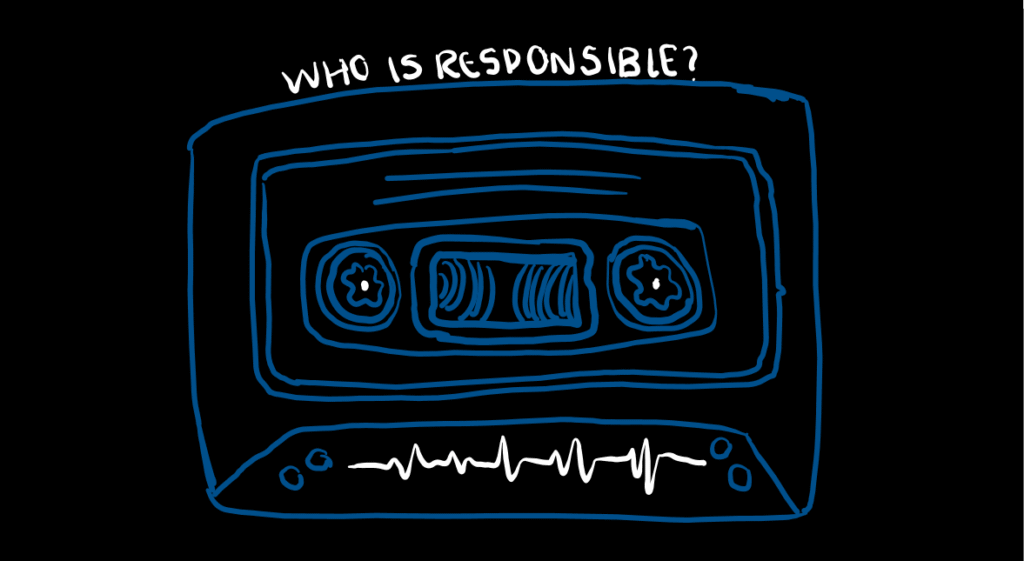
‘Who is Responsible?‘ is a fictional detective podcast which stages a critical comparison between Roland Barthes’ 1967 essay ‘The Death of the Author’ and the operation of generative Artificial Intelligence, asking to what extent Large Language Models (LLMs) collapse the relationship between meaning and responsibility in literary interpretation (Barthes).
When it comes to a text’s meaning, Barthes famously denies the notion of total authorial originality, arguing instead that meaning is understood as a recombination of historical and cultural influences, which are interpreted differently between individuals (Barthes 144).
When turning to Large Language Models, the role of the ‘author’ is ‘not singular, but rather distributed among a network of agents’, comprising programmers, prompt providers etc., who contribute to its creation (Shearing). Compared to Barthes, this results in a similar distribution of intention, in which authorship is no longer associated with a singular entity. The issue, then, is not the killing of the author figure but rather the killing of the alchemy of personal history, culture and influence which Barthes relies on for meaning. This distinction is crucial; where human writing is shaped by embodied experience and historical context, LLMs produce text ‘by statistically reproducing patterns they have encountered during training,’ and thus meaning results from the interactions between the model’s programming and the algorithms that determine the likelihood of a response (Poibeau 65).
Yet for Barthes, meaning must remain inherently human. As Joanna Bryson points out, we have simply found a way to ‘transfer and represent what’s already been computed by our culture’ into digital ones and zeros (Bryson).
Furthermore, the implications of these questions of authorship extend towards poststructuralist issues of responsibility and accountability. Michel Foucault’s concept of the ‘author-function’ frames the author as a necessary role that is constructed through discourse (124). Crucially, he links this function to systems of accountability, observing that texts became attributed to identifiable authors when their discourse was subject to regulation ‘to the extent that [the authors] discourse was considered transgressive'(Foucault 124). In this sense, he argues that authorship should be inseparable from responsibility.
However, when a text generated by AI spreads bias or misinformation, it becomes difficult to pinpoint exactly who is responsible for its content. The coder? The prompter? The thousands of authors in the training data?
For Barthes, because authority is displaced from the author to the reader, he argues that ‘the responsibility for a narrative is never assumed by a person but by a mediator’, thereby relocating responsibility from an individual to the broader processes of language and culture (Barthes 141). Barthes’ idea here is extended to the Digital Humanities by Johanna Drucker, who contends that ‘interpretation is performative, not mechanistic,’ and that texts are ‘encoded provocations for reading’ which are continually reconstituted through acts of interpretation (Drucker).
In the context of generative AI, this model of performative interpretation becomes increasingly problematic, as texts produced without intention still invite interpretative engagement, leading readers to construct meaning in the absence of any accountable agent.
This issue is reflected in empirical studies of AI bias discussed by Karen Hao, where both language and image-generation systems have reproduced racial and sexist stereotypes without explicit instruction, such as disproportionately sexualising images of women and associating them with traditionally gendered roles (Hao). While such outputs appear meaningful, albeit negative, they are actually generated through statistical pattern recognition as opposed to intention, drawing on datasets shaped by existing biases, misinformation, and cultural assumptions we have produced as humans.
As noted in ‘Do We Collaborate With What We Design’, these systems are ‘theologically aimless’ (Evans et al. 396); they lack the principal agency required to be a stakeholder in the discourse they produce. While we might sometimes anthropomorphise AI as a collaborator in our research or discourse, it fundamentally remains a ‘subsidiary agent’, and yet it’s outputs that are ‘exotic to human cognition’ (Evans et al. 393). The issue with responsibility here is that these systems produce meaning-like structures which receive interpretation and discourse, yet lack a coherent source of responsibility.
Consequently, the author-function that Foucault describes as necessary is entirely dissolved; instead, we have created a transgressive force that remains morally untouchable, and leaves the reader to navigate the responsibility of a text in which any perceived meaning was never intended.
This is the underlying concern of my project: if interpretation and responsibility are displaced entirely from human intention, then with the death of the human author comes with the death of the human reader.
The purpose of using an audio-only medium was to foreground a tension between digital and non-digital modes of knowledge production. Turning to Tanya E. Clement, her distinction between text mining and sound mining emphasises the importance of what she characterises as ‘an aporetic mode of analysis’, specifically in relation to sound (Clement). In this sense, the project’s use of audio reflects Clement’s emphasis on interpretive engagement in sound analysis, which in turn dramatises Roland Barthes’ own insistence on reader interpretation.
Meanwhile, the project incorporates analogue aesthetics to replicate the audio distortion of a tape recorder, specifically by using appropriate sound effects and modifying the equaliser settings through Audacity. This stylistic choice reflects a broader concern within Digital Humanities; that is, the risk of over-reliance on computational systems at the expense of human interpretive practices (Prose). In this way, the project seeks to balance creative experimentation with critical engagement, situating itself at the intersection of literary theory and digital humanities scholarship.
Despite this, however, user feedback on this project emphasised that the balance between creative and critical engagement would be strengthened by offering listeners verbal citations of the sources mentioned. Furthermore, having a clear distinction between my own words and any direct quotations would offer listeners similar critical clarity. In response, I made sure to directly reference titles and authors, and clearly distinguish quotations by lowering the pitch of my recording. Additionally, I created a downloadable script within which I could directly reference my sources, as well as offer an alternative medium to increase the accessibility of my project.
Ultimately, this project argues that generative AI does not simply extend poststructuralist thought, as understood by Barthes and Foucault, but exposes its limitations by introducing a crisis of responsibility and meaning that these earlier theories were not yet equipped to address. Thus, the goal of the podcast is to clearly lead readers to believe in the guilt of Artificial Intelligence for ‘killing’ the author, and to connect the narrative to the real-life implications that generative AI has on authorship, interpretation, and responsibility.
Bibliography
Barthes, Roland. ‘The Death of the Author.’ Readings in the Theory of Religion: Map, Text, Body, edited by Scott S. Elliott and Matt Waggoner, 1st ed., Routledge, 2009, pp. 141–45.
Bryson, Joanna. ‘Three very different sources of bias in AI, and how to fix them.’ Adventures in NI, 2017, https://joanna-bryson.blogspot.com/2017/07/three-very-different-sources-of-bias-in.html.
Clement, Tanya E. ‘The Ground Truth of DH Text Mining.’ Debates in the Digital Humanities, edited by Matthew Gold and Lauren Klein, University of Minnesota Press, 2016, https://dhdebates.gc.cuny.edu/read/untitled/section/ef78ddc7-4087- 4bb3-b192-16724631a172.
Drucker, Johanna. ‘Humanistic Theory and Digital Scholarship.’ Debates in the Digital Humanities, edited by Matthew K. Gold, University of Minnesota Press, 2012, https://dhdebates.gc.cuny.edu/read/untitled-88c11800-9446-469b-a3be-3fdb36bfbd1e/section/0b495250-97af-4046-91ff-98b6ea9f83c0#ch06.
Evans, Katie D, et al. ‘Do We Collaborate With What We Design?.’ Topics in Cognitive Science. Wiley, 2023, pp. 392-411. https://doi.org/10.1111/tops.12682.
Foucault, Michel. ‘What is an Author?’ Language, Counter-Memory, Practice: Selected Essays and Interviews, edited by Donald F Bouchard, Cornell University Press, 2021, pp. 113–38.
Hao, Karen. ‘An AI Saw a Cropped Photo of AOC. It Autocompleted Her Wearing a Bikini.’ MIT Technology Review, 29 Jan. 2021, https://www.technologyreview.com/2021/01/29/1017065/ai-image-generation-is-racist-sexist/.
Poibeau, Thierry. ‘Large Language Models and the Future of Writing.’ Understanding Conversational AI: Philosophy, Ethics, and Social Impact of Large Language Models, Ubiquity Press, 2025, pp. 65–82. JSTOR, http://www.jstor.org/stable/jj.37105684.7.
Prose, Francine. ‘They’re Watching You Read’. The New York Review, 13 January 2015. https://www.nybooks.com/online/2015/01/13/reading-whos-watching/.
Shearing, Matt. ‘Death of the Author in the Age of AI’. Matthew Shearing designs, 22 March 2023. https://matthewshearing.com/blog/the-death-of-the-author-in-the-age-of-ai.
Cite this page:
Armstrong, Eilidh. 'Who is Responsible?'. Cream of the Slop. version 1.0, Digital Humanities for Literary Studies 2025-26, University of Edinburgh, 10 Apr. 2026, https://blogs.ed.ac.uk/dh2025-26/.
