Week 7 Updating my curatorial project
🧱Idea for the Exhibition Wall
Following last week’s feedback, I began to reflect on the practical challenges in my curatorial proposal. One key piece of feedback was that my idea of a circular exhibition layout was interesting but may be too ambitious, especially because it would require constructing custom-built round walls, which could be physically not feasible, or too pricy to build.
In response, I remembered that exhibition I’d once visited earlier this year at Tramway, •~TUA~• 大眼 •~MAK~• by Rae-Yen Song, which gave me some inspirations. In this exhibition, there was a passage-like structure made of fabric material, which guided visitors through a space that felt like moving inside a creature’s body. The material was soft, yet it still created a clear spatial experience and directed movement, and most importantly——such material is very easy to shape.
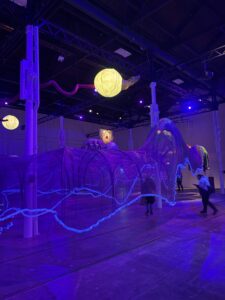
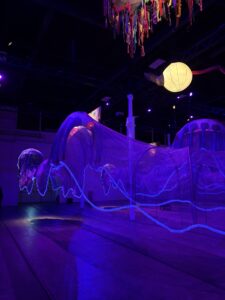
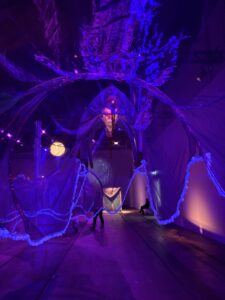
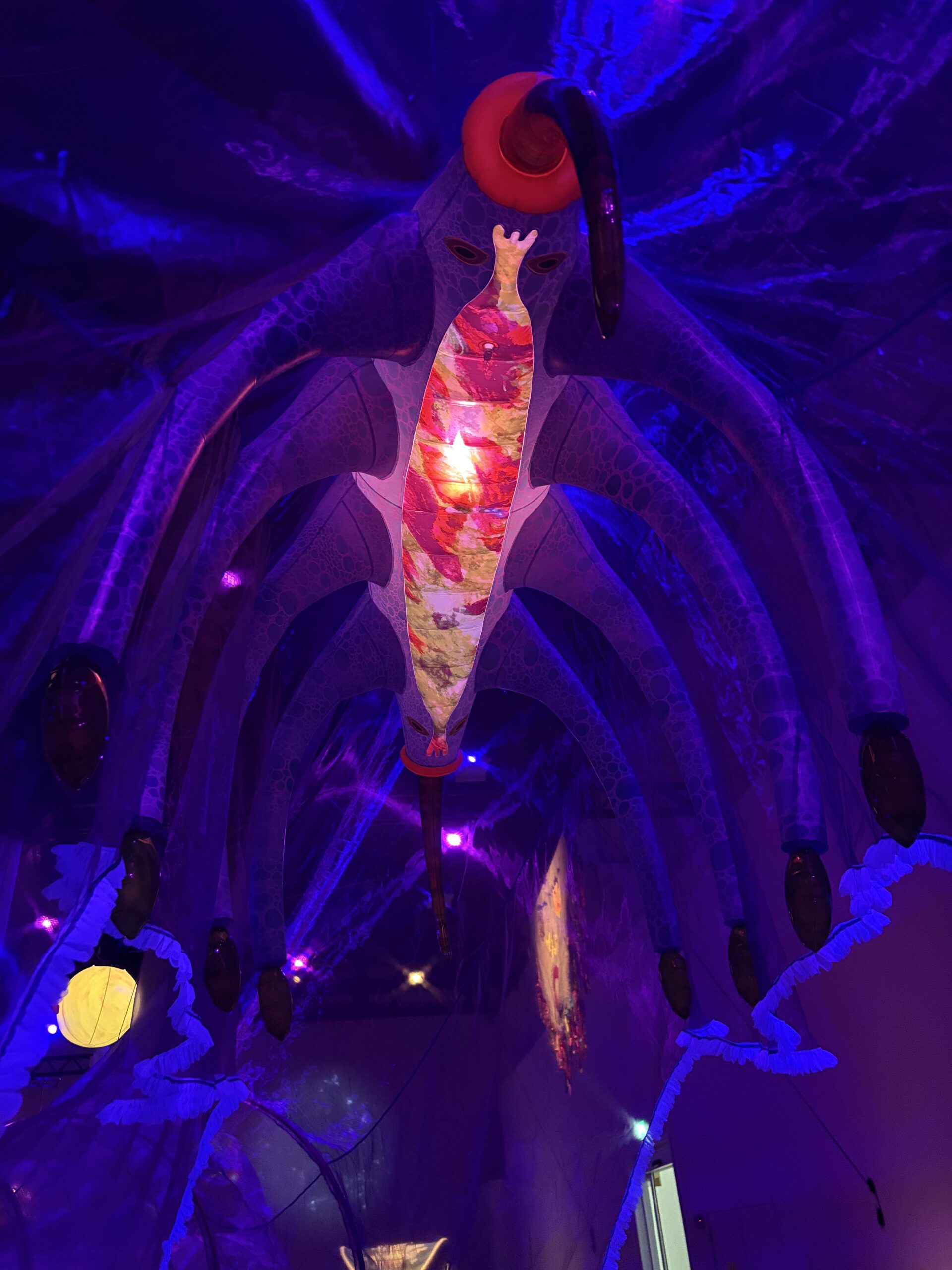
(Rae-Yen Song, •~TUA~• 大眼 •~MAK~•, installation views at Tramway, Glasgow. Photographs by Xiaobao Ye, 2025)
🧣Curtain as Wall
This led me to further research spatial design using fabric. In the project Gallery of Furniture by CHYBIK + KRISTOF, circular cutouts are defined by full-height textile curtains, which can be either closed or left open. As the designers describe, the space functions as a gallery that can be easily adjusted according to different needs.
This example is particularly relevant to my project, as it shows how curtains can be used to construct circular spatial divisions without relying on fixed walls. More importantly, the ability to open and close the curtains introduces flexibility into the exhibition layout, allowing the space to shift between enclosure and openness. This made me realise that using fabric not only solves practical constraints, but also enables a more adaptable and fluid spatial structure, which aligns closely with my idea of a circular and continuous movement.
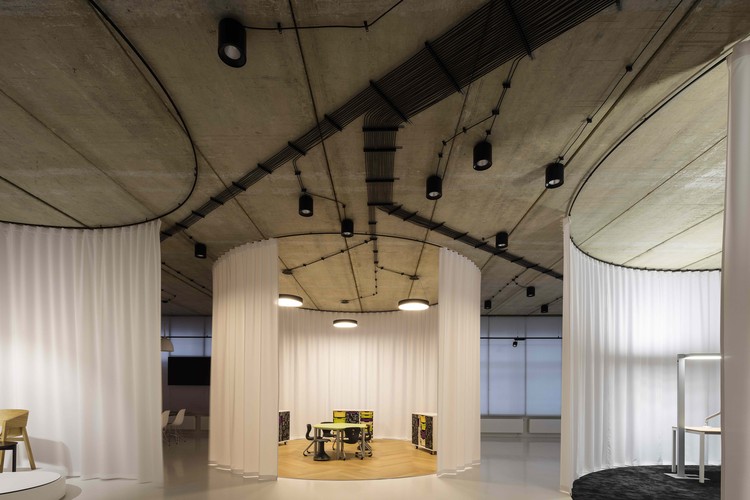
(Curtains used as spatial dividers in architectural design. Source: ArchDaily, 2020)
Also, in the exhibition Behind the Curtain at the Groninger Museum, large curtains are used to replace traditional walls, partially concealing the works and structuring the space. Rather than seeing everything at once, visitors are encouraged to move through and around the curtains to access the exhibition.
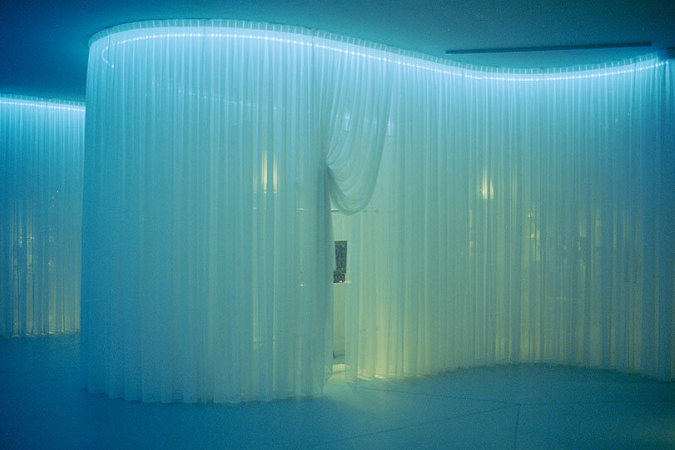
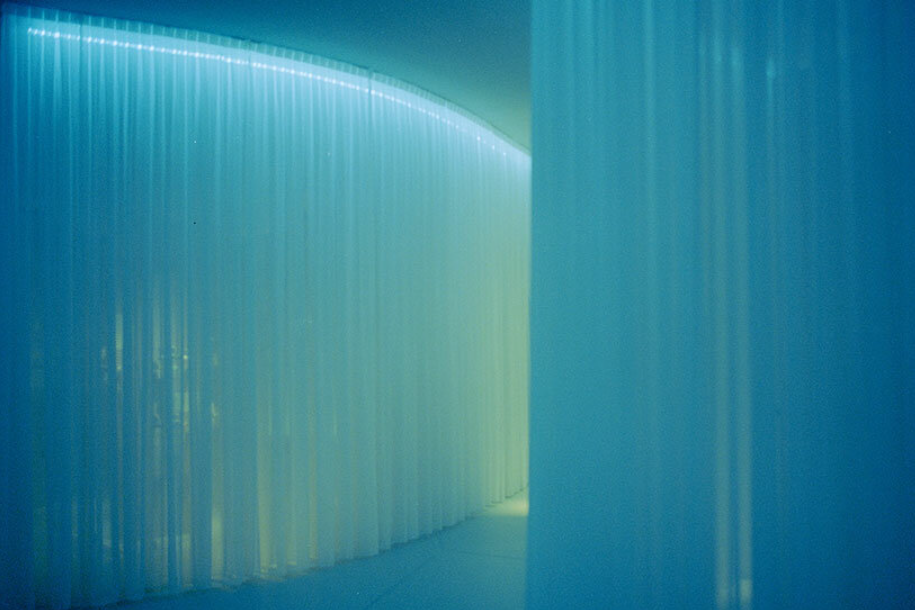
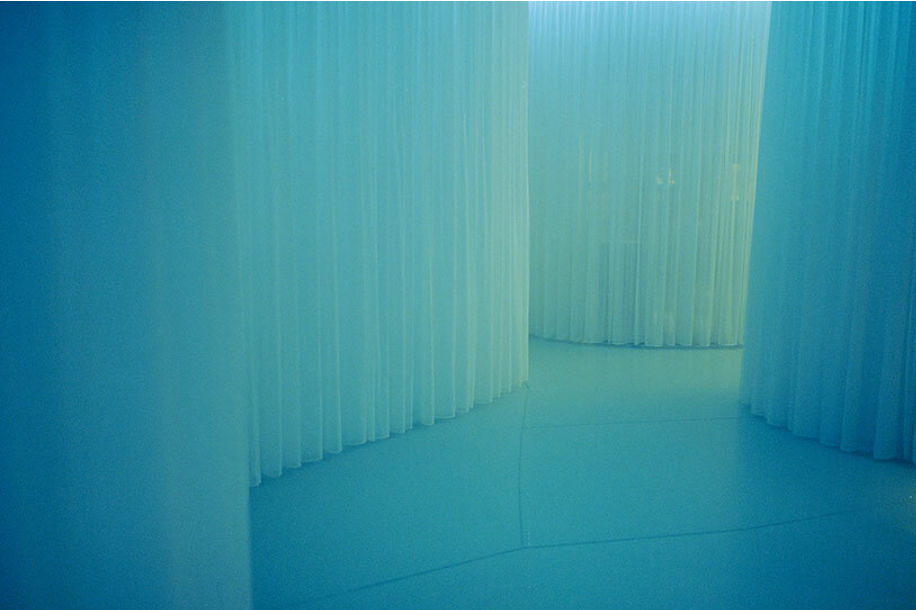
(David Altrath, Curtains, installation view at Groningen Museum. Source: Designboom, 2024)
This approach creates a more fluid circulation, as movement becomes a natural way of navigating the space. It also showed me that using fabric as a spatial device can guide visitors more smoothly, while being easier to install and shape according to the needs of the exhibition, which I plan to apply to my own circular layout.
Reference
https://www.archdaily.com/936540/curtains-as-room-dividers-towards-a-fluid-and-adaptable-architecture/
.https://www.designboom.com/art/curtains-david-altrath-blue-hued-atmosphere-groningen-museum-exhibition-03-14-2024/
.