In terms of the blog’s overall structure and content, the post titles and text layout are clear, allowing readers to immediately understand the weekly theme. Each weekly post is well-structured with coherent content. Starting from the first week, the author explored the relationship between exhibition structure and power. The structure of the posts progresses from theory to exhibition-viewing experiences and then to personal curatorial content. The transitions between paragraphs are smooth, presenting a progressive “theory—case study—practice” structure. By adjusting their research direction based on weekly coursework and insights gained from visiting exhibitions, the blog demonstrates strong structural organization and academic rigor.The author exhibits a strong critical thinking. The content reflects curatorial thinking rather than theoretical summaries, effectively utilizing relevant theories to support their arguments. In the following weeks’ blog entries, she combines theoretical reading with personal exhibition experiences. This approach connects theory with practice, making abstract concepts tangible.
In terms of exhibition viewing practice, the author is not only able to refer to the course reading materials, but also can transform the exhibition curation theory into practical curation through on-site exhibition viewing experiences. During the exhibition viewing at Talbot Rice Gallery, the author described the spatial atmosphere of the exhibition in detail, and cited multiple cases to enhance the multi-dimensional argumentation. During the exhibition viewing at SummerHall, the author introduced the exhibition halls and works, wrote down the parts that impressed she the most and linked them to her own curation content. Through the exhibition viewing experience at Fruitmarket in the seventh and eleventh weeks, the author realized that the placement of screens, the distance between the audience and the images would affect the way of perceiving the works. Moreover, she analyzed the installation method of “small screen + tripod + headphones”, focusing on the viewing distance, spatial flow, and audience rhythm, confirming Brian O’Doherty’s viewpoint in “Inside the White Cube” that the exhibition space itself is an ideological device (O’doherty, 1999), and borrowing it into her own curation content. In the eleventh week, through Halperin’s exhibition, the author associated it with the role and importance of her seminar and reading area, demonstrating her ability to refine the curation consciousness and strong practical sensitivity.
In terms of individual curatorial proposals and collective practices, the author has demonstrated strong curatorial thinking and practical abilities. The core issue of the author’s individual curatorial content is clearly defined: “How is artistic value produced rather than existing inherently (Bourdieu, 1993).” She provides information on the relevant works, and has comprehensively considered the selection of exhibition venue space, layout, lighting design, curatorial budget, and also reflects on her own curatorial-related issues, demonstrating strong professionalism and project feasibility. In the collective practice section, the author actively participate in the determination of exhibition topics, the selection of works, on-site spatial measurement and SketchUp modeling, and can effectively integrate personal ideas and practical skills into collective collaboration, demonstrating strong curatorial practical abilities.
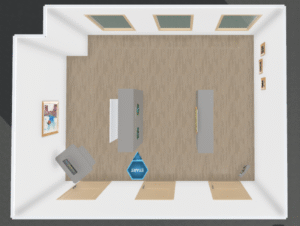
Fig 1 :A top-down view of the 3D exhibition model Nan created for a group curatorial project
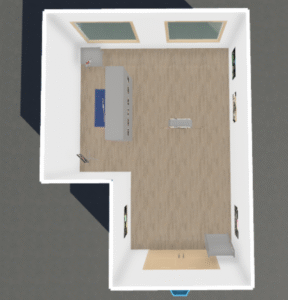
Fig 2 :Top view of the 3D exhibition model for Nan’s SICP personal curation
The blog still has some areas that can be improved: In terms of theoretical application: The theories cited are more inclined towards general integration and lack critical intervention. For example, when discussing “artistic value construction”, by comparing and analyzing different theoretical positions, the depth of the theoretical argument can be enhanced; In terms of image insertion: Descriptions of image-related information can be added at the bottom of the images, enabling readers to clearly know the content information of the images when reading; In terms of exhibition record: The description of the works themselves is more than the analysis, which can enhance the analysis and reflection on the exhibition curatorial strategy; Finally, in terms of individual and collective curating: In individual curating, in addition to the setting of reading areas and writing seminars, workshops for interaction between artists and audiences can be added to enhance the interactivity with the audience, “encouraging the audience to transform from passive art recipients to more active participants, directly participating in artistic creation (O’Neill, 2016).” For collective curating, the critical reflection and gains during the collective collaboration process can be described more, and the depth of understanding the collective curating structure can be enhanced.
The author’s blog demonstrates a solid theoretical foundation, a clear sense of inquiry, and strong practical skills. She is able to translate theoretical concepts from course readings into a clear sense of inquiry and use case studies to construct a coherent logical chain. Each week, she consciously develops her personal curatorial interests, ensuring that her curatorial work progresses and gains insights. There is a strong coherence between the weekly coursework, her exhibition experiences, and the development of her SICP. Her blog content is invaluable for me to learn, I have gained a lot and received many inspirations.
References:
O’doherty, Brian. Inside the white cube: The ideology of the gallery space. Univ of California Press, 1999.
Bourdieu, Pierre. The field of cultural production: Essays on art and literature. Columbia University Press, 1993.
O’Neill, Paul. The Culture of Curating and the Curating of Culture (s). Mit Press, 2016.



Leave a Reply