Any views expressed within media held on this service are those of the contributors, should not be taken as approved or endorsed by the University, and do not necessarily reflect the views of the University in respect of any particular issue.
After the curatorial pitch, the project entered a testing phase, which raised a basic question: once the exhibition enters real urban space, can its original structure still hold? Public space is not a neutral display container. Its use is always shaped by systems of management, pedestrian flow, and architectural environment, so curatorial form itself must be reshaped by real conditions. This week, therefore, my work focused on spatial testing. For a project structured around six public sites, permission becomes a crucial issue. It is one of the clearest and most direct expressions of spatial power, because it reveals how a place is organised, restricted, and made accessible to different people.
This also pushed me to rethink the place of “intervention” within the project. Simply bringing works into the city is not enough to produce an effective intervention. It has to be able to interrupt patterns of use that have already been accepted as normal, so that a naturalised spatial order reappears as something constructed. The Situationist International provided an important reference here, especially through its discussions of dérive and psychogeography, which examine how the city organises perception and action through flow, function, and rhythm. Marcus Jack’s classroom use of Debord’s statement that “all that was once directly lived has become mere representation” was also important for me, because my project deals with a similar spatial reality: some places appear natural only because the inequalities within them have been repeated so often that they are no longer questioned. In that sense, the value of intervention is not to create a visual event, but to disturb existing spatial relations.
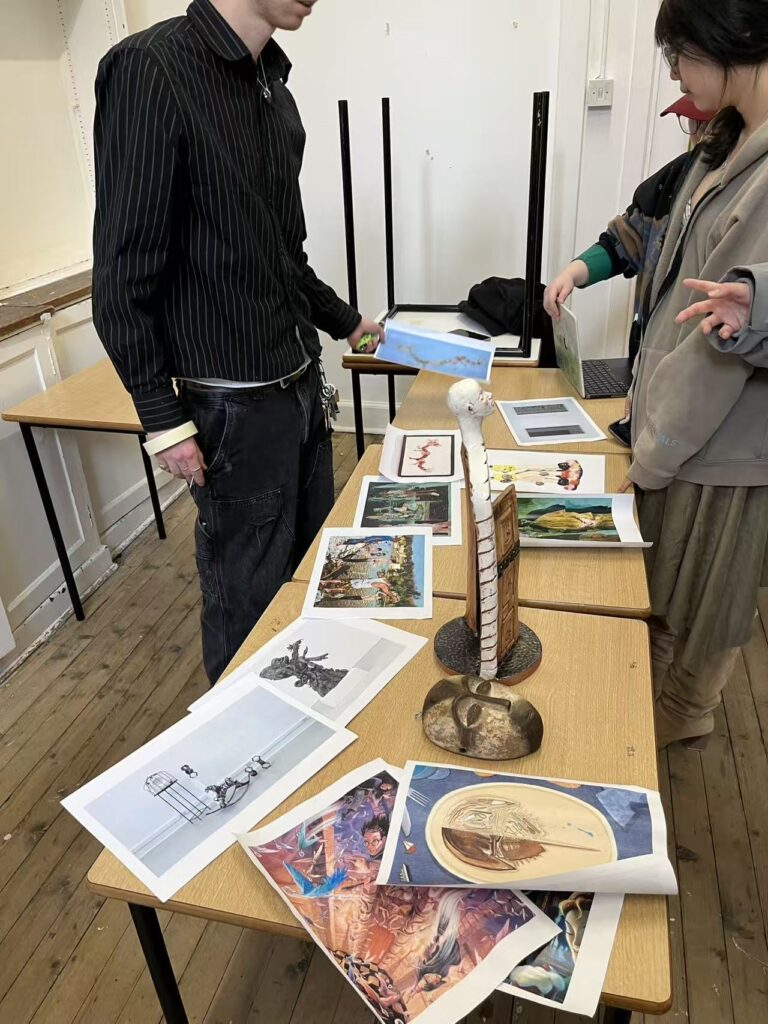
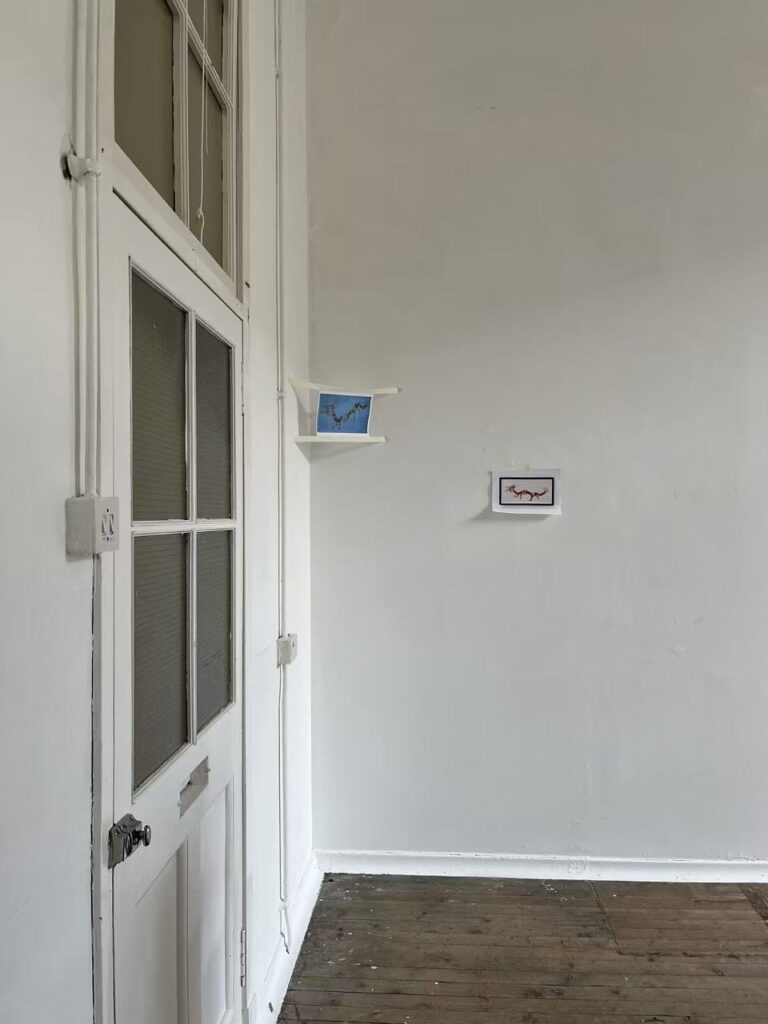
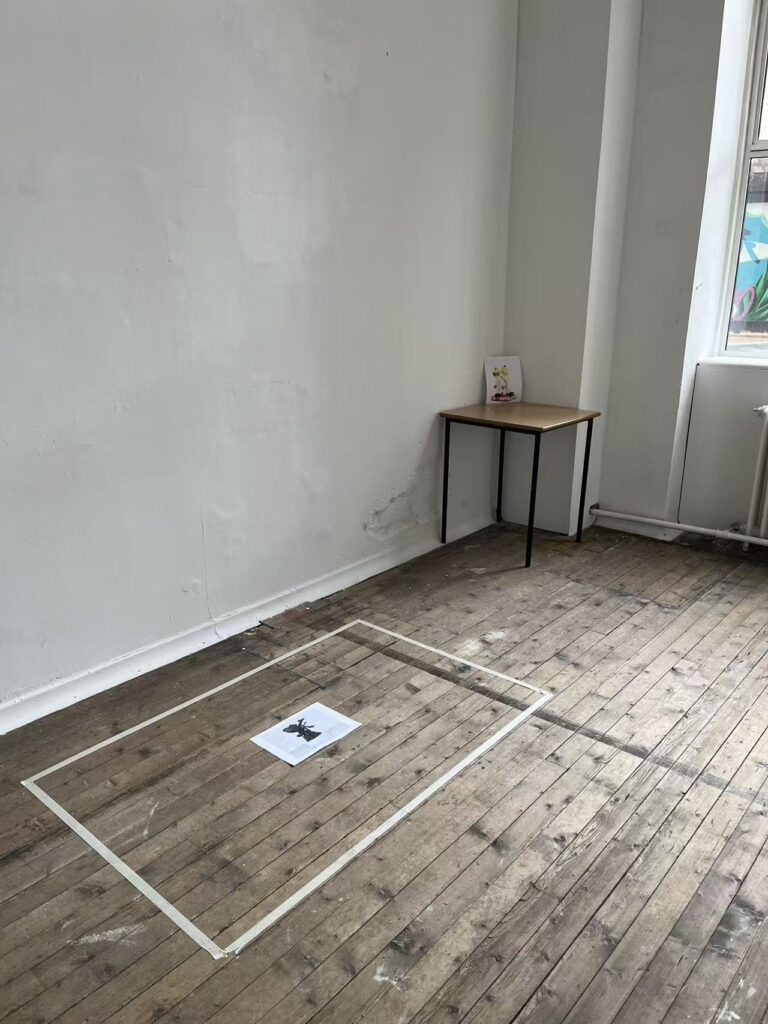
The collective spatial test at Summerhall gave me a further insight. Shared themes do not automatically produce coherence. The distances between works, the order in which they enter the viewer’s field of vision, and the arrangement of different media all directly affect how the exhibition is understood. Adjustments to the position of video, installation, and painting were therefore not minor technical matters, but ways of constructing the inner logic of the exhibition. The lesson for my personal project was clear: the six sites cannot be treated as six separate statements, but must form a rhythm and set of relations that can be genuinely perceived.
Collective discussion and artwork grouping during the first offline setup at Summerhall, March 2026. Photograph by Hazel Ren.Early wall arrangement test during the collective setup at Summerhall, March 2026. Photograph by Hazel Ren.Initial spatial test during the first offline collective setup at Summerhall, March 2026. Photograph by Hazel Ren.
References
Han, Shuyan, Dexuan Song, Leiqing Xu, Yu Ye, Shurui Yan, Feng Shi, Yuhao Zhang, Xiaodong Liu, and Hu Du. “Behaviour in Public Open Spaces: A Systematic Review of Studies with Quantitative Research Methods.” Building and Environment 223 (September 2022): 109444. https://doi.org/10.1016/j.buildenv.2022.109444.
Chitrakar, Rajjan M, Douglas C Baker, and Mirko Guaralda. “How Accessible Are Neighbourhood Open Spaces? Control of Public Space and Its Management in Contemporary Cities.” Cities 131 (December 2022): 103948. https://doi.org/10.1016/j.cities.2022.103948.
Lewis Jacob, Adam. Underground, Overground, Inside and Out: Exploring the Dynamics of Artist-Run Spaces. MA Contemporary Art Theory: Curating course presentation, University of Edinburgh, 2026.
University of Edinburgh. Week 6 SICP Toolkit. MA Contemporary Art Theory: Curating course document, 2026.
The central question of this project is straightforward but difficult: for whom is public space actually allowed to function? I am interested in how openness is arranged, limited, and unevenly experienced, rather than assuming that public space is naturally shared. The issue cannot be reduced to a simple opposition between residents and tourists. What matters is how tourism, infrastructure, commercial visibility, and managed movement work together to shape public space. Some people remain at ease. Others are pushed towards the edge.
Curatorial Format
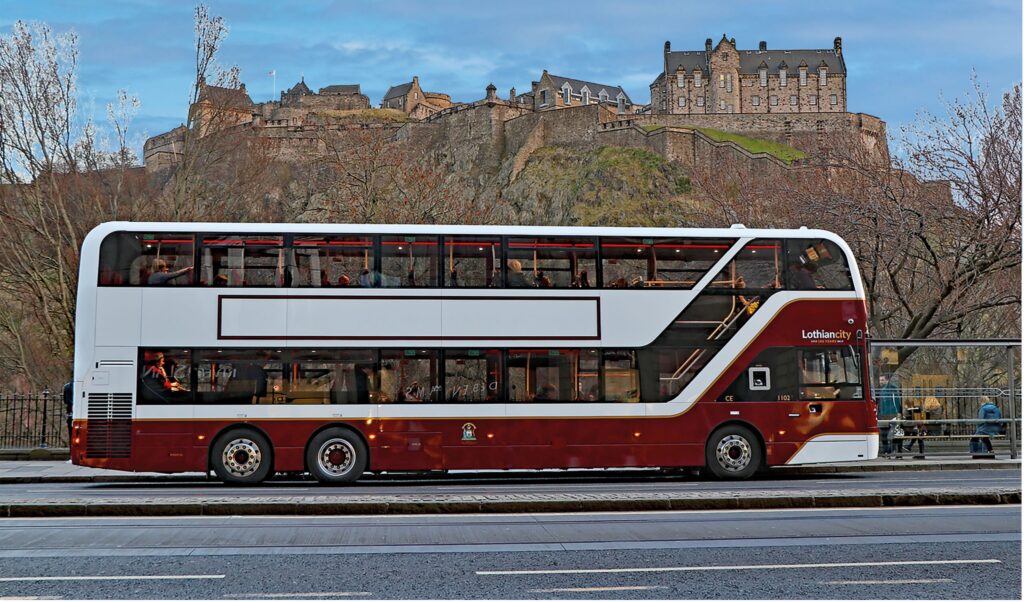
The project is designed as a self-guided outdoor exhibition linked through Edinburgh’s public transport network. Route 35 functions as the main structure connecting the sites. The bus is not only a practical device. It is part of the curatorial argument. The exhibition unfolds through infrastructure rather than simply taking place beside it.
Lothian Bus Route 35 in Edinburgh. Screenshot used to indicate the public transport route proposed as the connective structure of the curatorial project. Source: Lothian Buses / route information screenshot.
Why This Structure Is Necessary
The project adopts a non-linear structure because it should not depend on one fixed route or one authorized order of interpretation. Viewers may enter from different points, decide how long to stay, and connect the sites in their own way.
At the same time, readability still matters. A project without one dominant sequence can easily become fragmented. For that reason, route design, site prompts, and interpretive tools need to work harder. The main challenge is clear: the structure must be strong enough for dispersed entry to remain meaningful.
Main Concerns
The project approaches its main concerns through three points of entry. First, it examines how tourism reshapes everyday public space, especially where commercial attraction starts to outweigh public need. Second, it focuses on rules that are rarely written down but still affect who feels able to stay, pause, or return. Third, it treats public space as socially produced rather than naturally neutral, and asks how management, infrastructure, and repeated patterns of movement organize space in practice.
Theoretical Framework
The project is informed by critical spatial theory. Henri Lefebvre’s argument that space is socially produced gives me a way to understand public space as something built through power, use, and repetition rather than given in advance. Doreen Massey pushes this further. Her writing treats space as relational, contested, and always under negotiation. Together, these frameworks allow me to read Edinburgh as a city in which wider tensions become sharply visible.
Site Logic
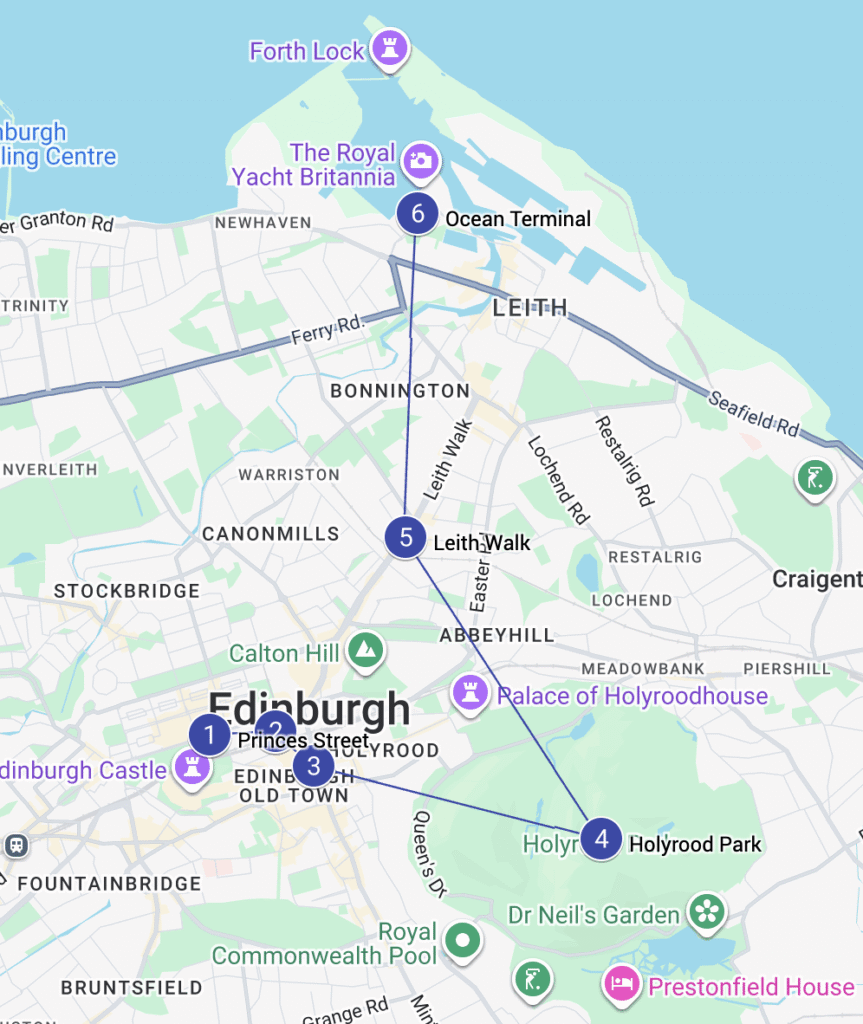
The project is currently organized around six sites in Edinburgh, linked through bus travel. The six-site structure is intended to register different forms of invisible boundary. Movement between sites is equally important. It creates comparison. It exposes uneven experience. It prevents the project from collapsing into a single example.
Exhibition Site Overview Map for the proposed project in Edinburgh, showing the six selected sites connected through the Bus 35 route. Map prepared for curatorial planning. Source: project planning screenshot by Hazel Ren.
AR as an Interpretive Method
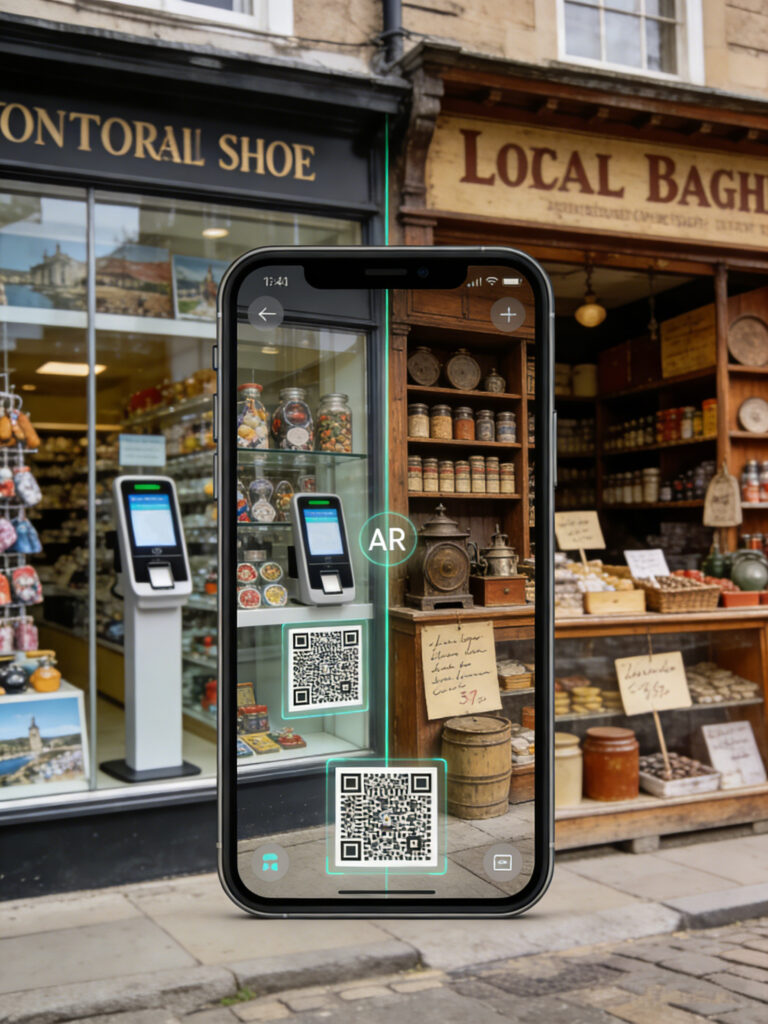
AR is proposed here as an interpretive method. I am using it because it can bring different spatial layers into view at the same location and from the same perspective. At selected sites, viewers would be able to access simple AR overlays on their phones. A place that now appears stable and familiar could then be re-read as the result of commercial pressure, redirected movement, spatial replacement, and selective visibility. The point is not technological novelty. The point is to interrupt the assumption that the present condition of a site is natural.
Indicative Artist Candidates
The project now has a relatively clear shortlist of artist candidates. These names function as realistic references through which I can test how different forms of intervention might support the argument of the project.
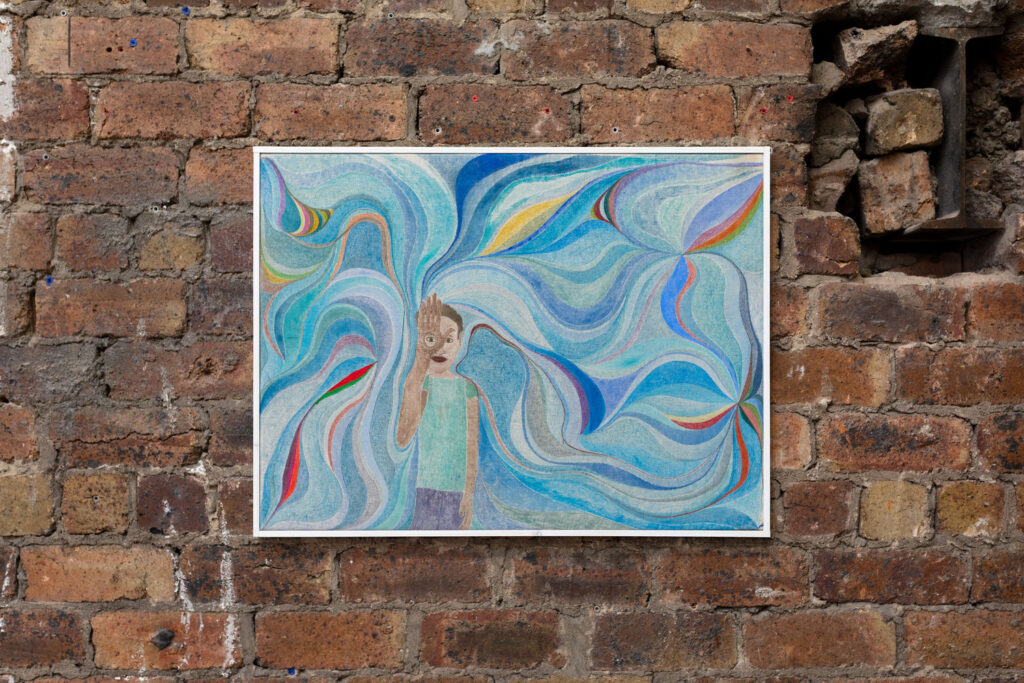
Chris Johanson
Chris Johanson is relevant because his work attends to everyday texture, emotional colour, and the relation between ordinary life and environment. What matters here is not formal similarity. His work offers a way of addressing subtle and affective tensions in public space, especially in places where daily urban life collides with commercial visibility.
Chris Johanson, Impermanence #9 (Ron from the past says hello to me in the present), 2025. Acrylic and house paint on recycled canvas, 57.2 × 76.5 × 2 cm. Source: exhibition image.
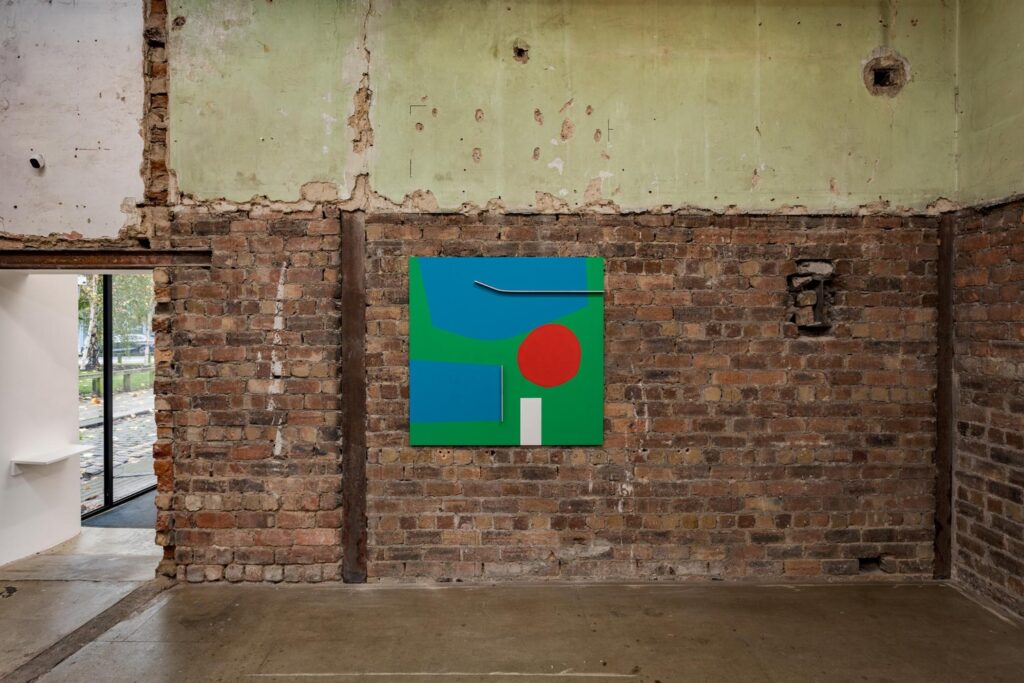
Toby Paterson
Toby Paterson is currently the strongest visual reference for the project. His abstract language responds directly to spatial structure, movement, and urban rhythm. The project needs a way to make pathways, circulation, and infrastructural order visible without falling back on simple explanation. Among the three candidates, his practice aligns most closely with the spatial and visual logic of the project.
Toby Paterson, installation view, The Modern Institute, Aird’s Lane Bricks Space, 15 November 2024–15 January 2025. Source: exhibition image.
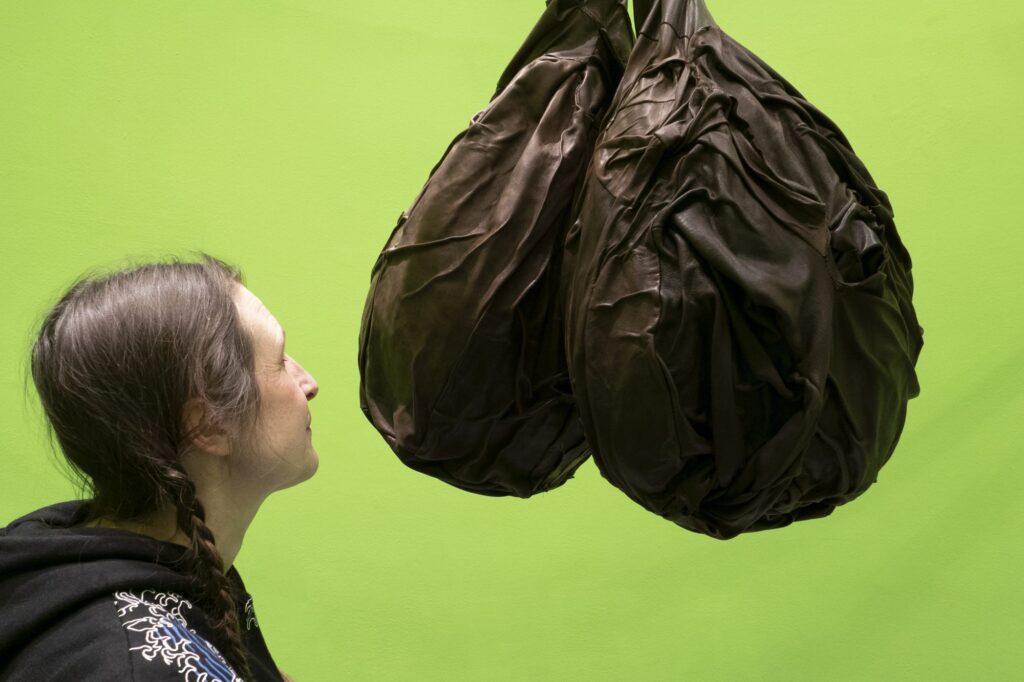
Clara Ursitti
Clara Ursitti opens another valuable direction. Her scent-based work refuses to keep spatial experience within the visual. Smell can shape the atmosphere. It can also shift attention. At certain sites in this project, where managed public image and lived environmental experience do not fully match, sensory contrast may be a productive way of making that gap perceptible.
Clara Ursitti, scent-based installation work. Source: exhibition image.
Publics
The project is aimed mainly at local residents and visitors. It also addresses commuters, passers-by, and those who move through Edinburgh without necessarily questioning how that movement is organized.
Practical and Ethical Conditions
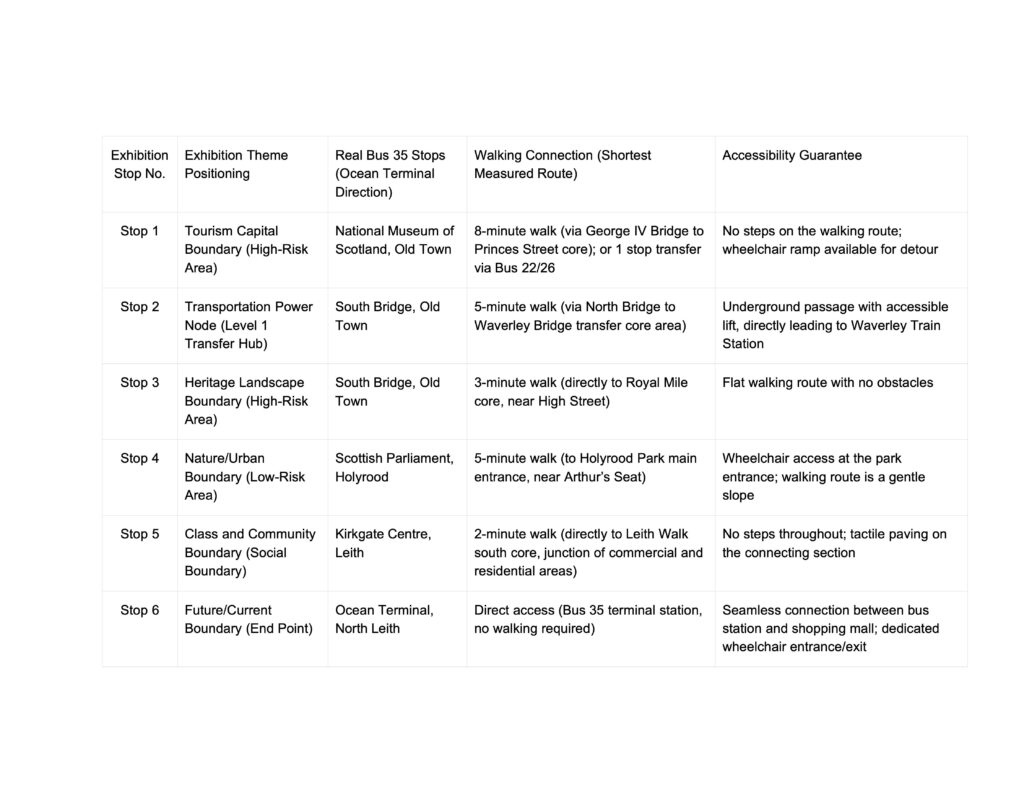
The proposal is intended as a temporary, low-impact, and accessible project. Interventions should remain lightweight. Routes need to stay publicly navigable. Accessibility must be treated as part of the curatorial method and considered from the start.
Because the project depends on connections between different sites, permission strategy, route planning, and risk awareness also become part of its critical structure. A public-space exhibition has to remain ethically and conceptually coherent if it is to hold together at all.
Core Route Table for the Bus 35 self-guided tour, showing exhibition stop number, theme positioning, nearest bus stops, walking connections, and accessibility information. Prepared for curatorial planning by Hazel Ren.
References
City of Edinburgh Council. “About the Edinburgh Visitor Levy.” Accessed 14 April 2026. https://www.edinburgh.gov.uk/business/visitor-levy-edinburgh.
City of Edinburgh Council. “The Scheme for the Edinburgh Visitor Levy.” Accessed 14 April 2026. https://www.edinburgh.gov.uk/business/scheme-edinburgh-visitor-levy.
Kester, Grant H. “Dialogical Aesthetics: A Critical Framework for Littoral Art.” Variant 2, no. 9 (Winter 1999/2000).
Fitzgerald, William, and Efrossini Spentzou, eds. The Production of Space in Latin Literature. First edition. Oxford: Oxford University Press, 2018.
Massey, Doreen. For Space. London: Sage, 2005.
McGillivray, David, Alba Colombo, and Xavier Villanueva. “Tensions and Disputes over Public Space in Festival Cities: Insights from Barcelona and Edinburgh.” Journal of Policy Research in Tourism, Leisure and Events (Abingdon) 14, no. 3 (September 2022): 229–41. https://doi.org/10.1080/19407963.2022.2032109.
This week, the development of my individual curatorial project focused on two connected areas: artist selection and public feasibility. As the questions raised over the previous weeks became clearer, I began to define my criteria for selecting artists. Because the whole project is structured around non-linear viewing, I did not begin by asking whether an artist “fits the theme”. Instead, I looked at whether their practice treats space as an experience in its own right, rather than simply as a backdrop for the work. In this project, how audiences move, how they enter a site, and how they form a viewing experience through routes are all direct parts of the exhibition structure.
Secondly, because the project is explicitly concerned with the inequalities in Edinburgh’s public space produced by tourism, movement, and institutional management, I need artistic practices capable of addressing spatial conditions that are not directly visible, yet continue to shape who can remain, who becomes more visible, and whose actions are treated as legitimate. What I am looking for, then, is not simply urban-themed work, but methods that can make hidden structures more perceptible.
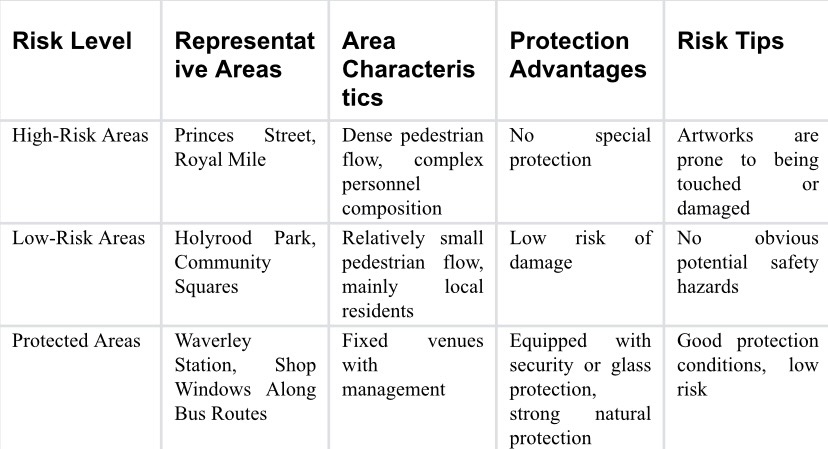
From my current position, I also need to confront a practical question: what does it actually mean to curate in public space? This project does not follow the model of a traditional gallery exhibition, so its feasibility within the real city environment must be assessed in advance. Public space is not a stable, open, always-available display site. Different locations have different rhythms of use, and any intervention must be adjusted in relation to risk conditions. This is not an extra technical step. It has to be treated as an inseparable part of the project’s method.
Risk-level classification table for potential exhibition sites in Edinburgh. Prepared by Hazel Ren for project development, 2026.
Edinburgh, as a major festival city, constantly reorganises public space through tourist volume, temporary events, and commercial pressure. Spaces that appear open often become subordinated to controlled patterns of movement. Risk assessment therefore, directly affects my curatorial judgement. I need to understand not only how workers enter the city, but also under what conditions public relations can actually be formed. Artist selection helps me determine what kinds of artistic language the project requires, while risk assessment helps me judge whether that language is truly workable in a real urban environment. Together, these two strands have made me more aware that public space is already a field of uneven use, and that curating within it means reorganising the relationship between viewing and access.
References
McGillivray, David, Alba Colombo, and Xavier Villanueva. “Tensions and Disputes over Public Space in Festival Cities: Insights from Barcelona and Edinburgh.” Journal of Policy Research in Tourism, Leisure and Events (Abingdon) 14, no. 3 (September 2022): 229–41. https://doi.org/10.1080/19407963.2022.2032109.
Quagliarini, Enrico, Gabriele Bernardini, Guido Romano, and Marco D’Orazio. “Users’ Vulnerability and Exposure in Public Open Spaces (Squares): A Novel Way for Accounting Them in Multi-Risk Scenarios.” Cities 133 (February 2023): 104160. https://doi.org/10.1016/j.cities.2022.104160.
Richards, Greg, and Maria del Pilar Leal Londoño. “Festival Cities and Tourism: Challenges and Prospects.” Journal of Policy Research in Tourism, Leisure and Events (Abingdon) 14, no. 3 (September 2022): 219–28. https://doi.org/10.1080/19407963.2022.2087664.
Robazza, Guido, Jacqueline Priego-Hernández, Silvio Caputo, and Alessandro Melis. “Temporary Urbanism as a Catalyst for Social Resilience: Insights from an Urban Living Lab Practice-Based Research.” Buildings (Basel) (BASEL) 14, no. 6 (June 2024): 1513. https://doi.org/10.3390/buildings14061513.
Following this week’s collective discussion, I continued to explore how invisible boundaries in Edinburgh are made in everyday life. They are generally not imposed explicitly. More often, they are produced through repeated habits, time patterns, and ordinary ways of using space, until they start to feel natural. Which is why they are difficult to recognize.
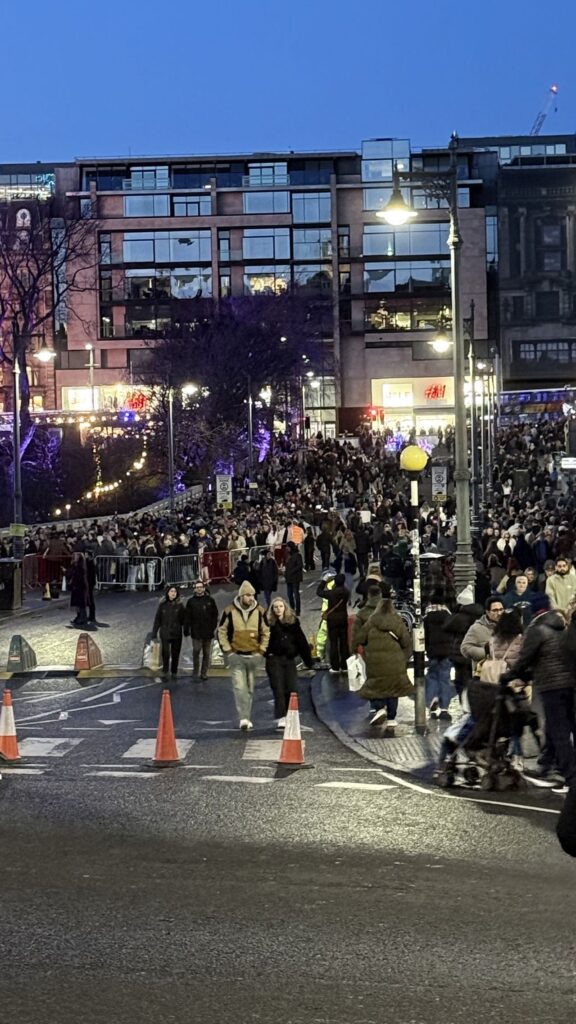
This was clear to me when I started to closely observe people’s everyday use of space. In the Royal Mile and Princes Street, where the tourist presence is significant, local inhabitants tend to avoid the “busy” hours and instead move to other areas for recreation or relaxation. During festival periods, squares, streets, and pedestrian areas are reorganized by performances, tourist flows, and temporary structures. As a result, how these areas are accessed is transformed. After repeating the same use pattern a couple of times, unbalanced space use can be mistaken for being a matter of choice. These barriers, therefore, are not invisible because they don’t exist, but because of their ubiquity.
I also started thinking of creating a light AR element. I did not want to use technology simply to make the project more up-to-date. I was interested in whether different surfaces at the same location could be recovered. So, if I made an augmented street scene, I might be able to see today’s retail tourist scene and a trace of previous life. This natural and fixed place could, then, be viewed as the outcome of commercial interests, choreographed movement, and controlled visibility. In this context, AR could be used to undo the idea of “this area has always been like this”.
AI-generated mock-up for Lightweight AR Visualisations for Edinburgh. Produced as a speculative visualisation for project development.
We also had a private meeting with the collective about the title and manifesto, and that helped me to understand the public stance of the project better. I don’t want high-profile commercial activity confused with the public. It might be crowded and commercial, but that does not necessarily follow that it will also be of equal public value. Nor do I want differences in rates of use, which vary by hour, day, or season, to be treated as an inherent part of public space. More importantly, I do not want the project to equate the problem with that of residents and tourists. Of more concern is the relationship between capital, management, and circulation that results in spatial hierarchy. Otherwise, there would be a risk of reproducing exclusions within the exhibition.
References
City of Edinburgh Council. City Centre Public Spaces Manifesto Update Report. 2 June 2015. https://democracy.edinburgh.gov.uk/Data/Transport%20and%20Environment%20Committee/20150602/Agenda/item_77_-_city_centre_public_spaces_manifesto_update.pdf.
Kester, Grant H. “Dialogical Aesthetics: A Critical Framework for Littoral Art.” Variant 2, no. 9 (Winter 1999/2000).
McGillivray, David, Alba Colombo, and Xavier Villanueva. “Tensions and Disputes over Public Space in Festival Cities: Insights from Barcelona and Edinburgh.” Journal of Policy Research in Tourism, Leisure and Events (Abingdon) 14, no. 3 (September 2022): 229–41. https://doi.org/10.1080/19407963.2022.2032109.
This week’s class on exhibition ethics, together with James’s discussion of curatorial responsibility, helped me clarify the direction of my project. I chose Edinburgh as the site of the project because, from the outset, I understood its public space as a field of clear contestation, shaped by tourism, movement, accessibility, and institutional forms of use. Edinburgh is therefore not an accidental choice for a project about invisible boundaries. The deeper reason is that the pressures within the city have already been made visible in policy discussions. The forthcoming visitor levy is one direct and clear attempt by the city to balance two competing aims: maintaining attraction for visitors while protecting the city’s liveability for local residents. The tension between liveability and the tourist economy offers a strong point of entry for discussing invisible boundaries.
Crowded Princes Street, Edinburgh, 2025. Photograph by Hazel Ren.
This also helped me answer a basic question: why curate this project at all? What I want to make clear first is that I am not simply trying to criticise tourism or festival culture. What interests me is how public space is organised, who has greater capacity to remain within it, and who becomes marginalised. Edinburgh is not a self-contained case. It operates more like a mirror, reflecting wider questions of spatial inequality.
James’s workshop also helped me understand more clearly why this exhibition format is worth exploring. I began to consider whether Edinburgh’s public transport network could connect a series of exhibition sites, allowing urban transport itself to become an organic part of the exhibition. If audiences enter the exhibition by different routes and spend different amounts of time in different places, then the meaning of the exhibition will not be strictly controlled by a single path. In this sense, the idea continues the non-linear viewing model I had been considering last week, but this week it became more clearly and consciously linked to the politics of public space.
I also developed a more specific understanding of the audience. My primary audience is local residents, because they are most likely to feel the long-term effects of changing accessibility, crowding, and belonging in public space. At the same time, I do not want to reduce the issue to a simple opposition between residents and tourists. Tourists also matter, because they usually encounter Edinburgh through pre-set routes and standardised city images, and I want to interrupt that familiar way of looking. Students, researchers, and disabled people are also important publics, because accessibility is never only an economic issue; it is also shaped by bodily conditions, time pressure, and many other factors. Different people experience public space differently, so the framework of the audience itself must recognise that difference.
References
City of Edinburgh Council. “About the Edinburgh Visitor Levy.” Accessed 14 April 2026. https://www.edinburgh.gov.uk/business/visitor-levy-edinburgh.
City of Edinburgh Council. “The Scheme for the Edinburgh Visitor Levy.” Accessed 14 April 2026. https://www.edinburgh.gov.uk/business/scheme-edinburgh-visitor-levy.
City of Edinburgh Council. City Centre Public Spaces Manifesto Update Report. 2 June 2015. https://democracy.edinburgh.gov.uk/Data/Transport%20and%20Environment%20Committee/20150602/Agenda/item_77_-_city_centre_public_spaces_manifesto_update.pdf.
This week, I reconsidered the meaning of curating. Curating is far more than placing works in a space. It is, in fact, a practice of reshaping narrative and actively guiding how audiences understand what they see. The classroom discussion of dematerialisation, contemporaneity, decolonisation, and intersectionality made me realise that curating takes place within a reality structured by inequality. For that reason, it cannot pretend to be neutral or entirely objective.
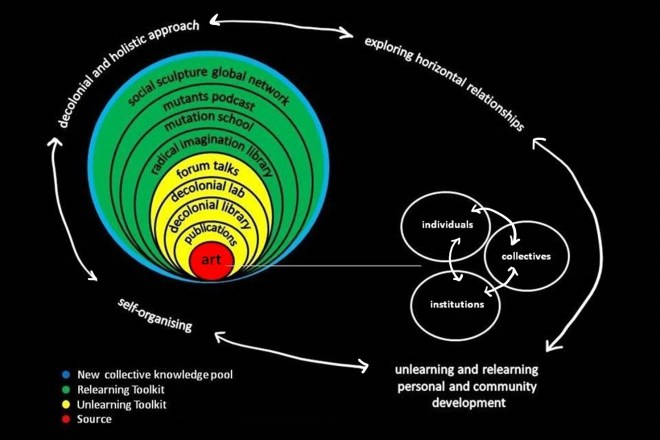
The case that affected me most directly this week was Counterspace. What interested me was its clear attempt to build an ongoing structure of interaction and exchange between individuals, groups, and institutions. This led me to rethink curating as a continuous process of building relationships rather than a simple act of display. More importantly, the case also brought out a contradiction worth taking seriously: once critical curatorial methods enter a large institutional framework, how can they avoid being absorbed by that system, or even repackaged as a consumable form of “difference”? Documenta 15 exposed this problem further and pushed me to think seriously about whether critical curating can still retain any real power to challenge structures of authority once it enters an institution.
Counterspace diagram, Cultural Strategy, London, 2021. Commissioned by Cristina Morales. Source: Counterspace website.
Because this contradiction had a real effect on my own project, I began to think more systematically about whether modes of viewing are themselves already arranged in advance by institutional logic. Does institutional power not only shape space and organisation, but also determine the order in which audiences encounter works and the ways in which those works are understood? I began to see clearly that route design is itself part of how narrative authority is distributed. I discussed this further with my tutor and group members during our collective discussion. This then led me to the question that increasingly concerns me: how do audiences move within an exhibition, and can that movement itself become an organic part of the exhibition’s structure?
My initial idea was to connect several outdoor sites through a map, offering a suggested route while also allowing audiences to choose their own path. But I quickly realised that the real issue was not simply to provide one more route option. What mattered was whether route design itself could change how audiences enter the works. If a fixed route often corresponds to a relatively fixed interpretive logic, then multiple routes and audience choice leave more room for participation, judgment, and understanding. I therefore developed a strong and lasting interest in a non-linear viewing structure. Such a structure does not require the audience to move in a single sequence, but instead treats the act of viewing itself as part of the exhibition narrative.
References
Counterspace. Cultural Strategy. London, 2021. Commissioned by Cristina Morales. Counterspace website. https://counterspace.zone/about/.
The Anthropocene, the Capitalocene, and A Billion Black Anthropocenes together provided a layered critical framework for the ecological crisis I am concerned with this week. The Anthropocene shows that human activity has shaped a global crisis. The Capitalocene challenges the idea of “humanity as a whole” and instead treats capitalism itself as a major historical structure of ecological destruction. Yusoff then powerfully connects geological extraction, colonialism, and racial violence. A clear and important insight follows from this: curating cannot operate on only one level.
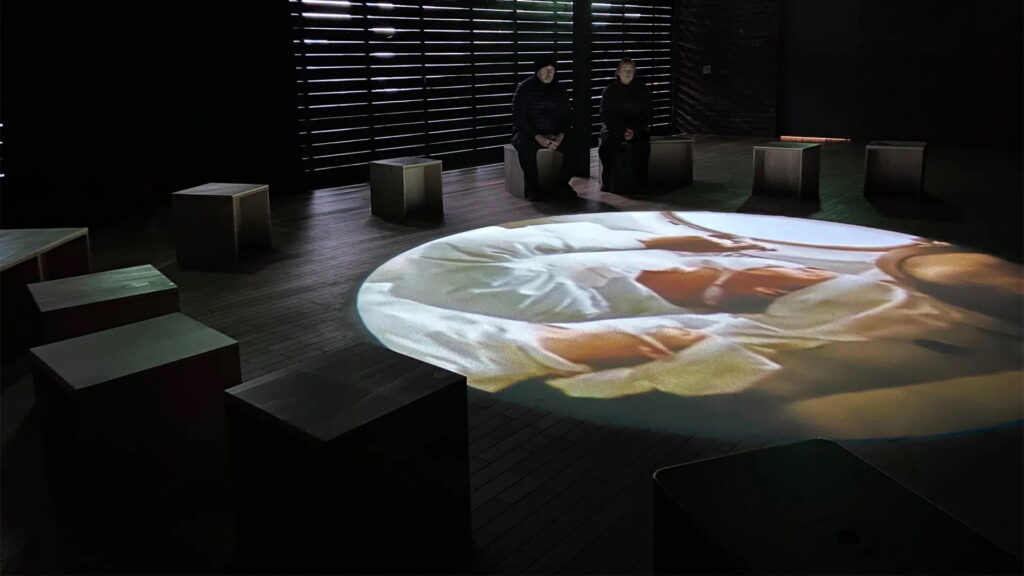
Because of this line of thinking, my way of viewing Sarah Wood’s Project Paradise changed. What now seemed especially important to me was not only the content of the work, but also its mode of presentation. The work takes the form of a floor projection, and viewers enter it from an overhead angle into a space composed of archival images, drone footage, history, and memory. From this, I drew the conclusion that exhibition form is not simply a support for content. It actively shapes how content is experienced and understood.
Installation view of Sarah Wood, Project Paradise, Fruitmarket, Edinburgh, 2023–24. Source: Fruitmarket website.
Using these three concepts, I was also able to reread the exhibition more critically. Fruitmarket introduces Project Paradise mainly through ecology, landscape, memory, and extraction. This is a useful point of entry, but it also naturally leads to more fundamental questions: which histories are made visible, and which structural or racialised dimensions remain underdeveloped? This was the first time I understood very clearly that the same curatorial work can open into different layers of meaning depending on the theoretical lens through which it is read. From this, I gradually began to understand that curating is not only about displaying material, but also about organising how that material is read.
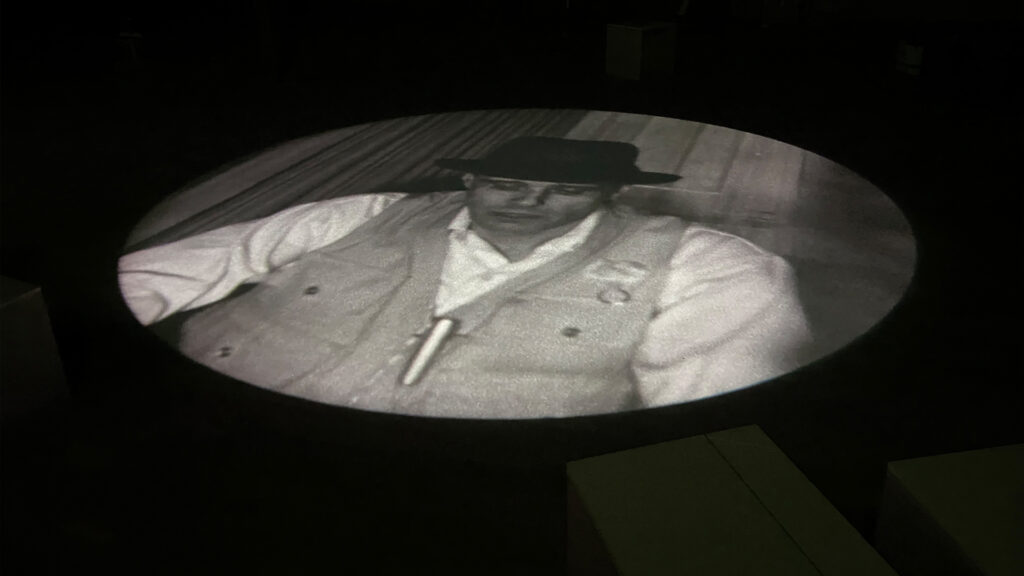
Figure 2. Film still from Sarah Wood, Project Paradise, Fruitmarket, Edinburgh, 2023–24. Source: Fruitmarket website.
During the first collective discussion, everyone introduced their own background and areas of strength. I could see that group members had different kinds of experience in installation, editing, communication, and modeling, and many of these were areas in which I am not yet strong. This helped me understand the purpose of the collective. Learning in this course will not develop through theory alone, but also through collaboration. For me, the collective is therefore an excellent site for building practical experience.
References
PAUL J. CRUTZEN, EUGENE F. STOERMER and WILL STEFFEN. “‘The “Anthropocene”’ (2000).” In The Future of Nature, edited by Libby Robin, Sverker Sörlin, and Paul Warde, 483. Yale University Press, 2013.
Moore, Jason W. “The Capitalocene, Part I: On the Nature and Origins of Our Ecological Crisis.” The Journal of Peasant Studies (London) 44, no. 3 (May 2017): 594–630. https://doi.org/10.1080/03066150.2016.1235036.
Yusoff, Kathryn. A Billion Black Anthropocenes or None. Minneapolis: University of Minnesota Press, 2018.