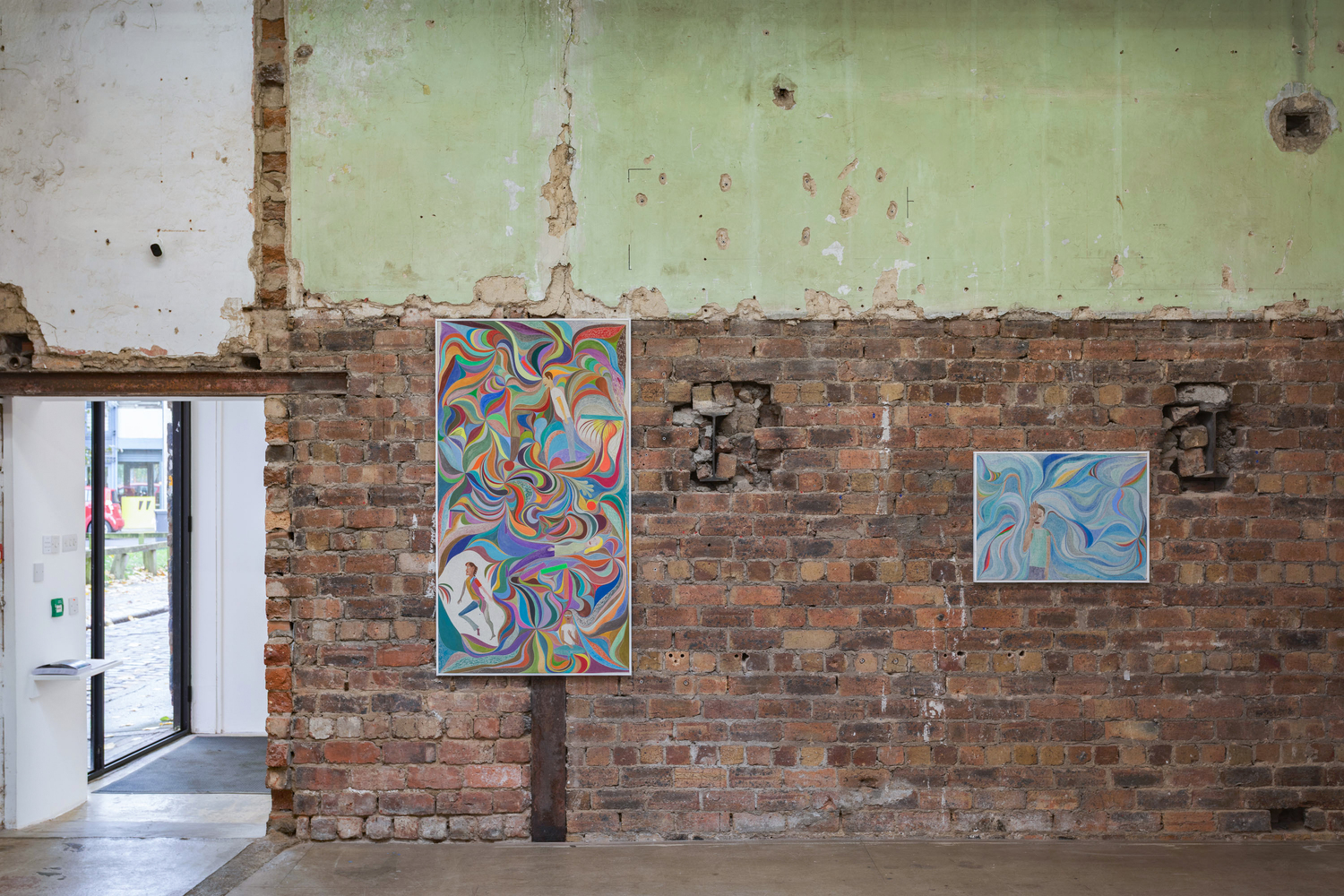


This week, the development of my individual curatorial project focused on two connected areas: artist selection and public feasibility. As the questions raised over the previous weeks became clearer, I began to define my criteria for selecting artists. Because the whole project is structured around non-linear viewing, I did not begin by asking whether an artist “fits the theme”. Instead, I looked at whether their practice treats space as an experience in its own right, rather than simply as a backdrop for the work. In this project, how audiences move, how they enter a site, and how they form a viewing experience through routes are all direct parts of the exhibition structure.
Secondly, because the project is explicitly concerned with the inequalities in Edinburgh’s public space produced by tourism, movement, and institutional management, I need artistic practices capable of addressing spatial conditions that are not directly visible, yet continue to shape who can remain, who becomes more visible, and whose actions are treated as legitimate. What I am looking for, then, is not simply urban-themed work, but methods that can make hidden structures more perceptible.
From my current position, I also need to confront a practical question: what does it actually mean to curate in public space? This project does not follow the model of a traditional gallery exhibition, so its feasibility within the real city environment must be assessed in advance. Public space is not a stable, open, always-available display site. Different locations have different rhythms of use, and any intervention must be adjusted in relation to risk conditions. This is not an extra technical step. It has to be treated as an inseparable part of the project’s method.
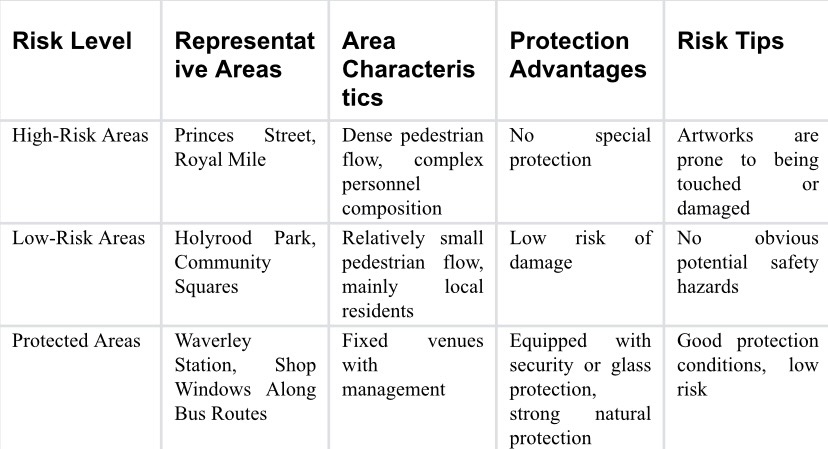
Edinburgh, as a major festival city, constantly reorganises public space through tourist volume, temporary events, and commercial pressure. Spaces that appear open often become subordinated to controlled patterns of movement. Risk assessment therefore, directly affects my curatorial judgement. I need to understand not only how workers enter the city, but also under what conditions public relations can actually be formed. Artist selection helps me determine what kinds of artistic language the project requires, while risk assessment helps me judge whether that language is truly workable in a real urban environment. Together, these two strands have made me more aware that public space is already a field of uneven use, and that curating within it means reorganising the relationship between viewing and access.
References
McGillivray, David, Alba Colombo, and Xavier Villanueva. “Tensions and Disputes over Public Space in Festival Cities: Insights from Barcelona and Edinburgh.” Journal of Policy Research in Tourism, Leisure and Events (Abingdon) 14, no. 3 (September 2022): 229–41. https://doi.org/10.1080/19407963.2022.2032109.
Quagliarini, Enrico, Gabriele Bernardini, Guido Romano, and Marco D’Orazio. “Users’ Vulnerability and Exposure in Public Open Spaces (Squares): A Novel Way for Accounting Them in Multi-Risk Scenarios.” Cities 133 (February 2023): 104160. https://doi.org/10.1016/j.cities.2022.104160.
Richards, Greg, and Maria del Pilar Leal Londoño. “Festival Cities and Tourism: Challenges and Prospects.” Journal of Policy Research in Tourism, Leisure and Events (Abingdon) 14, no. 3 (September 2022): 219–28. https://doi.org/10.1080/19407963.2022.2087664.
Robazza, Guido, Jacqueline Priego-Hernández, Silvio Caputo, and Alessandro Melis. “Temporary Urbanism as a Catalyst for Social Resilience: Insights from an Urban Living Lab Practice-Based Research.” Buildings (Basel) (BASEL) 14, no. 6 (June 2024): 1513. https://doi.org/10.3390/buildings14061513.