

Talbot Rice Gallery&Curating Scenario
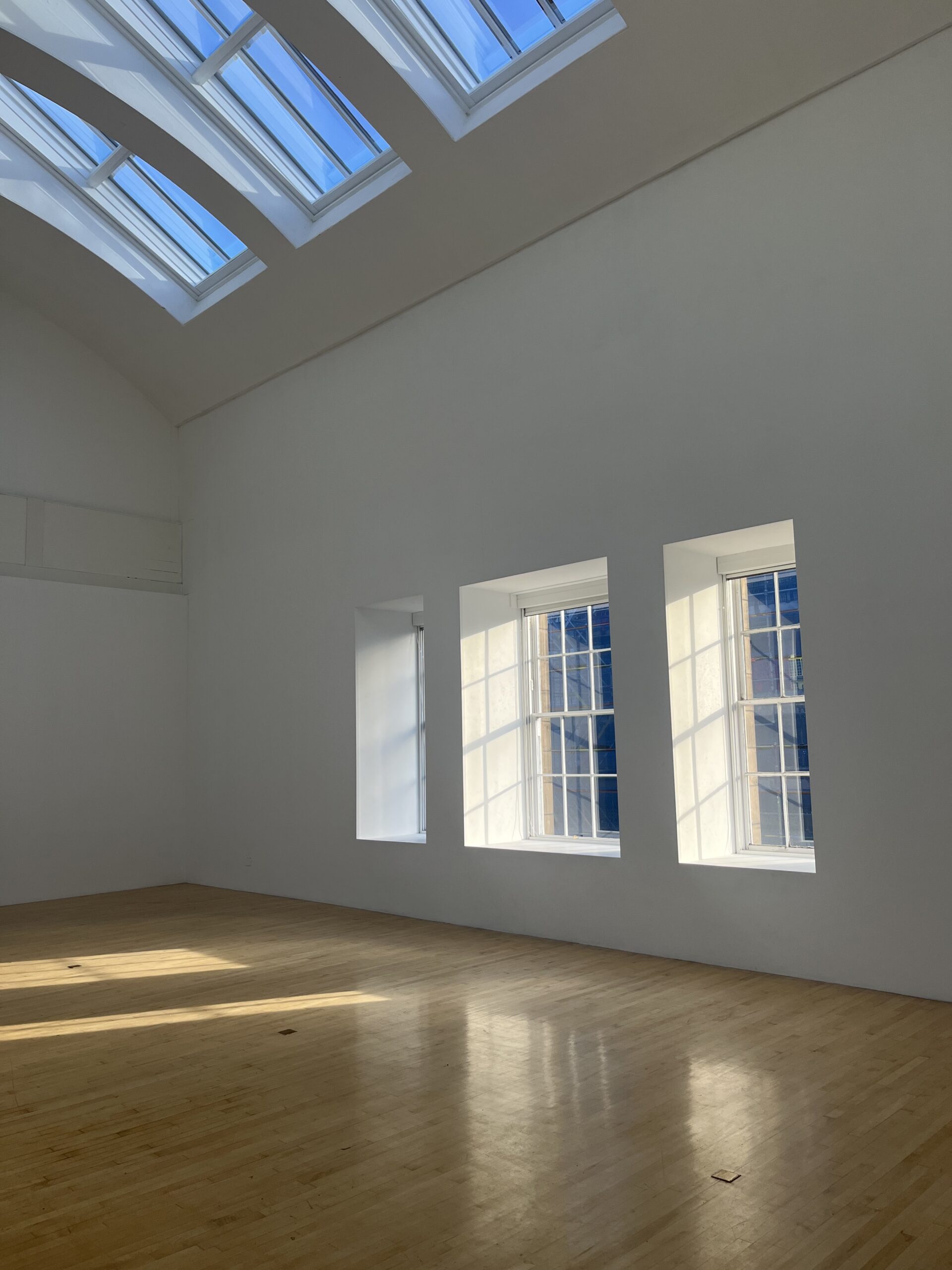
I’d like to talk about my feelings on TRG.
You can see that it is actually part of the Old College, which according to James is an art gallery formed by the refurbishment of historic remains from the nineteenth century.
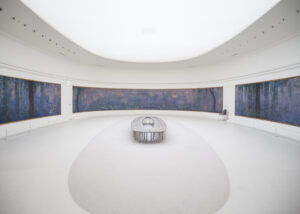
In fact it is a common practice to convert historical buildings into museums or galleries, especially in Europe, such as the Musée d’Orangerie in France (one of my favourites), which was originally built by Napoleon to protect the orange trees in the Jardin des Tuileries and was converted into a museum after the First World War and used to house the world-famous “Water Lilies “. The transformation is truly praiseworthy, as the pavilion itself is a perfect match for Monet’s giant water lilies! You can see that the huge oval-shaped skylight allows natural light to enter the entire pavilion, so he has done a wonderful job of restoring the natural light that Monet was using to create his work, and you can even see the sparkling surface of the lake. At the same time, the oval design mirrors the oval of the lotus leaf, and the white walls and simple curves of the pavilion make it very easy to get into an atmosphere where you can fully appreciate the water lilies.
(The Orange Garden Gallery is on the left)
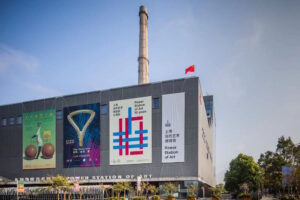 The Power Station of Art (PSA), converted from an old power plant in Shanghai, was the first public museum of contemporary art in mainland China and the main venue for the Shanghai Biennale. The 165-metre-high chimney is both an urban landmark and an exhibition space in its own right, and was the ‘Urban Future Pavilion’ during the 2010 Shanghai World Expo. It has witnessed Shanghai’s urban transformation from the industrial to the information age, and its gritty industrial architecture offers a wealth of imagination and creative possibilities for artists.I have seen a number of exhibitions here and it has a large interior space, which is ideal for exhibiting some of the larger works of contemporary art, including the number of works from the Biennale, and it is a very good renovation gallery in my opinion.
(PSA is on the right)
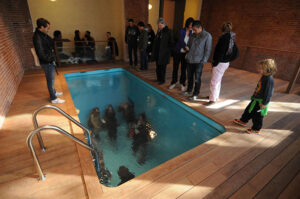
I would say that the best part of transforming an art gallery is also the worst part – the artwork that is selected, which is really difficult because many of the artworks are of different sizes, require different spaces, and need different light. But an old building is very limited in terms of the parts of itself that can be changed.James mentioned these as well, in the later workshops we tried to have an exhibition in the TRG and tried to move Leandro Erlich’s work Swimming Pool into the TRG, which caused no small amount of trouble because the work needed natural light, so the White Gallery was probably a better choice, but you know, it wasn’t big enough So having an art exhibition in some of the converted galleries really requires more thought, you have to be more careful about the size of the work and everything you need to show it, otherwise you don’t really have any way of putting an exhibition into practice.
(swimming pool is on the left)




Recent comments