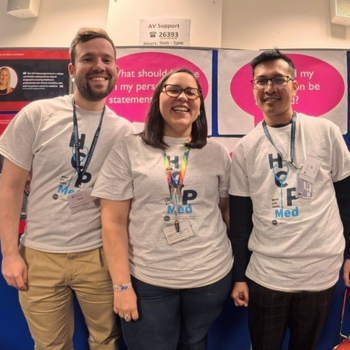
Jack had never considered a career as a doctor until he began working alongside doctors during his student nurse training. He discovered he enjoyed being more involved in the medical management of his ICU patients and increasingly drawn to the work of the medical team rather than nursing.
During my nurse training I began to appreciate the depth of knowledge doctors required. I really enjoyed learning the pathophysiology of conditions, but always felt I was scratching the surface. But studying medicine was never a lifelong dream for me. At school I never got the grades and honestly, it never even crossed my mind. I always felt it was unachievable unless you were a top-of-the-class performer or your parents were in the medical field, and it was never really discussed at school as an option either.
I had always had an interest in healthcare, but had never even considered nursing initially as a career. I had applied for a computer science degree and a nautical science degree, both very different to what I ended up studying. Ultimately, I was unable to find accommodation in Ireland for both courses which lead me to looking further afield in the UK for study options. Paramedicine was my first choice but unfortunately at the time you needed a C1 driver’s license to apply for many courses, which was unobtainable in the short timeframe I had. It was only then that I considered nursing as a career. Which was a fantastic decision! If you’d asked 16-year-old Jack what he’d end up doing, he wouldn’t have believed he’d become a nurse.
I completed my nursing degree in Edinburgh Napier University and began working at the Royal Infirmary of Edinburgh in intensive care where I have continued to work during my studies. I had found out about the HCP Medicine course whilst I was still finishing my nursing training and it had always been in the back of my mind as something I would potentially apply for.
The transition back to studying after several years away has been very challenging.
Despite trying to prepare in advance, I still found the transition difficult. Medicine is a demanding course at any stage of life, but being out of formal education for a while can place you at a slight disadvantage initially.
The volume and pace of content can feel overwhelming at first, and it takes time to adjust and find an approach that works for you. Early on, I found myself comparing my progress to others, which wasn’t particularly helpful. One of the most important lessons I learned was to focus on developing my own study methods rather than trying to mirror someone else’s.
Finding an effective way to learn is very much a process of trial and error. Speaking to peers who are further along in the course reassured me that this is completely normal— many people adapt and refine their study strategies multiple times during the programme.
I’ve found myself having a bit of a love-hate relationship with the teaching style.
The course is delivered through a series of online lectures, with a weekly structure covering different topics, alongside tutorials every two to three weeks. These sessions, often delivered as team-based learning (TBL), provide an opportunity to consolidate knowledge and test your understanding with peers.
There are definitely pros and cons to this style of learning. At times, working through hours of online content can feel isolating. However, one of the biggest advantages is the flexibility it offers. Being able to pause, rewind, and take notes at your own pace has been incredibly helpful for reinforcing more complex topics.
Like many aspects of the course, it takes time to adjust to this style of learning. That said, the course itself is very well organised and easy to navigate. Importantly, the teaching team are highly receptive to student feedback—if something isn’t working, they are proactive in making changes, which really enhances the overall learning experience.
What has surprised me most is just how much doctors need to know. You come into the course expecting a heavy workload, but nothing really prepares you for the sheer volume and breadth of knowledge involved.
A real stand-out moment has been the GP placement.
The placement has really opened my eyes to the world of primary care. I’ve particularly enjoyed getting to know patients over time and seeing the impact of clinical decisions—whether that’s how a treatment plan has helped or how ongoing care can make a real difference to people’s lives. It’s given me a much deeper appreciation of the role primary care plays in the healthcare system.
I’ve been fortunate to have fantastic tutors who are genuinely invested in your learning, taking the time to ensure you understand key concepts and offering plenty of opportunities to get involved.