 MBChB student Hannah Yoncer reflects on how volunteering for a charity shop changed her perspective.
Medical school has a way of occupying your entire world—attending lectures, tutorial prepping, society events, and more studying. Starting medical school, I expected that routine. What I did not expect was that one of the most useful parts of my education would really happen in a small charity shop on Grange road.
Goodies is the first charity I’ve been involved in since moving to the UK, and looking back, it has shaped my development as a medical student in ways both expected and unexpected. Below I outline five things community engagement has taught me so far.
Lesson 1: Reality check
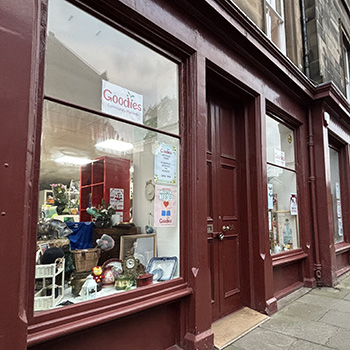
Being in medical school can feel like being wrapped in a bubble of textbooks, lectures, and flashcards. We study the underlying science and management of diseases often find ourselves deep in “ideal” medicine which can be very different from the realities faced by current patients. But conversations with customers who through the copper-coloured door of Goodies charity remind me how far that can be from reality. People share about their medical journeys and the stark reality of navigating limitations—financial, social, or medical—that reminded me that medicine cannot fix everything, but often it is about managing and supporting patients.
Lesson 2: Health outside practice
Volunteering at Goodies also exposed me to parts of people’s lives not often emphasised in lectures. Regulars who come in are community members who rely on the charity’s supply of bread and veg -so much of health is determined what happens in these shops and within the community. Access to healthy foods and a community have such monumental impacts on people’s wellbeing long before they have to see a doctor.
Lesson 3: Empathy
Throughout my weekly shifts, I see customers both old and new. I learn a lot from my charity manager, who takes such a genuine interest in each person who steps foot in the shop – remembering names, noticing the new haircut, following up on previous conversations. Not dramatic moments, but consistent and quiet displays of care and concern within the community. This shattered my abstract understanding of empathy and replaced it with a real example of patience, attention and genuine interest. Being able to witness and take part in these human interactions after a long day of Latin words and drug names feel like a much-needed reset.
Lesson 4: Cultural competence
In medical school, cultural competence often shows up as a checklist: be aware of differences, avoid assumptions, respect beliefs. But working in a charity shop with a mix of local and international colleagues and customers makes it much more concrete – and much less tidy. At first, I would over-analyse or feel unsure about what’s “appropriate.” But over time, I become more comfortable navigating difference without turning it into a big deal. This confidence is something I know I can carry into clinical setting.
Lesson 5: practicing real world communication
People say medicine is a language on its own and I have to agree. It isn’t just the constant urge to use medical jargon; it can also be very tempting to fall back onto an unnecessarily quick rhythm of speech and conversation even outside a medical setting. I find that community settings have challenged me to pause, respond naturally and handle unpredictable interactions.
The average medical student is not a stranger to the concept of community engagement – most of us would have had to do some form of volunteer or work experience to get into medical school but not everyone continues it after starting university. While time, work, and other commitments can make regular involvement difficult during medical school, these experiences can offer a different kind of learning that’s easy to overlook.
For me, the small charity shop with the copper-coloured frame ended up being one of the most valuable learning environments I’ve had in the UK – an unexpected teacher in my medical education.