Introduction
A rich aesthete, a therapist, and a manager walked into a university… It sounds like the setup for a joke, but it is no laughing matter. These three characters have quietly shaped the moral logic of many contemporary universities and show no signs of leaving.
In After Virtue, Alasdair MacIntyre diagnoses modern culture as emotivist: a culture in which moral claims – questions of right and wrong – are reduced to expressions of preference rather than appeals to shared standards of reason, judgement, and excellence. Emotivism, he suggests, finds its representative social embodiments in three archetypal characters: the Rich Aesthete, the Therapist, and the Manager. In what follows, I argue that these characters, in their emotivist forms, exert a decisive influence on the contemporary university, recasting higher education as entertainment, therapy, and service provision rather than as initiation into practices with their own internal standards of excellence and goods.
Characters and moral diagnosis
Before turning to these characters in turn, it is worth clarifying what MacIntyre means by a character. Characters are not social roles as such, nor psychological types. They are culturally recognisable moral figures who embody a society’s implicit understanding of rationality, authority, and value. As MacIntyre puts it, characters ‘are the masks worn by moral philosophies’ (2004, p. 28). To describe a culture’s dominant characters is therefore to diagnose its moral condition.
MacIntyre’s point is historical as well as conceptual. Victorian England, for instance, was partly defined by figures such as the public school headmaster, the explorer, and the engineer – characters through which particular standards of judgement and authority were publicly modelled and socially endorsed. Similarly, the characters he identifies in After Virtue – the rich aesthete, the therapist, and the manager – embody the moral assumptions, priorities, and expectations of our own age. In each case, characters make visible what a society takes to be rational, authoritative, and worth endorsing.
What follows, then, is not an attempt to assign these characters to individual actors, but to examine how the logics they embody shape institutions and practices. In the case at hand, this means examining how they inform expectations, incentives, and pedagogic norms within contemporary universities.
The aesthetic logic in university learning
For the Rich Aesthete, life is experienced as a sequence of consumable moments. MacIntyre’s use of the term aesthetic, indebted to Kierkegaard (Kavanagh, 2012), does not primarily concern art but an attitude to experience itself. What matters is not whether something is true or worth pursuing, but whether it is engaging and capable of holding attention. The governing threat is boredom.
This orientation sits uneasily with education. As MacIntyre observes, the aesthete is fundamentally a spectator rather than a participant in demanding practices, and in cultures where this stance is taken for granted, teaching becomes difficult work. Learning anything of substance is effortful and often frustrating, and its point may initially be opaque to the learner. A teacher who aims above all to entertain may therefore be rewarded with positive evaluations, but does students a disservice by encouraging the illusion that education should always be enjoyable.
This is an aesthetic conception of learning: “What do I get out of it personally?” rather than “What does this practice require of me?” In many contemporary university settings, this outlook is tacitly accommodated. Degree programmes are framed as lifestyle choices; modules are selected on the basis of interest or enjoyment alone; lectures are expected to be engaging but not overly demanding; and higher education is treated as a vehicle for personal expression and validation. In such contexts, boredom is interpreted not as a difficulty to be worked through, but as evidence of pedagogic or institutional failure. The continual solicitation of student feedback, though often well intentioned, can allow measures of satisfaction to substitute for judgements about educational goods, thereby entrenching a consumer model of learning at the expense of intellectual formation.
The therapeutic logic and the redefinition of education
Alongside the aesthete, MacIntyre identifies the figure of the Therapist as a central character of emotivist culture. The therapist does not ask which ends are worth pursuing, but helps individuals to cope, adjust, and function more effectively within the social world as it is. Moral questions are redescribed as problems of psychological well-being, and success is measured in terms of reduced distress and improved self-esteem.
In After Virtue, MacIntyre argues that the idiom of therapy has increasingly invaded the sphere of education. When this happens, teaching is no longer oriented towards initiation into shared intellectual goods or demanding practices with their own standards of excellence. Instead, it is reframed as a process of support and facilitation, aimed at helping students manage anxiety, experience reassurance, and remain comfortable. Intellectual difficulty and moral challenge come to be treated as risks rather than necessities.
From a MacIntyrean perspective, aspects of contemporary university practice can be read through this therapeutic logic, regardless of their historical origins or stated intentions. The growing authority accorded to student voice and lived experience, the emphasis placed on emotional safety and well-being, and pedagogical approaches designed to minimise discomfort all sit comfortably within a therapeutic framing of education. Practices such as trigger warnings, safe spaces, grading for effort rather than achievement, and the language of trauma-informed pedagogy can thus be interpreted as expressions of a broader tendency to recast education as care rather than formation.
The difficulty, for MacIntyre, is not that care is misplaced, but that the therapeutic model assumes students already know what they need. Education becomes a matter of affirmation rather than transformation, adjusting individuals to their current preferences rather than challenging them to acquire the virtues required to pursue goods they do not yet fully understand.
The managerial logic and the virtue of unresponsiveness
The third character shaping the contemporary university is the Manager. Where the aesthete demands enjoyment and the therapist prioritises adjustment, the manager promises efficiency, predictability, and control. Education is reframed as a deliverable process, monitored through outcomes frameworks, employability metrics, and satisfaction surveys, with students recast as clients and academics as service providers. The manager claims neutrality with respect to ends, focusing instead on the optimisation of means.
For MacIntyre, this stance is illusory. Management always presupposes ends, but in refusing to debate them it entrenches the preferences of institutions and markets as if they were given. What is lost is sustained engagement with education as participation in practices: coherent forms of activity governed by internal standards of excellence and oriented towards goods that can only be understood through disciplined involvement.
It is in this context that MacIntyre defends what he describes as unresponsiveness. Teachers faithful to a practice cannot simply give students what they want or respond immediately to expressed preferences. Their responsibility is to the standards of the practice itself, which sometimes requires resisting, correcting, or frustrating students’ initial desires. Such unresponsiveness is not pedagogical hardness for its own sake, but a consequence of aiming at goods whose value cannot be immediately recognised. The educational aim is not satisfaction or adjustment, but the cultivation of the virtues required to come, over time, to want what is genuinely good.
Conclusion
The contemporary university is increasingly shaped by three figures: the aesthete, the therapist, and the manager. Together, they tend to recast education as entertainment, therapy, and service provision, weakening its orientation towards truth, excellence, and the formation of judgement. What is lost is not simply intellectual rigour, but the idea that education should transform students rather than merely reflect their existing preferences.
A MacIntyrean response does not begin by proposing an alternative set of institutional priorities, but by insisting on what it means for any activity to count as education at all. Education, on this view, is participation in demanding practices with their own internal goods – goods that can only be apprehended through sustained effort and guided initiation. Such education cannot be fully responsive to immediate wants. Its task is instead to educate desire, so that students gradually come to recognise and value goods they could not initially see. This vision does not require nostalgia or wholesale reform. It can survive, precariously but genuinely, in small communities of practice where standards are taken seriously and teaching retains the authority to challenge. If universities abandon this unresponsive commitment, they do not become more open or humane; they cease to be educational institutions in any robust sense at all.
References
Alasdair MacIntyre (2004). After virtue: a study in moral theory (2nd ed.). Duckworth. (Original work published 1981)
Liam Kavanagh (2012). ‘Interview with Alasdair MacIntyre’, Expositions, 6(2), pp. 1–8. Available at: https://expositions.journals.villanova.edu/index.php/expositions/article/view/1452/1314
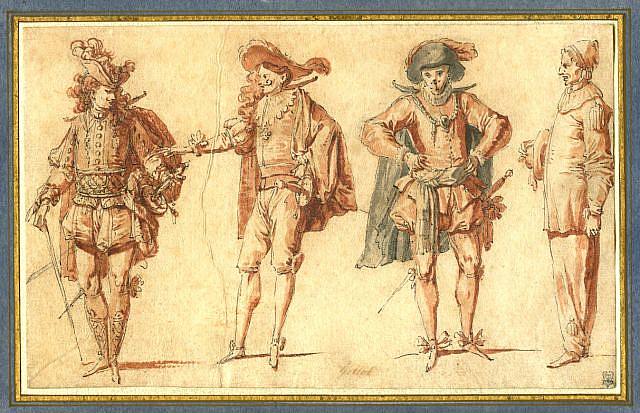
(Claude Gillot (1673–1722): Four Commedia dell'arte Figures - Three Gentlemen and Pierrot, c. 1715)