1.
From time to time, we might move, or be moved, from one place to another. When that movement comes to an end – or at least, to a temporary pause – we find ourselves displaced. Before we have any chance of settling, let alone flourishing or thriving in our new environment, it is important to feel placed again. To be in place. This does not always happen easily, or fully, and it relies on various factors, some of which are beyond our control.
What do we need to feel placed? The first thing is a sense of community; another is a connection to our environment, which is more-than-human, expansive and entangled; a third is empirical knowledge and understanding; yet another is time for self-growth, processing and reflection. If we have a lack of agency in one of these areas – perhaps through separation from family, financial hardship, or border rules – then our placement can become challenging. Sometimes it is not possible to surmount such conditions. But if one or more are out of our control, perhaps there are others we can nurture or grow?
2.
After searching for too long, I find a spot on a wooded hillside and rig a hammock between two pine trees. Scents of rosemary, birds that I am familiar with from back home, a gentle breeze, and sunshine filtered through the canopy. This is the first time that I have done this, and I don’t feel confident that I have tied the straps correctly. Perhaps there is an elegant way of mounting this suspended canvas, but I don’t know it yet. It is low enough for me to straddle it, with one leg either side. I trust that it will hold, and lie back, leaving the ground to the ants and lizards. The sides are not taut, so I am enveloped. I try to adjust my position and find it difficult to get purchase enough to shuffle backwards. But by increments, I manage to centre my body and fold the excess material into a more manageable configuration. I am nervous about the buzzing insects that have joined me in the trees. I can’t get comfortable with my running shoes on, so I remove them and carefully drop them to the ground below me, but one rolls down the bank, and my phone falls out of my pocket. I try a new position and find equilibrium, but now I am hungry and I can’t reach my bag to get my lunch and water bottle. So I awkwardly climb out again, retrieve my phone and shoe, gather my meal and re-enter the hammock. I find the right balance again and work out how I might eat without getting covered in breadcrumbs and cheese. I have everything I need now to feel comfortable here. I am ready to learn from this experience. I look up to a mosaic of leaves and breath in the fullness of the mountain air.
3.
How can the different conditions of placedness be brought together in such a way as to suspend their interconnections? This would be to recognise and hold space for their individual effect, which in each case is absolutely necessary for us to fall into place. But also to bring them into interdependence, so that all of them are joined together, just as the Anthropologist said, as an entangled meshwork of lines. Our place in the world is always and only a moment of tension between the strands of connection that uphold us.
4.
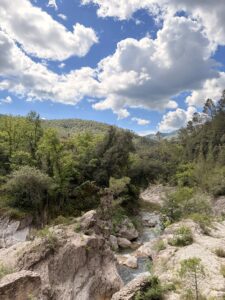
We reach the Muga River at a place where it crosses a forge and is channelled through a rocky part of the valley. After trekking up the pathway in the sun, I am feeling drawn to and by the running water. I remove my socks and shoes and tentatively make my way into the pools, balancing on the slippery crossing way and feeling the flow of the river on my calves. I would like to be immersed in the water – to plunge into the pools and embrace the river. But while others who are here with me are shedding clothes and jumping straight in, there is something holding me back. As it starts to rain, I lie on a rock and feel the droplets on my face. This is not a smooth rock. I make micro-adjustments and try to relax. This is a different kind of surface to the hammock. I am no more capable of finding stillness here. But I close my eyes, feel the moisture and listen to the river turning and racing through narrow passages towards the Mediterranean Sea.
5.
To be replaced is to be moved somewhere else. As a passive verb, the subject is compelled to make this move because someone or something else is coming into their place. But if re-placement can be understood more actively – as a word that gives agency to the subject, then we can examine how this might be done in such a way as to maximise the possibility of feeling in place again.
6.
There are many of us here – a confluence of people from different countries, disciplines, professions. This coming together is not straightforward for me. I find moments of connection, learn names, exchange hopes and ideas. At other points, I am outside this social dynamic, feeling uneasy, impatient, out of place. I am staying in a small cabin on my own, which is my preference. Others are in shared accommodation in groups of three or four, cooking together, making plans and getting to know each other. At mealtimes, it is necessary for me to attach myself to one of these temporary families. I am invited in, welcomed and made to feel at home. Accepting hospitality is not always easy. It takes an openness and reciprocity that I have to work towards. I am very grateful to be looked after in this way, and I hope that my company has been as enjoyable to others as theirs has to me. On the fourth day, as I sit with new friends and fellow walkers, drinking wine and eating well, I feel a sense of place that I have yet to experience on this trip. I am held in this moment of conviviality.
7.
Lying in my hammock by the banks of the river, I focus on the strands that keep me here. I have improved my technique and find a better position for my canvas – stretched out further between my chosen trees, tied more carefully, and at the correct angles. My location affords much more than yesterday’s hidden spot of woodland. Today, I am inches from the flowing waters, open to the sunshine and the breeze, which rocks me from side to side. Now I am flowing with the Muga, subject to its ripples, its eddies and its whims. All around me – one across the water, two in either direction along the bank, and several more who are out of sight – are other hammockers. We agreed that we are sailing the Muga River in these vessels. We are a gathering of river-farers, suspended above the water, held in the holly oaks together. For an hour, we commune with the more-than-human world, tied as we are to the branches and trunks, which are rooted to the valley and connected through mycorrhizal networks that draw in nutrients, and the water that brings all manner of lives together in the shifting, shimmering atmosphere of the Muga valley, the Pyrenees, Catalonia, Europe, and our planetary home. We are all part of that. We are all that.
8.
The Anthropologist expresses his frustration. All this talk of connections, pace and place, has brought us into our bodies and in tune with our emotions. We have become ‘touchy-feely’. But what of our context? How can we reconcile our inner worlds with the rocks and birds that surround us? What can we know about them? What can we learn? A tension is perceived and called out and thereby made real.
Perhaps this tension is no bad thing. It is there in the strands of connection that suspend us in place: between collective experience, ecological subjectivity, scientific observation, and personal reflection. To be held between these different ways of being and knowing is to be placed. We need the tension.
