When I meet David on Kirkintilloch Road, he is wearing a camouflage jacket, which he attributes to his career as a deer stalker. David used to work for Scottish Natural Heritage (now NatureScot) in the Cairngorms National Park. He then went on to study countryside management and was involved in surveying the deer population across the East Dunbartonshire area, including at Lenzie Moss. David also remembers working for the council in this area in the 1990s, when he was employed to clear rhododendrons from the north part of the Moss. I hope we will see the roes on our walk today.
It is one of those days in Scotland when all the seasons come together: frost on the ground among the daffodils; snow on the hills beyond; clouds in the sky; and sunshine cutting through the trees. There is also a strong breeze. Given our direction of travel, this might help us locate the deer, who will not be able to smell us coming.
When I walked with my brother, Phil, just before Christmas, he recounted some recent deer stalking adventures and talked about the appeal of slowing down and paying careful attention to the environment. This is a sensibility that David knows well. David reads the landscape as we walk, noting the way that the wind moves through the branches – which are still without leaves – and the direction of the higher clouds, as well as the behaviour of the dogs we meet, and the flight of birds. It is fascinating to walk with someone who experiences the Moss in this way.
A silver-grey Weimaraner dog runs ahead of us and David notices that it has picked up a scent. We suddenly veer off the path and walk slowly through the trees towards the bog. As we reach the other side of the narrow strip of birchwood, we encounter two deer enjoying the sunshine. As they move away from us, David makes a squeaking call and instructs me to head slowly back towards the main path. We meet the dog once more, and his owner puts him on the lead, on our suggestion. But the deer have taken a different route now, and we don’t see them again.
As we reach the top of the boardwalk, David points out the location of the entrance to the drainage tunnel that runs between the Gadloch, south of the railway line, and Park Burn in Boghead Wood, to the west of the Moss. David tells me that the tunnel was dug by Napoleonic prisoners of war. We examine the area through his binoculars (David extols the benefits of a good pair) and notice an access point by the railway bridge on Crosshill Road, which seems aligned with the path of the tunnel.
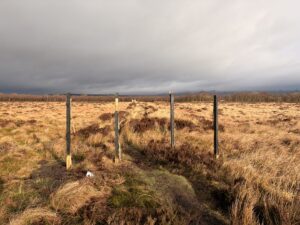
We reach the boardwalk and look out across the bog. When I walked with Tony and Julia six weeks ago, we noticed the sections of fencing that had appeared, preventing access to the centre of the site. I said at the time that I wasn’t sure that they would be there for long. After various signs were put up and quickly removed, Carol and I noticed the addition of anti-vandal paint. Today, David and I observe what is left after someone has visited in the night and torn down most of the fencing. The route has been opened again, leaving only the deep-set posts that would have been difficult to remove on the fly.
David says it is all a bit of an eye-sore, but he is sensitive to the efforts to discourage access. David sees the bog as a vast carbon sink. He notes that the Moss used to extend further – reaching Bishopbriggs and further south than the trainline. He sees the fragment that is left as an important place that needs to be protected. For David, the answer lies in education. If people knew what was at stake, they would take more care.
David worries that people are becoming disconnected from landscapes like this. Young people stay inside on their screens (a situation I am often attempting to counter at the very local level of my own household). But if we can get them outside, engaged with the issues of conservation and biodiversity, then sites like the Moss are more likely to be protected. David says that we need to appreciate nature and the natural world more.
David tells me about a walk with the Ramblers (where he met Carol, who put us in touch). Half-way along the ‘Magnificent 11’ route round Linn Park, King’s Park and Castlemilk Park in the south side of Glasgow, he asked the group to stop. They stood in a circle with hands linked and eyes closed. And they listened. This invitation to become immersed in the environment and to take part in a listening exercise together had a profound effect on some of the group. Some told David they had not expected to be so deeply moved.
David encourages me to close my eyes and listen now. For a couple of minutes, I tune into the wind. It sounds different notes from various directions: a shrill whistling through the trees and a low, rumbling countermelody from the west. An approaching train joins the harmony, and I open my eyes to sunshine falling across the heather.
Suddenly, there is a commotion, and David excitedly directs my attention to the far side of the bog. He tells me there is a buzzard being mobbed by crows. I see a flash of brown dropping to the ground and we watch as a single, brave corvid sustains the attack. This is similar behaviour to the incident that I noticed with Carol, in the nearby trees. I wonder whether there was more going on then than I realised at the time. Perhaps the buzzard was involved then, too.
For the final section of our walk, we return to the main path. We say good morning to a jogger, who I have chatted with during the Lenzie Running Club outings. He is always very encouraging to Ruairidh, who joins in too. A mother pushes her baby in a pram. A couple walk their labrador.
I feel like I have just returned from an adventure into a wilder Moss, which exists just beyond the everyday journeys that people take here. David has shown me that there are roe deer, buzzards, and shifting winds out there to be discovered by those who take the time to listen. I think we can all learn something from David’s way of being in a place like this.