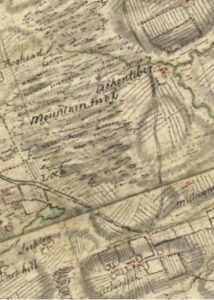
For the first walk of 2026, I am joined by Eddie, an engagement officer at Archaeology Scotland. Eddie is preparing to lead some fieldtrips at Lenzie Moss with pupils at the local secondary school, Lenzie Academy. He has studied maps of the area, searched the archives, and planned locations for augering (a method of core sampling, similar to the coring method that Phil G told me about). But this is Eddie’s first visit to the site. It is a valuable opportunity for him to plan the visits for later in the year, when the weather will hopefully be more agreeable than this cold, wet day.
Eddie is working on a large-scale project known as the Clyde Valley Archaeological Research Framework (CVARF). Eddie’s job is to work with the local authorities in the Clyde River catchment to ensure public engagement with the project. Lenzie is part of East Dunbartonshire, but there will also be workshops and fieldtrips exploring the archaeology of the Clyde in East Renfrewshire, Glasgow City, Inverclyde, North Lanarkshire, Renfrewshire, South Lanarkshire and West Dunbartonshire. Together, over a third of Scotland’s population live in these areas.
As we walk from the station up Bea’s Path, Eddie tells me what he has discovered so far. He mentions the Roy Military Survey of Scotland, an extensive survey of Scotland’s landscape between 1747-1755. A hundred years or so before the modern Lenzie was built, it is possible to see that the bog reached further and connected with other wetland areas. The trainline was constructed in the 1830s and 40s, cutting through the landscape and soon bringing further building (including my house on the new Fern Avenue some time around 1870, when Jane Vary Campbell and David Sinclair Campbell may have been the first occupants). Lenzie Moss became demarcated, boxed in, and separated.
Eddie will share this mapping exercise with S3 pupils – fourteen- and fifteen-year-old’s in their third year of Scottish secondary education. Prior to their fieldtrip to the Moss, they will also learn about some of the things that have been found in local bogs. These include the Cambusnethan bog body, found in North Lanarkshire in 1932, and initially believed to be a 17th-century Presbyterian Covenanter; and the Peelhill horde, the discovery of Late Bronze Age weapons at a site in South Lanarkshire in 1961, which were most likely buried ritualistically after a battle. While the bog body may in fact have been a murder victim, who died some years later than originally thought, both cases raise questions about the ways that bogs have been used throughout history as spaces of transition, between life and death, our world and the next.
I tell Eddie what I know about a gruesome discovery on Lenzie Moss, recounted in Bill Black’s excellent history of ‘Peat Extraction on Lenzie Moss’:
[Colin Graham] was on the moss about 400 yards west of Moncrieff Avenue on Wednesday [7th] July 1880. He had dug down about 4 feet when, suddenly, he exposed a human head, partially preserved, including the hair. When it was extracted it was identified as that of a female but further exploration around the area by the police failed to produce the remainder of the body. The victim was never identified, although it was suggested it might be that of a domestic servant, employed some years earlier by Mr Lang at Gallowhill House. She had disappeared without explanation, a fact confirmed by Lang, but in circumstances that were described as ‘suspicious.’
I imagine myself in the position of a teenager learning all this and then being invited to explore the local peatland. Perhaps they will hope to make a discovery of their own, whether grisly or golden.
When Eddie and the school groups extract samples from this site, they will look at the different layers and see how the differences in the peat indicate how long the bog has been forming, whether accumulation has slowed due to drainage and extraction, and how the site has been used for fuel, grazing, or industrial use. They will consider the different proxies that can be measured, such as Phil’s pollen analysis and Meike’s data on elemental composition. Eddie has a real passion for ‘weird watery places’ like this, and I can see how this enthusiasm makes him the ideal person to inspire young people about our local peatlands. Eddie reminds me that Lenzie Moss is a tiny fragment of what was once a wide-reaching area of lowland bogs.
We head onto the bog path and walk a short way into the centre of the Moss. Eddie tells me about the survey he is currently undertaking of Rannoch Moor in the Scottish Highlands. He spends days poring over satellite images of the site, identifying evidence of different activities and infrastructure, such as grazing, sheilings, and charcoal burning platforms. Eddie wants to counter the idea that places like this are ‘wicked wild wastes’, by developing archaeological narratives about moors and bogs. Rannoch Moor has been mentioned a few times on these walks. Like Michael, I think of Lenzie Moss as a miniature landscape that recalls the vast expanse of Rannoch. Despite the difference in scale, both places have complex histories of use and inhabitation.
We reach the southeast woodland and make our way through the trees to the ruins. I’m sure that Eddie will have some thoughts about the old buildings. I have always assumed that the concrete platform that I have explored with Meike and others, was part of the light railway that was used for the peat extraction industry. Eddie agrees that this is likely and says it would be easy to confirm that by checking the plans for the site. While he is careful to frame his response as purely speculative, Eddie offers an alternative theory. He tells me that during the Second World War, a number of fake townships were created by positioning lights in rural areas away from major urban centres, in an effort to trick the Luftwaffe into wasting their bombs. Whenever large concrete platforms are located in places like this, that is always a possibility. Alternatively, as the Moss was an important location for fuel and close to the railway line, this could be the base of a barrage balloon, the gas-filled deterrents of low-flying aircraft, which could be brought down by the steel cabling tethering them to their concrete bases. While these theories might not be accurate in this case, I will now be on the search for such structures on future walks.
We exit the Moss into the station car park and pass the Nature Reserve notice board, with the Friends of Lenzie Moss map of the site. After walking through history with Eddie, I am reminded that the current layout is only a snapshot in time. Bogs are often thought of archives of past events, whose traces are preserved for generations. Pollen, metals, artefacts and the dead are buried deep in the ground and are later discovered by farmers, peat cutters and archaeologists. But bogs have futures too. If we can teach young people about them now, then there will be people to care about them, visit them and stay close to them as they change along with the next generation.