Today is the first day of this year’s wonderfully long Christmas holiday, so I should be relaxed and jovial. But I have just had to take my car back to the garage after some very expensive repairs have failed to do the job. So I am feeling stressed as I return to Lenzie by train, just in time to meet Michael outside Billington’s. A friendly introduction soon settles my mood, and we set off to join the Moss through the station car park. We are accompanied by Lucy, Michael’s old red labrador, who very calmly wanders along beside us. I will talk and walk myself into better spirits.
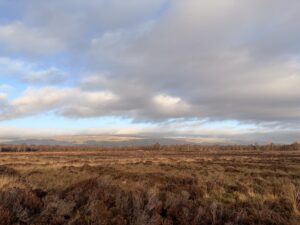
Michael is in his fifties and has very recently moved back to Lenzie with his family, after many decades living elsewhere. He first moved to the town at the age of seven and lived here until he left to study. His memories of growing up here are not entirely positive, but he talks about returning home and doing so on his own terms. For Michael, the view of the Campsies across the bog represents a lifelong connection to this place. It is the image that comes to mind when he thinks of home.
Michael tells me that a lot has changed here while he has been away. There is more to do now, with a lively high-street and improved transport links. As I also learnt from Alison, the Moss has been developed a great deal too, with new pathways and conservation of the woodland and the bog, and careful management of the relationship between the two. Michael has changed, too. He moved here after living in different cities – London, Edinburgh and Brussels – and then settling in the nearby new town of Cumbernauld. As he enjoyed a career change from public relations to academia, he reached a slower, quieter phase of life that would be nurtured by living next to the Moss. Michael also tells me that Lucy has never been happier than on her walks here.
As a teenager in the eighties, the Moss was there for Michael in a different way. He would come here on his own as an escape from the cloying insularism of small-town Scotland, with all its sectarianism and conservatism. The Moss was also a good place for a sneaky cigarette. As a catholic, Michael went to school at St. Ninian’s in Kirkintilloch, beyond the predominantly protestant area of Lenzie. Michael and his school friends typically played together in Peel Park, so Lenzie Moss was often his private domain. At other times, Michael would visit the Moss with friends. He says that there must be evidence of this: countless lost shoes, claimed by the bog.
Michael’s memories of growing up here lead me to reminisce about my own childhood in rural Derbyshire, and we soon discover a connection. The nearest town to my village was Matlock, where I went to secondary school. It turns out that Michael’s wife is from Matlock as well. Michael moved to Lenzie in the early eighties, in the year that I was born. I suppose that his wife would also have been growing up in Derbyshire back then. Walking this route with so many people has revealed several unexpected connections like this: Steve attending a wedding in my garden; Sophie and Cathy knowing each other from university. It is always pleasing to be reminded of how entangled we all are.
We find another connection around my work in theatre, and I learn that Michael is from a family of actors, including the well-known couple, Barbara Rafferty and Sean Scanlan, both of whom appeared in the popular Scottish sitcom, Rab C. Nesbitt. Michael’s fifteen-year-old also acts and has had roles in award-winning films. After my walk with Nalini, I have been thinking of developing a performance project about Lenzie, so it is useful to know that there are more actors living here. I think I have now met enough to form a small theatre company!
We reach the bottom of the boardwalk and Michael opts for the less muddy path along the railway, which is also Lucy’s preference. I suggest a detour, and we wander along the edge of the bog a short way to look out towards the Campsies. The sun shines through the clouds, casting shifting light onto the hills. Michael enjoys how remote this place can feel, even though Glasgow is only a few short miles southwest. He likens it to Rannoch Moor, a large area of wetlands to the south of Lochaber, which I traversed years ago when I walked the West Highland Way. Once again, I find myself imagining a longer walk that starts here and takes me over the hills and far to the north. Maybe I could chart a route that connects all the peatbogs from home to the Hebrides (from where Jill has just emailed me).
We double back on ourselves, and Michael says that this is something he always tries to avoid on the Moss. If he veers off the main path and ends up somewhere new, he always looks for an alternative route. I like this rule and I share my own for this project: always anticlockwise; only one person at a time; no predetermined questions or topics. I am discovering that everyone who regularly walks round the Moss falls into their own patterns and habits. Walking with Michael shows me that some of these can endure over time, lying dormant for decades but easily reestablished when we return to the places of our childhood.
It seems that Michael is very happy to be back in Lenzie. Looking back to his earlier life here, he even wonders whether it was really the town that was the problem. Maybe some sixteen-year-olds would have a tough time wherever they were. At any rate, it suits him here now and he is where he wants to be.
As we reach the station car park (I almost forgot about my car for a while!), we chat for a bit longer about work, before we go our separate ways. We agree to stay in touch. It is good to be slowly getting to know more people in the community through these walks. While I am much newer to Lenzie than many of the people I have walked with, each time I complete a circle of the Moss, I feel that I know this place a little better.