Any views expressed within media held on this service are those of the contributors, should not be taken as approved or endorsed by the University, and do not necessarily reflect the views of the University in respect of any particular issue.
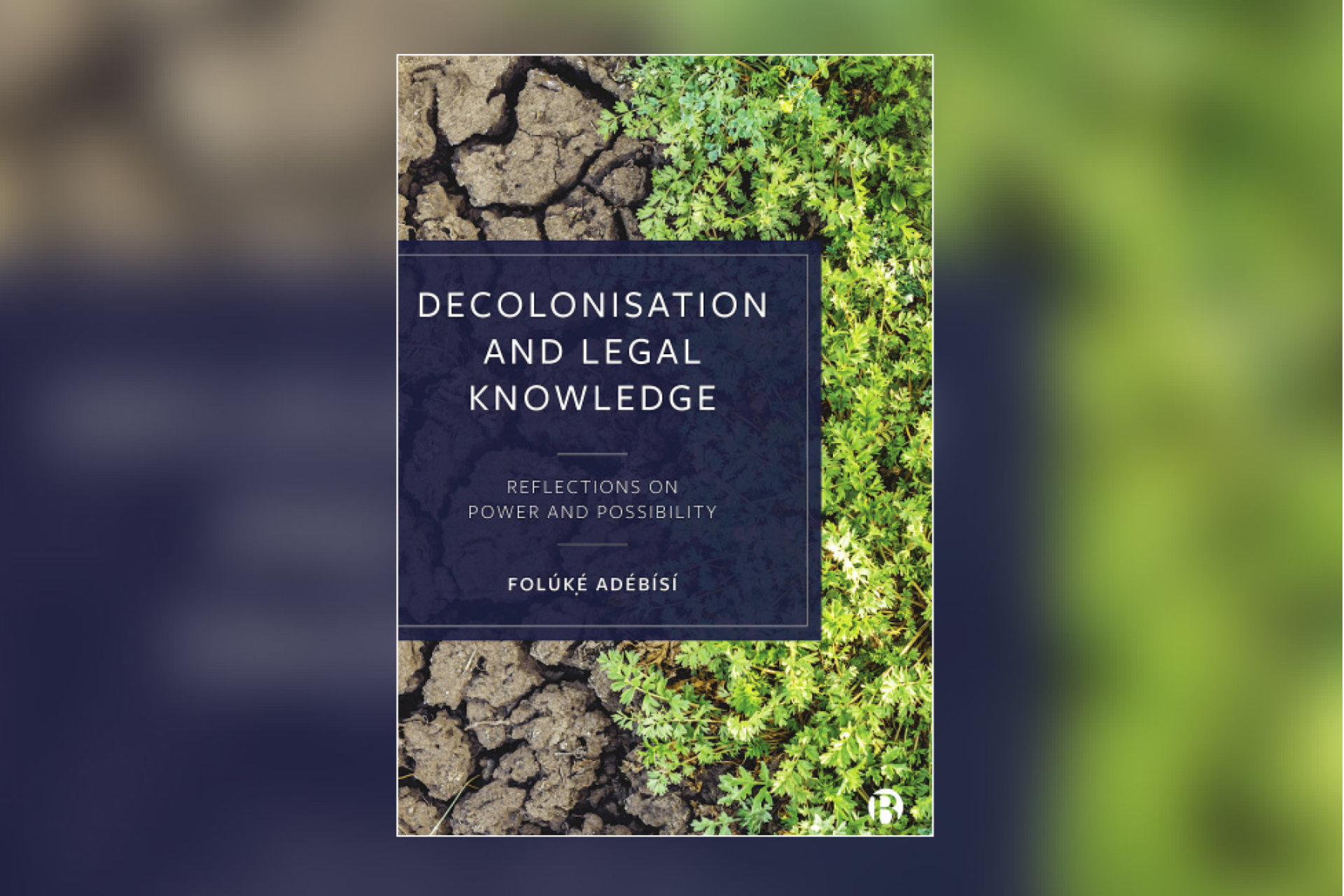
In January the School of Law was fortunate to host the book launch event for Professor Folúkẹ́ Adébísí’s Decolonisation and Legal Knowledge: Reflections on Power and Possibility.
From the publisher:
The law is heavily implicated in creating, maintaining, and reproducing racialised hierarchies which bring about and preserve acute global disparities and injustices. This essential book provides an examination of the meanings of decolonisation and explores how this examination can inform teaching, researching, and practising of law.
It explores the ways in which the foundations of law are entangled in colonial thought and in its [re]production of ideas of commodification of bodies and space-time. Thus, it is an exploration of the ways in which we can use theories and praxes of decolonisation to produce legal knowledge for flourishing futures.
If you’re interested in requesting material like this that you think would be a valuable addition to the Law Library, you can complete the Request A Book (RAB) form. Alternatively if you’re interested in the library securing access to subscriptions or expensive items that you think would benefit teaching or research, contact us by email (law.librarian@ed.ac.uk) to discuss your idea!
For those rejoining us in January for Semester Two, welcome back! For those who are new to the Law School or just this blog, welcome! This is where we report news, updates and offer tips for training in library resources. The blog is currently written by SarahLouise, the Law Librarian who works Wednesdays to Fridays, as we have a vacancy for the other half of the post. We hope to have a new Law Librarian joining the team over the next few months and will introduce them when they start!
We’ve received quite a few queries about locating some key resources for research and study over the last few months so we wanted to clarify how best to access these. First up, the Stair Memorial Encyclopaedia. This is a resource which is core for our undergraduate students as they get to grips with Scots Law. We do have instructions listed on the Law Databases Help & Training page under ‘Resources for Scottish Legal System’, but we wanted to add some screenshots here for the visual learners.
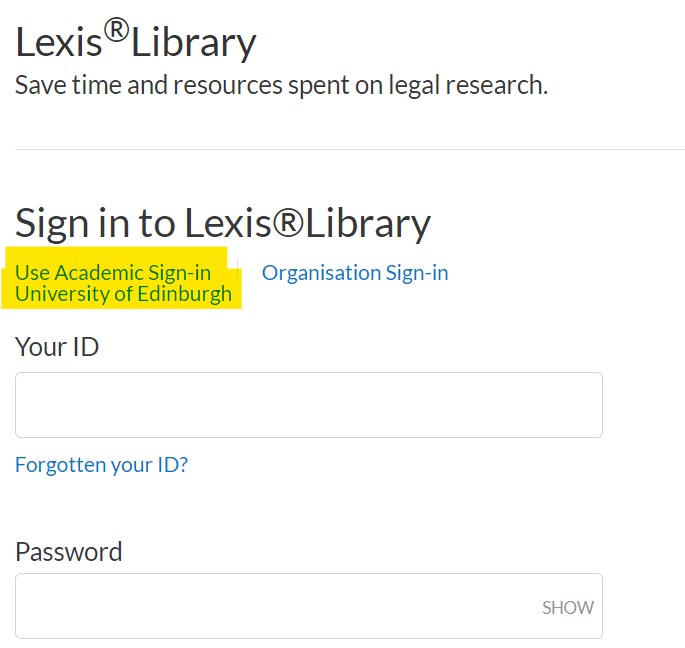
To log in toLexis+, you will need to select ‘academic log in’. You may then be presented with a dropdown box to select ‘UK Access Federation’. Select ‘University of Edinburgh’ from the list, and you will be logged in. Alternatively you may have the option to select ‘University of Edinburgh from the front page – do this if available!
You may be asked to log in with your UUN at this stage if you’re not on-campus. Use your usual student ID and password.
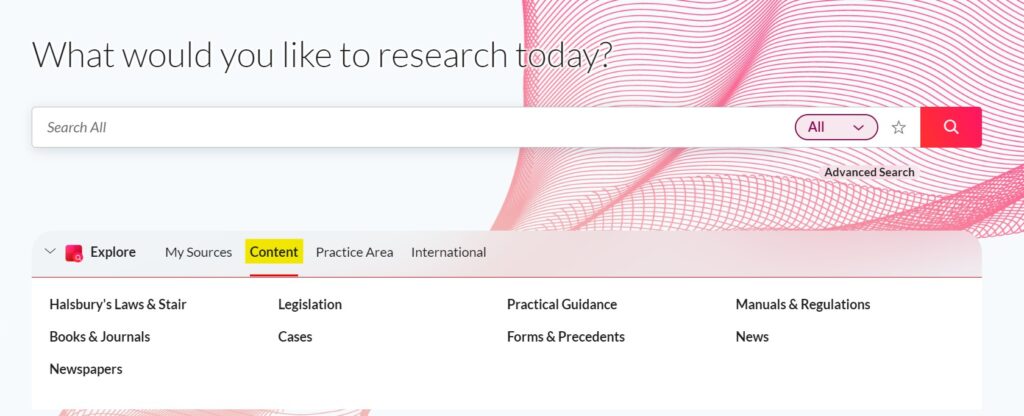
In the middle panel in the centre of the page, select ‘content’ from the navigation menu.
The resource will be one of the first items listed as ‘Halsburys Laws and Stair’. Click this.
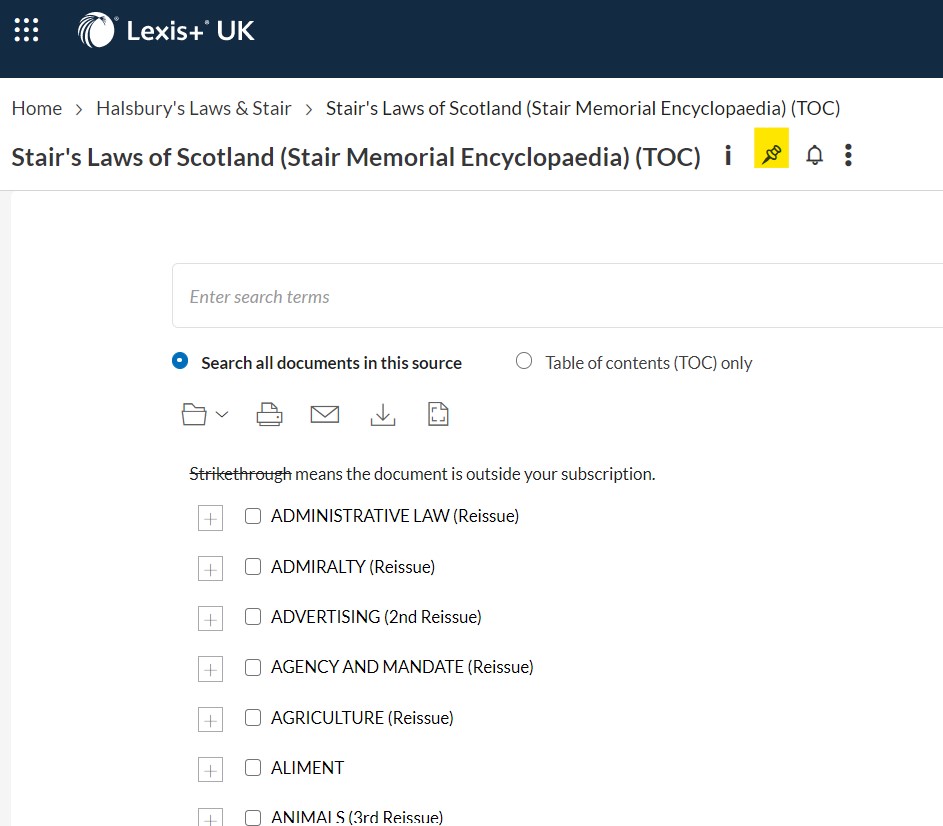
Then you will see a link to Stair Memorial Encyclopaedia. Click the title, and use the plus and minus boxes to navigate through to find the section you need.
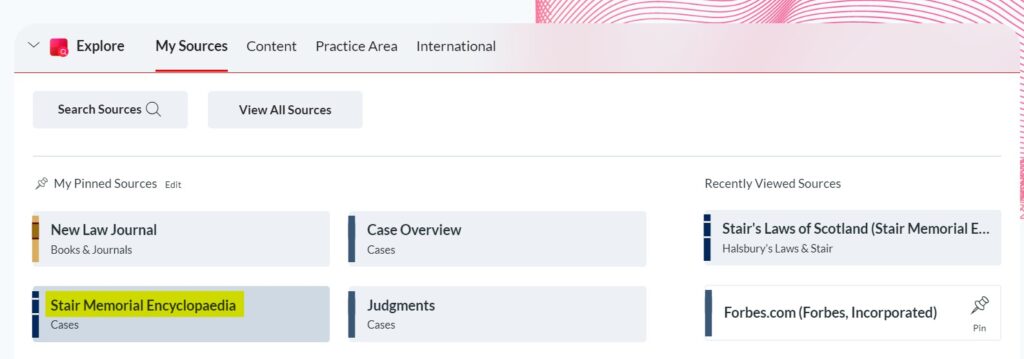
If you want to, use the pushpin icon near the title to add this to your pinned sources. This bookmarking tool means that a shortcut will appear under ‘My Sources’ on the main panel when you log in to Lexis in future, which will save you a few steps.
We hope this is helpful. If you have a resource you’d like a little more advice on accessing, please let us know by email (law.librarian@ed.ac.uk) or by commenting on this post.
Rays of sun through houses at sunset, Morningside, Edinburgh (@eilisgarvey via Unsplash)
Welcome back to Edinburgh! Although we don’t yet know what 2022 has in store for us, we do know that we’re keen to make sure our students are the best prepared they can be! For the Law Library team that means offering you a full range of induction and refresher sessions on how to use the library. If you’re feeling like you could do with a little update on the best ways to find resources, book on to one of our upcoming events using the links below.
Aimed at all undergraduate and postgraduate students, this session is a whistle-stop tour of all the things we told you at the start of the year. We’ll rattle through the resources and links relatively quickly so that we’ve lots of time to answer your questions, and if you’re feeling confident by the end of the session we’ve also got a quiz for you!
Come along if…you found researching your assignments just a little bit tricky at the end of last term, and you can’t remember where to go to find help.
Join us for an introduction to using library resources at the University of Edinburgh. Topics covered will include how to find and access books, journal articles and legal databases using library resources, and how to get help if the library doesn’t have what you need. The second part of this presentation will take a closer look at major legal databases including Westlaw and Lexis Library where you will learn how to find full text cases, legislation and commentary, and tips on how to use these resources efficiently and effectively.
Come along if… you’re a PG Online student starting in January 2022 at the School of Law.
We don’t just work directly with students, we’re keen to speak to fellow staff members about how we can support their work too. We’re running a short session where we’ll present a bit and chat to anyone who works with the School of Law to make sure they know about all the ways we can help enhance their teaching or support throughout the year.
Come along if…you’re a member of staff and want to find out more about how we can help you!
(contact the Law PhD office for a link to the Collaborate room)
This session is aimed directly at PhD and PGR students, and takes the form of a one hour session featuring top tips on how to conduct complex research and construct your projects. We also look at some of the key resources you will need and signpost some bespoke materials that may be useful for students at this level.
Come along if… you’re a PhD students starting in January 2022 at the School of Law.
As the end of semester approaches, you may be concerned about the hours the library will be open in the run up to exams. We’ve increased weekend hours as we get closer to the exam period by opening later on Sundays in December:
Monday 29th November 2021 to Monday 20th December 2021
Monday – Thursday
9am – 9:50pm
Friday
9am – 6:50pm
Saturday
9am – 4:50pm
Sunday
12 noon – 6:50pm
There will also be changes to the opening hours over the winter break, as follows:
Tuesday 21 December 2021 to Sunday 16 January 2022
Tuesday 21 – Thursday 23 December 2021
9am – 4:50pm
Friday 24 December 2021 – Tuesday 4 January 2022
Closed
Wednesday 5 – Friday 7 January 2022
9am – 4:50pm
Saturday 8 & Sunday 9 January 2022
Closed
Monday 10 – Friday 14 January 2022
9am – 4:50pm
Saturday 15 & Sunday 16 January 2022
Closed
Normal semester opening hours will resume on Monday 17th January 2022.
If you find the times above don’t suit your schedule for study, you may want to look at the Main Library opening hours, or for a complete list of library opening information please check the Library website.
If you’ve attended any of the induction sessions we’ve run in the past few weeks, you’ll have heard us mention Media Hopper (and specifically the Law Librarian Media Hopper Channel) many times as part of our introductory material.
Media Hopper is like the University’s own version of Youtube. It’s an online storage repository and player for videos, and it means we can upload videos and recordings that you can watch to find out about more about library services, subscription databases, and many other resources. If you study online you may be used to watching videos or pre-recorded lectures that have been made for you on your course; the great thing about Media Hopper is that it’s not just for your coursework, it can be for other things too!
What does the Library use it for then?
Loads of things! We upload recordings of sessions, promotional videos for our online information skills course, and demonstrations of databases. We can also create playlists which link together useful videos on popular themes. For example, on the Law Librarian channel we have the following:
Recordings of the introductory sessions we offer for UG, PG and PhD students
Westlaw demonstration (with more databases demos to come)
Using Legal Databases training
Using news databases
Simple search in DiscoverEd
Referencing help, including demonstrations of the latest version of Endnote.
Sounds great! But do you have a video for….?
If there’s something you think we should make a video about, why not contact us to let us know. We take requests! Email us on law.librarian@ed.ac.uk with your suggestions. We want the resources we make to be as useful as possible, so all ideas are welcome.
It’s that time of year where everyone is focused on exams and assignment deadlines. In 2020 of course there’s the added pressure of taking a different kind of test and worrying about getting home safely. It is an extremely stressful time.
If you’re struggling to find your studying groove you may find the links in our Exam and Revision subject guide helpful. You will find information about library services and how to access resources online, but there’s also a wellbeing section with ideas on how to take care of yourself.
The Law subject guide has loads of information including links and instructions on how to use many of the subject specific resources we have available.
And of course we’ve been putting videos up on the Law Librarian Media Hopper channel all semester, so if you’ve forgotten how to use Westlaw or need a refresher on referencing take a look.
Here are our top five tips for revision and successful study:
Drink plenty of water. It sounds obvious, but the better hydrated you are, the better your brain functions.
Take breaks. Make sure you get up from your desk and stretch and move around a bit, ideally for a few minutes every hour. Get outside if you can, or open a window. Even when you’re studying on-campus in a library it’s possible to leave your workspace for a short period to take a walk around.
Organise your notes. It’s a well known fact that librarians love stationery! We’re big fans of colourful highlighters, sticky notes and fancy pens. Even if that doesn’t make organisation fun for you it’s a good idea to keep notes from the same subject together and easily accessible when you’re working on assignments. It’s amazing how much time can be wasted looking for that one scrap of paper that had an important case citation on it.
Give yourself plenty of time. Inevitably if you’re still working on the day your work is due your references will disappear, you’ll miss the bus, your internet will conk out and the printer will jam. Try to anticipate the issues by planning for the worst-case scenario – sometimes this means tricking yourself into pretending the due date is a day or two before the real deadline.
Work hard, play hard. When you’re finished studying for the day do something completely different with your free time. Switching off from revision and doing something active, creative or social will help you unwind which will give your brain a rest and will allow you to come back to the task fresh.
We hope some of this information has been useful to you, and wish you the best of luck with your upcoming exams, assignments and submissions. If you have any questions about library resources please do let us know on law.librarian@ed.ac.uk.
You may remember that as part of your introduction to library services the Law Library team presented information on how to find legal resources using our databases. We’ve created a short online quiz for you to test your knowledge and identify areas you may need more practice on.
The questions have been chosen with particular reference to the material used on the Scottish Legal Studies undergraduate course, however we think it’d be a useful resource to practice your skills at all levels.
The quiz can be accessed using the link below and will be live until the 11th December.