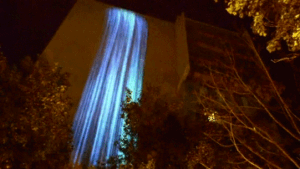
One project that I find particularly compelling is Particle Falls by media artist Andrea Polli. Installed on the façade of a public building, the work uses real-time air quality sensors to detect particulate pollution (PM2.5 and PM10) and translates this data into dynamic LED light patterns visible at night.
What interests me most about this installation is how it makes something normally invisible part of everyday visual experience. Air pollution usually exists as numbers in reports or as abstract warnings in the news. It is rarely something we can directly see. By turning particulate data into shifting intensities of light, Particle Falls brings environmental conditions into the shared space of the city.
Rather than presenting raw statistics, the work operates through translation. Higher pollution levels result in denser and more intense light “falls” across the building surface. In this way, scientific measurement becomes atmospheric and spatial. I find this shift important, because it reduces the gap between environmental monitoring systems and public awareness. The building itself becomes a kind of interface.
At the same time, the project makes me question the relationship between aesthetics and crisis. Does visualising pollution increase awareness in a meaningful way, or does it risk softening the severity of the issue through beautiful light effects? By embedding air quality data into the night-time cityscape, the installation reframes pollution as something present and continuous rather than distant or abstract.
For me, Particle Falls demonstrates how design can mediate between scientific systems and public understanding. It suggests that environmental data does not have to remain confined to expert discourse, but can become part of shared urban experience—something we encounter, notice, and reflect on together.
Reference
Polli, A. (2010). Particle Falls.
Science History Institute.
https://www.sciencehistory.org/sensing-change-particle-falls/