Any views expressed within media held on this service are those of the contributors, should not be taken as approved or endorsed by the University, and do not necessarily reflect the views of the University in respect of any particular issue.
In my last post I shared six things I wish I’d known sooner about the Library. But there’s more to university life than studying! Even though in the depths of essay season you might feel like you should be paying rent to the Library staff rather than your landlord, when you’re working hard it’s important to remember to rest and play too! So here are five tips for taking care of yourself and enjoying your time at Edinburgh...
1. Get out and about
An evening swim at Portobello...
Edinburgh is one of the most stunning cities in the UK (I’m not at all biased). It is also one of the greenest cities – with more green space than any of the UK's other big cities. We literally have a 650-acre Highland-esque landscape ten minutes’ walk from central campus... visit Holyrood Park if you haven’t already!
If you’re lucky enough to be living in the city during your studies, make the most of it. Grab a few pals and plan a hike up Blackford Hill after a big essay deadline – or a meander through the Meadows after a library session. Maybe even take a cold plunge at Portobello Beach before your morning tutorial. I found getting away from screens and into nature one of the best ways to rest and escape throughout my studies. ...continue reading "Things I wish I’d Known: Work, Rest, Play"
You may have read our recent article about LibSmart I, the foundation of our online information literacy course hosted on Learn. If you haven't, check it out here.
Where LibSmart I provides a solid start in the library and information landscape, we think that LibSmart II offers a great next step for those a little further in their university career.
Earn digital badges for every module you complete in LibSmart I and II.
So what does LibSmart II offer?
You can pick and mix from ten subject specific modules to develop knowledge of a wide range of digital resources. You can also learn specialised or advanced digital search techniques and develop the skills to manage your research literature and data effectively. We recommend you complete LibSmart I before moving on to LibSmart II, as you will build on the foundations developed in the first level of the course as you complete each of your chosen modules.
A brief overview of LibSmart II and its learning objectives
The ten modules which are currently available to study are:
Business information
Data mindfulness: finding and managing data for your dissertation
Digital news sources
Digital primary sources and digital scholarship
Finding and using digital images
Government and Policy Research
Health information
Legal information
Special Collections fundamentals
Systematic reviews
We estimate each course will take a maximum of 3 hours to complete, and you can select as many or as few as you like. You'll earn a digital badge for each module you complete to show off your new achievement!
Ready to get started?
Visit the LibSmart webpage to find out more about how to self-enrol for this course.
If you have any questions or concerns about LibSmart you can contact us via the EdHelp portal.
As a recent graduate from Edinburgh, you can imagine I’ve spent the summer reminiscing and reflecting on my time at university. Over my four years studying Geography I spent a lot of time in the Main Library, whiled away hours on DiscoverEd, and thought I had the whole library thing down. Reader, I barely scratched the surface.
For the past few months I’ve been lucky enough to intern with the Academic Support Librarian team at the university. I have found myself learning things about the Library I wish I’d known sooner – and remembering things that I discovered during my studies that made it all a bit easier.
This blog will cover some ideas for how to get the best out of the Library, where you can go to broaden your reading and research, and things that will make studying easier (*cough* reference manager *cough*).
LibSmart I is designed to give you an introduction to library resources for your study and research! The course enables you to take control of your learning as you self-enrol (click here to find out how) and choose the modules you cover. I personally love the flexibility of the course as you can recall the information provided by LibSmart easily on Learn.
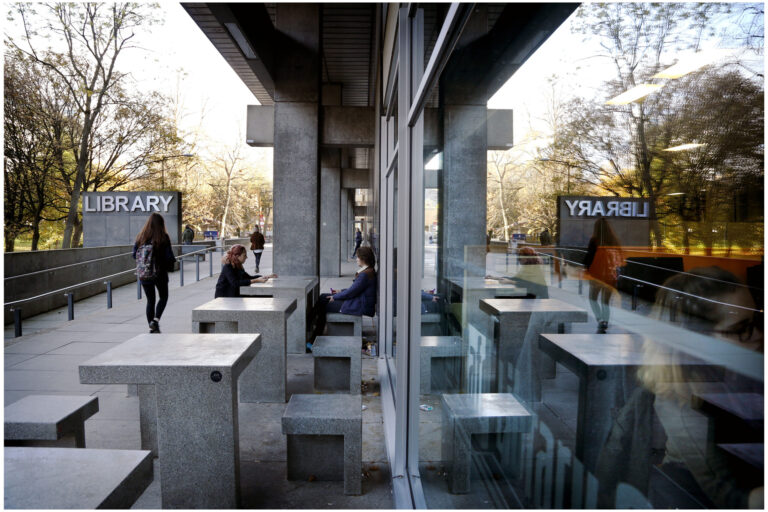
Students studying in the library [Paul Dodds copyright of the University of Edinburgh]
So what does LibSmart I review?
In short, by completing LibSmart I you will develop your information literacy skills and understand what library support is available to you. For a more detailed overview keep reading or better yet check out the course for yourself!
A brief overview of LibSmart I and its learning objectives
Within the LibSmart I course there are five modules that cover key areas:
Introduction to using the library
Your information landscape
Finding and retrieving information
Managing information
Referencing and avoiding plagiarism
With each topic, you will gain the confidence and knowledge to effectively research and use resources provided by the Library. My favourite module would be “Finding and retrieval”, I found the tips on research strategy construction and explanation to Boolean operators have been extremely useful when exploring a topic area.
The course has clear goals that you can use to guide your learning and ensure you are finding the support you need. There are also activities and reflective quizzes to help you consolidate your learning to discover the subject matter you need. When you've completed the course you'll also be awarded a Digital Badge, which you can use to show off your newfound expertise.
Ready to get started?
Visit the LibSmart webpage to find out more about how to self-enrol for this course. If you've completed LibSmart I, you also read more about how to build on these skills with the next level of research support in LibSmart II!
If you have any questions or concerns about LibSmart you can contact us via the EdHelp portal.
If you haven’t heard about LibSmart I and II yet - then what have you been doing?!
To quickly summarise, LibSmart I and II are fully flexible, self-enrol Learn courses designed to help you get started and advance your library resource knowledge. If the description has got you intrigued and you want to know more, do not worry! In this blog, I will give you five reasons why LibSmart I and II can be beneficial to your studies, general university knowledge and digital skills development.
1. Builds awareness on library offerings
Edinburgh University’s Library and University Collections (L&UC) has a range of awesome resources - I am sure you will be aware of DiscoverEd, Special Collections and physical library locations like the Main Library. Well, the department has two new assets by the names of LibSmart I and II. They will help you discover other library-related services that will help you build your information literacy skills.
The Main Library entrance on George Square. [Taken by Paul Dodds, copyright of the University of Edinburgh]
2. Increases your knowledge: LibSmart helps you be more productive
The information contained in LibSmart will not only boost your awareness of library resources but also guide you, so you can use these resources effectively! Throughout the modules, there are activities and quizzes to help you consolidate your knowledge and test yourself.
3. Supports subject specialism
With LibSmart I you build a foundation of knowledge so you can confidently use library resources when researching for a report or topic. LibSmart II enables you to “advance your library research”, supporting you as you complete your thesis or dissertation. The modules in LibSmart II are subject-specific so you can tailor your learning to your project needs. See the image below of the 10 different modules tackled in LibSmart II.
4. Fully-flexible
As mentioned earlier, LibSmart has been created so that you can work independently and interact with the modules as and when you wish. By working at your own pace, you can make the most out of the courses, ensuring you understand the content available. You can still interact with others who are completing the course and Academic Support Librarians (ASLs) using the discussion board whenever you want, so you gain thoughtful insights into the material you are learning.
5. Earn Digital Badges
The final reason you should enrol onto LibSmart is because you have the opportunity to be rewarded for the work you complete with Digital Badges! After finishing a module and subsequent quiz you will be notified that you have earned a LibSmart eBadge that you can share on various digital platforms such as LinkedIn, Facebook, Twitter, or a website.
On 7 June I attended a CILIPS conference session on Decoloniality and the library: the case at Goldsmiths, University of London, by Marilyn Clarke, Director of Library Services at Goldsmiths, University of London.
Marilyn started off with a quote from Desmond Tutu “If you are neutral in situations of injustice, you have chosen the side of the oppressor.” What can we do as librarians to be more than neutral?
At Goldsmiths, a Liberate our library working group was set up to look at this question. They started out by asking : do students see library spaces, books on the shelves, which looks like them? Do students see themselves when they come into the library?
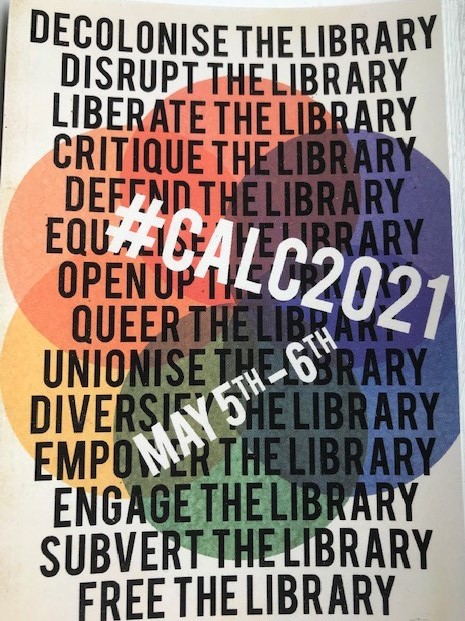
It is once again Conference Season, where academic librarians would usually be collecting a variety of colourful lanyards, discussing who had the best snacks with mid-morning coffee and which exhibitors had the best swag. It’s a great time to network with colleagues from other institutions or sectors, and to make new contacts and finally put a face to the name of those twitter accounts. However, as we rounded the bend on a year of online working, we’ve all become quite well versed in the pivot to not only online teaching but also online events. Although we’re used to communicating through a screen – and the related Zoom Fatigue – CALC was an event to get excited about. The speaker list was diverse and exciting. The topics felt relevant to the work we’re doing, or want to be doing. The days looked well thought out and not too overwhelming. The ethics of the conference organisation included an optional additional fee to allow the organisers to provide bursary places free of charge to those from marginalised backgrounds. ...continue reading "Critical Approaches to Libraries 2021(CALC) Day 2"
Despite being in my fourth and final year, I am still constantly discovering resources offered to students by the University! Most recently, I attended a Library Bitesize course for "Online Resources for Literary Studies".
In the past, I have completed Bitesize courses. However, they were in person and not subject-specific. For those interested, it was on referencing and avoiding plagiarism (and I would highly recommend it)! Therefore, this was a bit of a new experience for me and I did ask myself when signing up how learning about literary resources would benefit me. However, by the end of the session, I was extremely glad I went! Reading this blog you will understand why and hopefully be encouraged to attend a session for yourself.
The Session
The session was hosted on blackboard collaborate by Academic Support Librarian (ASL) Shenxiao Tong. It was easy to follow and informative – and fortunately, there were no technology issues during the event!
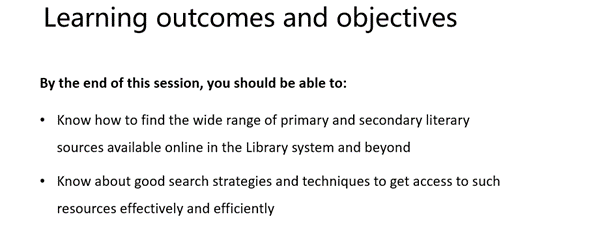
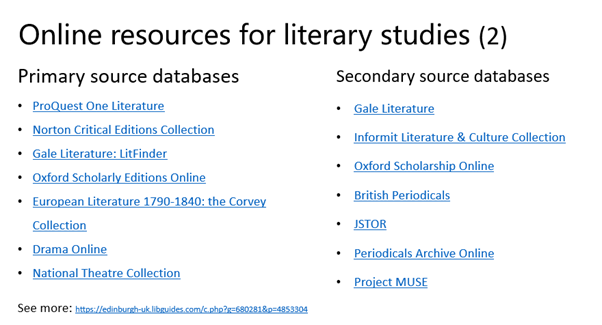
The session began with a helpful introduction to the online library resources made available to university staff and students. It is easy to forget that the Library has such a vast collection of e-books, databases, streaming videos and e-journals. The definitions of primary and secondary resources were also provided! This allowed the rest of the presentation to flow as I was shown which databases to use for primary and secondary resources, with demonstrations given on key resources. Other online resources were also covered including internet resources like google scholar, bibliographies and book reviews. Throughout the session, the usefulness and drawbacks of the different materials were highlighted meaning you would be able to draw your own conclusions to what resource would be most effective for you. This tied in well with the conclusion of the presentation which covered next steps such as how to construct your own research strategy!
Conclusion
You can never go wrong learning new digital skills and resources that can help you with your work! Even if you don't explicitly need to know about these literary resources for your studies - they may be useful for your extracurricular activities! Plays, poems and novels can all be found using the resources covered in the Bitesize session I attended. If you still aren't convinced, why not look at what other topics Library Bitesize sessions cover, and I am sure you will find a subject that information needs!
One of the key parts of our role as librarians is to help staff and students find the things they need to complete their work. One way in which we do this is to create subject guides, which are like mini websites which collate all kinds of useful links and information we think will be helpful to those working and studying at the University.
You can find a full list of the subject guides we've made here, but some of our most popular during 2020-2021 have been the guides for Law, Business, East Asian Studies, English Literature and Engineering. As you'll see from this list we have guides dedicated to each School and sometimes very specific guides which deal with subjects within those schools.
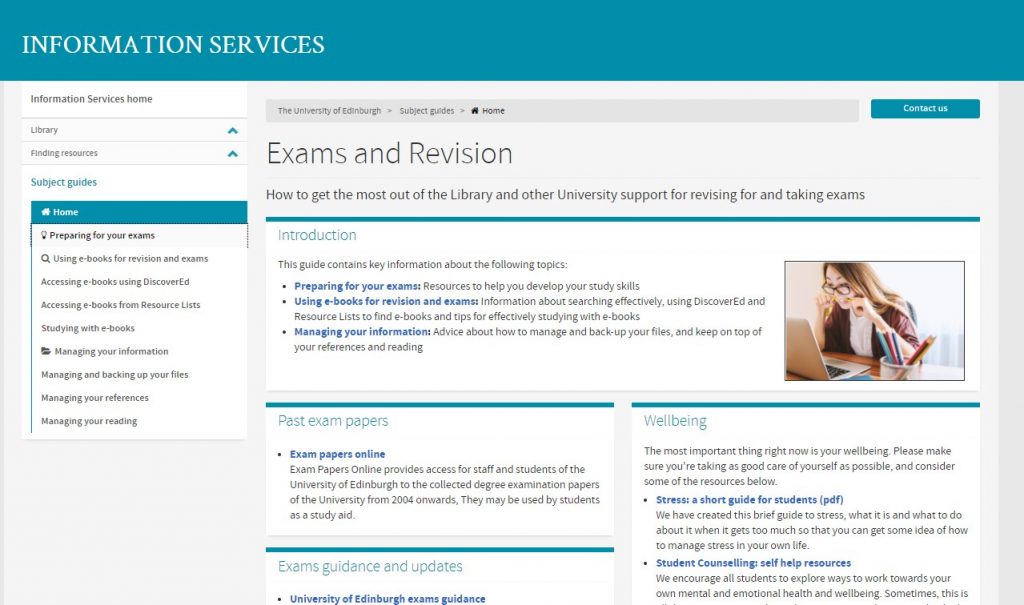
However we've also created guides which we believe are helpful resources for all students in any subject. For example our Exam and Revision guide is aimed at any student looking for top tips and news on the help that's available from the library and university services to help make their studying more successful.
A screen capture of the Exams and Revision subject guide
Our Dissertation Festival guide contains loads of useful resources for students based on the events that took place in our recent Dissertation Festival (March 2021). Check it out if you're looking for advice on how to get started with your dissertation research, or are interested in finding out more about some of the collections available from our library suppliers. Just like a face-to-face event you can also pick up your Festival Bag from this page, jam-packed with videos, information and helpful tips. You'll hear more about the Dissertation Festival from one of our student interns in the coming weeks so watch this space!
Over the summer we're working on guides relating to Disability and Open Resources which will be published in the coming months.
Did you know we take requests?
If you think that there's a previously untapped topic we should make a guide for, please let us know by leaving a comment on this post or emailing your Academic Support Librarian using the links on this page. We'd love to hear from you!