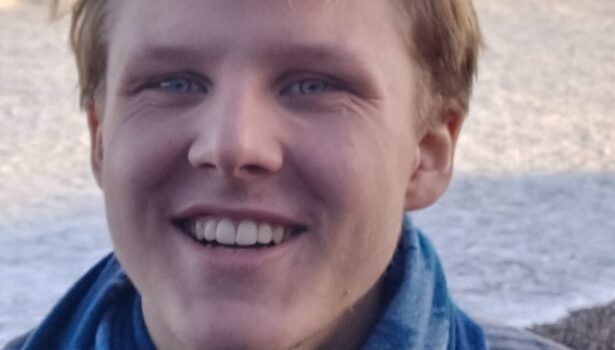
CO-WINNER OF THE LEWIS EDWARDS MEMORIAL PRIZE 2026
My name is Aidan, I am a first-year earth science student, and I love writing as well as music and theatre (especially a well-executed combination of all three). Alongside this prize-winning writing, I wrote and directed a one act play called “Billionaire in the Basement” with Bedlam Theatre, which, as far as I can tell was well received. Presently, I am mulling over more ambitious project to write a historical play set during the Yorkshire Luddite uprising of 1811/12 for which I am thoroughly enjoying researching. When I am not writing, I am cycling, cooking or planning my next adventure. Instagram: @aidanrobertsturner
“This award is great encouragement at a time when I am just beginning to take my writing more seriously. It is really very lovely.”
The Kingfisher Revisited
When the kingfisher dives, in a flash of blue and black, into the silver pool, beauty and
pain are held together like… well, I suppose I don’t really know. Perhaps not everything
needs to be a metaphor. It is hard to let things exist without interpretation. I would like
to. The kingfisher doesn’t interpret. All he knows is hunger. There is something freeing in
that. He emerges now. The water stretches like iron before unfurling. There is
something so aching in this movement, that I feel that there is nothing to do but cry.
I am sitting by the lake, beneath the beech tree. The sun is bright and it really is very
beautiful. It is not yet warm. But it will be. The air is dripping like an icicle. In a poem by
Mary Oliver, a line reads, “I think this is the prettiest world so long as you don’t mind a
little dying.” I think I agree. How could it not be, with leaves so green and a sky so blue
and that kingfisher as he streaks through the air? But when that kingfisher rises, like a
blue flower, my heart can only break for the fish hanging limp in his beak.
I am waiting for a friend. She is late. I don’t mind so much. I am enjoying looking up at
the sun through the leaves. There is something so wonderful about the fresh pale green.
If my friend was here now, she would be explaining to me about fractals, the hidden
geometry of nature. The thick branches splitting off into smaller ones and the smaller
ones splitting off into smaller ones still and on and on into the leaves and the fibres,
almost to infinity. She would hold my eyes with hers and with vivid words and tell me
how fractals are found everywhere, in rivers, and trees and lichens and mosses and
mountains, and I would be excited by this because she would be. She would tell me this
pattern had been hard-wired into our brains as we evolved so that in it we now find
comfort. And she would smile or laugh in a giddy sort of way and apologise for being so
nerdy and I would say “no, of course not. This is perfect” and she would lie back and
look up and be mesmerised by the intricacy. We would lie there, the two of us, just
heartbeat and breath and, we would know that this is the prettiest world. I look forward
to that.
I saw the first swifts arrive last week. I saw them turning and weaving and I heard their
cry. The heralds of summer, bringing hope from the Congo to Yorkshire. There is
something of a perfection in their aerial displays. Mary Oliver doesn’t have a poem
about swifts. This, I imagine, is because she is from America. If I wrote a poem about
swifts, I wonder what I’d say. It would be something about their migration, consistency
and change, maybe I’d throw in something about hope and unity, something about their
dogged determination and apparent joy in their movements. I would worry, I think, that
it would sound naïve or silly. Perhaps that’s all it needs to be. I never really know with
these things. Perhaps it is enough just to look up and be amazed. Maybe that is what
Mary Oliver would say. But she would use all the right words in all the right ways, and I
would read the poem and shiver with the teeth of it all. Sometimes I find that words are
too wide to be useful. When my friend comes, she will show me a new poem, one that I
have not heard of, and I won’t get it at first. The phrases will be nothing more than a
salted breeze. Then she will read it again, perhaps with a little more emotion and some
verbose gesticulation and irony, and despite the laughter, I will begin to feel the sand
beneath my feet. By the third time, the ocean that I had tasted in the air will reveal itself
in all its silver blues. There will be a silence while we listen to the waves and, as the
moment fades, I will declare it to be the greatest poem ever written, and we will stand
up and spin around and sing it into a song and laugh at our silliness and naïvety. The
ocean will disappear, and we will become the breeze. I look forward to that.
The kingfisher has no choice but to catch the fish. The fish caught has no say in his
hunger. The swift must fly north for the summer. They have no say in the winds.
Sometimes, I am scared by this. If my friend was here now, she would say something
profound, quoting some obscure philosopher she had read recently. And I would smile
and be comforted by it and ask where she finds all these forgotten thoughts from
centuries ago. And she would tell me that they are not obscure nor are they forgotten,
just that I don’t read enough, and I would roll my eyes and say something defensive or
maybe something tactless and then she would look at me for what would feel like a long
moment and then, she would turn around and hoist herself into the tree and, looking
from above, she would tell me about something else. Something light and new. She is
good like that; she pays attention. The sun now cuts the beech tree at an angle such
that shadows make patterns on the pool. Pond skaters blink in and out of the light,
leaving small ripples in their wake. It really is very beautiful.
If I were to paint this picture, I wonder what I’d create. I hope that I would make it as
beautiful as the scene really is. My fingers are clumsy, so it is unlikely. I wonder where I
would put the kingfisher in the scene. On the tree, perhaps, something bright against
the lengthening shadows. Like a jewel or a lighthouse. Or perhaps I would put it in flight,
in sparkling movement, struck by the sun. But here is the choice. In this moment of
movement, do I choose the beauty or the violence? If my friend was here, she would say
that it is not a choice at all, that it would be shallow to differentiate. She would say
something like “the beauty and the violence are one and the same and to try and
separate them is to diminish the whole.” But I cannot understand this. Perhaps this is
why I do not paint, and why my poetry is bad. She would say that there are lots of true
things, that in everyone and everything is lots of true things all at the same time. And of
course, I know this, but I cannot understand it. I am just me, with my name and my
mother and father and food and friends (sometimes) and I suppose I do find joy in
music of different kinds and of course there is the here and now, in the shadow of this
beech tree and the light of the yellowing sun, looking out at the cool water. I am a
simple creature, I think. I am simple like the kingfisher, who eats when he is hungry and
sleeps when the sun sets. If my friend was here, she would tell me that that is bullshit.
She would say that nothing is simple if you look at it long enough. She is right, of course;
she tends to be. She is not a simple creature. She is lots of things all at the same time
and I cannot understand it. Perhaps this is why I am often happy and she only
sometimes. I like it when she is happy. She is always so beautiful. When she smiles, it is
like the arrival of the swifts. When I am with her, and perhaps especially when I am not, I
cannot help but think that I am immensely grateful that she is a person who exists in the
world. When she comes, I will tell her that. It is useful to be reminded that you are
loved.
I have trust, I think, in this place and this tree and the water and that the kingfisher will
catch the fish and that the swifts will come before summer. I trust that when I am with
people I love, I am happy. It is easy to trust in these things; they have shown no reason
for me not to. When the moths come out in early evening, as they do now, they trust
their antennae not to lead them astray. It is easy for them; they have no reason not to
either; I suppose they will not live long enough for that. My friend, if she had come,
would have told me about pheromones sent out by a female moth, that from as far as
ten miles away she can attract a flurry of males, all desperate and waiting. She would
have talked matter-of-factly about the lust that is the core of the natural world, and she
would have told me with ironic casualness about the moth that is born without a mouth
whose only purpose from birth to death by starvation is to mate. She would have put on
a voice like David Attenborough or some BBC presenter and said something crude and I
would have laughed in disgust at the horror of the short and inescapable life of that
moth. When we had done giggling, she would have said something like “I think it would
have been easier to have that life.” Then we would have been silent for a moment, and I
would have looked at her for what would have felt like a long time. I would have stepped
forward and… this is the part where I get stuck. Perhaps I would say something
profound from some obscure philosopher, and she would say, “Ah yes, I know that one,
but I fear you are missing the full context.” And then I would have realised that I had
missed the full context, and she would laugh and say, “that’s ok,” and in a dramatic
voice she would stand up and say, “Sit down my dear pupil, let me dispense upon you
great wisdom!” and we would have laughed and been playful and silly and the moment
would disappear into something fleetingly joyful. Perhaps I could pull out my own fact
about the intricacy of the world that would be both unexpected and inspiring, or I could
remember a poem I had read that she had not and maybe that would have led her to the
blue silver of the ocean like she would have done for me or, perhaps, I could just give
her a hug. Maybe that would have said all that I needed to say.
The kingfisher has had his fill. He has gone back to his burrow. He will be hungry again
tomorrow. The swifts continue to arc through the air. They will be gone soon too. I
cannot rouse that kind of perfection out of my body. The orange glow is fading into the
blue of the moon, and the beech tree is black against the darkening sky. It really is very
beautiful. If my friend was here now, we would have stood beneath that moon in a
thoughtful silence and beauty and pain would be held together like… well, I suppose I
don’t really know.