Sensory adaptation

When sighted people ask about being blind, they often wonder:

Is it like seeing black all the time?

My favourite conversation about this took place on the metro in Oslo. I was doing research on blindness. And the person who asked seemed to be sleeping rough. I answered, ‘No, because there is nothing there to see black with’. She lifted her index finger into the air and cut straight to the chase: ‘So, like seeing with my index finger. Or my big toe.’

Is it better to have had vision or to be born blind?

But people seem to know, intuitively, that there is no single answer to this. My response is usually: ‘It depends.’ Then people, often spontaneously, talk about recognising friends by their faces; yet they soon realise that voices are just as important – as are the skills needed to identify them. Some also talk about the smell of colours, mostly ocean blue and grass green. (See our blog for the scientific approach, the crossmodal correspondences between the senses, Crossmodal brain plasticity and empowering of sensory abilities, and Multisensory processing.)

How long does it take to adapt to being blind?

Again, my answer usually is: ‘It depends’ – on when and how vision was lost, the use of other senses before and after, and overall health. The brain must adapt to recognise sensory information without vision. And new habits take on average 66 days to become automatic. (See our blog for Decay and maintenance of sensory memories, Visual memories and sensory experiences, Reading braille in colour, and My vision, my identity.) I wonder, therefore, if it would be better to ask not how long it takes to adapt, but rather: how to adapt?

In an attempt to explore this question – how do people adapt to new sensory information? – I started brushing my teeth with my left hand instead of my right. Doing this meant adapting to new sensory information, especially from proprioception, touch, and the vestibular sense (see our blog for Growing into one’s own body). Drawing on previous research on people who have lost vision, including some of my own work, I expected to:

– Do well on my first attempt, then struggle to adapt to sensory information from my left hand

– Have slip-ups – old habits die hard – that would set me back in my progress

– Try different routines before fully adapting to sensory information from my left hand

My first attempt went well, but then came the second and the third – and they felt strange. Holding the brush was awkward, and I did not really know how to move it properly. It felt as if the brush was sliding around with no clear purpose. And I was certainly not convinced my teeth were clean afterwards, but I resisted the temptation to go back to using my right hand.

Then, attempt five – and my first slip-up. I suddenly realised that my movements with the brush were different, and next came the feel of it against my gums. Judging from the position of the brush this was my usual right-hand brushing routine, I had at least caught my slip-up early.

For the next attempt, I reminded myself – even said it out loud – to use my left hand. I was expecting this brushing to be more difficult, but I did not notice any real setback. And I wondered if this was because I had not yet formed a routine for brushing with my left hand.

young child smiling and brushing teeth
AI-generated illustration for SmartSense

To stay on track, I decided to pay close attention to what I was doing from the moment I applied toothpaste to the brush. I noticed the difference in how I used my two hands. With my right hand, I used a full-hand grip to hold the brush. My wrist was often stiff, and the pressure on my gums was quite hard. With my left hand, I flexed the brush in my grip: I held it almost as if I were holding a pen, sometimes adding my middle finger; I gripped it between my index finger and thumb, again sometimes bringing in the middle finger, and my wrist bent, stretched, and turned. The pressure on my gums was much lighter than with my right hand.

Over the next three to four weeks, I began to establish a routine for how I brushed – moving from the left upper teeth, across to the right, then down to the right lower teeth, and over to the left, before returning to the middle for an extra clean. My grip on the brush became firmer, and the pressure on my gums more constant. It no longer felt as if the brush was sliding around with no clear purpose. And I was almost convinced my teeth were clean afterwards. I had had three slip-ups, but I caught them early and carried on brushing with my left hand. It was time to try a deliberate right-hand brushing again.

Week seven, day one: return to right-hand brushing. At this point, I had a consistent routine for my left-hand brushing: the movement and feel of the brush were the same every time. Returning to my right hand was a bit of a shock. My right hand now felt inferior to my left: the handling of the brush was less flexible, the pressure on my gums was harder, and my teeth did not feel any cleaner than with my left-hand brushing. Next time, I brushed with my left hand again, without noticing any setbacks in my progress. In fact, left-hand brushing now felt more natural to me.

I have continued with my left-hand brushing, and if you asked me which hand I used this morning, I would not be able to tell you. But it was most likely my left.

My required adaptation was both minimal and reversible – only two to three minutes in the morning and evening, and it could be stopped at any time – and so should by no means be taken as representative of how people adapt when every aspect of their life has to change. For example, after total sight loss. There is also a little twist to my experience. I am “a leftie” who was trained to use my right hand. So, I wonder if my adaptation to new sensory information was facilitated by some pre-existing left-hand architecture in my brain. Still, I hope my experience offers a glimpse into how people adapt to new sensory information.

See our blog for Activities; especially 94-96.

Blog post author: Dr Torø Graven

Why Is Sleeping More Difficult for Some Children?

Although all brains perceive and process sensory information, people differ in how much sensory input it takes for their brain to respond. For example, some only notice vivid colours, while others are overwhelmed by soft pastels – without trying to actively change the colour by adding or removing light. These groups simply respond passively. Other people seek sensory input, sometimes even creating it themselves by fidgeting, and some become overstimulated by certain types of input and withdraw. Both of these groups respond actively. (See our blog for the crossmodal correspondences between the senses, Crossmodal brain plasticity and empowering of sensory abilities, Multisensory processing, Growing into one’s own body and How the internal senses may connect sight and sound). And, how the brain responds to sensory information, may also affect how well people sleep.

In this post, I have invited Assistant Professor, Büşra Kaplan Kılıç, University of Health Sciences, Turkey to write about how people’s responses to sensory information can affect their sleep. She calls it: “the hidden link between sleep and sensory processing.” Her research includes several scientific publications on sensory integration, sensory processing, and sleep.

The Hidden Link Between Sleep and Sensory Processing in Toddlers

Sleeping child - icons for loud and quiet noise above their head.
AI-generated illustration for SmartSense

When a baby or toddler has trouble falling asleep, it is often thought to be due to fussiness, habit, or excessive activity. However, science tells us that sleep is not only a state of rest, but also a process closely related to how the baby perceives the world. Especially in the first years of life, the connection between sleep and sensory development becomes quite important.

So, the question we should be asking is not, “Why aren’t they sleeping?”. But rather: Do children perceive the world the way we think they do?

How Do Children Perceive the World?

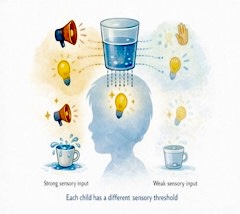
We constantly receive information from our surroundings: light, sound, touch, movement, taste, smell… Our brain filters and organizes this information and ensures we behave accordingly. This process is called sensory processing. Each individual has a different threshold value for these stimuli. Some of us can comfortably read a book in a crowded environment, while others may be disturbed by even the ticking of a clock.

Each child has a different sensory threshold: Child's head surrounded by icons for strong and weak sensory input.
AI-generated illustration for SmartSense

Similarly, some young children notice environmental stimuli immediately and experience them very intensely. Others notice stimuli later or ignore them. Some become distressed and prefer to avoid them. All these differences are part of children’s sensory profiles and are not problems in themselves. However, when these sensory characteristics are combined with a sensitive process such as sleep, challenging situations may arise. This suggests that sleep is not only a behavioral problem, but also deeply connected to the child’s biological makeup and sensory world.

We therefore conducted a study1, with 220 children aged 1-3 years, half with and half without sleep problems, to explore two key questions:

  • Do children with and without sleep problems have different sensory responses?
  • In which areas do these differences appear?


The results were quite surprising

Compared to their peers, the sensory profiles of children in the group with sleep problems differed from typical development in three areas.

  1. They had excessive sensory sensitivity

Children with sleep problems can be much more sensitive to sounds, visual stimuli, or touch. These children become irritated more quickly by stimuli in their environment and react more intensely. This can cause them to wake up at the slightest sound during sleep. Even small movements during sleep, such as turning or stretching, can cause rapid arousal in some children and make it difficult to maintain sleep.

  1. Their sensory avoiding tendencies were high

Some children may feel sensorially overwhelmed because they notice stimuli very quickly. This situation can increase the child’s tendency to avoid daily activities, starting with bedtime routines. A constantly avoiding and alert profile can cause the child to become restless during bedtime routines. For example, brushing teeth, putting on pajamas, and the characteristics of sheets and blankets can be overly stimulating.

  1. They exhibited intense low awareness behaviour

Another notable finding in the study was the low registration behaviour exhibited in response to sensory stimuli. In other words, some children needed more intense input to notice stimuli from their environment. These children may struggle to notice the calming stimuli in their environment (such as lullabies or gentle rocking). In this case, they may miss the relaxation signals needed to fall into sleep. Consequently, the transition to sleep can naturally take longer.

This study tells us that we should approach infant and child sleep problems from the perspective that “sleeping is difficult for them” rather than “they don’t want to sleep.”

Understanding sleep through the lens of sensory processing offers everyone a more nuanced and compassionate framework for supporting children and their families.

Recommendations

  • Consider sensory processing as part of sleep assessments. When observing a child with sleep difficulties, it may be valuable to reflect on their sensory profile. How does the child respond to sound, light, touch, or movement throughout the day? Sensory sensitivity, avoiding, or low registration patterns may help explain why falling asleep or staying asleep is challenging.
  • Think developmentally, not diagnostically. Sensory differences are part of typical developmental variability. Rather than labeling sleep difficulties as “problematic behavior,” interns and professionals are encouraged to view them as signals of how the child interacts with their sensory environment.
  • Reflect on the role of the environment. Sleep does not occur in isolation. Lighting, noise levels, textures, and routines can all interact with a child’s sensory thresholds. Understanding this interaction can support more individualized and supportive approaches in both educational and clinical settings.
  • Value interdisciplinary perspectives. Our study1 underscores the importance of collaboration between disciplines such as occupational therapy, psychology, pediatrics, and education. Addressing sleep difficulties through a sensory lens often requires shared perspectives and integrated support strategies.

See our blog for Activities; especially 88-90.

Some suggestions for further listening and watching:

How do Parents Assess Their Child’s Sensory Profile?

Sensory Processing Disorder

Sensory Profile explained

Understanding your sensory code

______________

1Kaplan Kılıç, B., Kayıhan, H., & Çifci, A. (2024). Sensory processing in typically

developing toddlers with and without sleep problems. Infant Behavior and Development, 76, 101981.