Sensory adaptation

When sighted people ask about being blind, they often wonder:

Is it like seeing black all the time?

My favourite conversation about this took place on the metro in Oslo. I was doing research on blindness. And the person who asked seemed to be sleeping rough. I answered, ‘No, because there is nothing there to see black with’. She lifted her index finger into the air and cut straight to the chase: ‘So, like seeing with my index finger. Or my big toe.’

Is it better to have had vision or to be born blind?

But people seem to know, intuitively, that there is no single answer to this. My response is usually: ‘It depends.’ Then people, often spontaneously, talk about recognising friends by their faces; yet they soon realise that voices are just as important – as are the skills needed to identify them. Some also talk about the smell of colours, mostly ocean blue and grass green. (See our blog for the scientific approach, the crossmodal correspondences between the senses, Crossmodal brain plasticity and empowering of sensory abilities, and Multisensory processing.)

How long does it take to adapt to being blind?

Again, my answer usually is: ‘It depends’ – on when and how vision was lost, the use of other senses before and after, and overall health. The brain must adapt to recognise sensory information without vision. And new habits take on average 66 days to become automatic. (See our blog for Decay and maintenance of sensory memories, Visual memories and sensory experiences, Reading braille in colour, and My vision, my identity.) I wonder, therefore, if it would be better to ask not how long it takes to adapt, but rather: how to adapt?

In an attempt to explore this question – how do people adapt to new sensory information? – I started brushing my teeth with my left hand instead of my right. Doing this meant adapting to new sensory information, especially from proprioception, touch, and the vestibular sense (see our blog for Growing into one’s own body). Drawing on previous research on people who have lost vision, including some of my own work, I expected to:

– Do well on my first attempt, then struggle to adapt to sensory information from my left hand

– Have slip-ups – old habits die hard – that would set me back in my progress

– Try different routines before fully adapting to sensory information from my left hand

My first attempt went well, but then came the second and the third – and they felt strange. Holding the brush was awkward, and I did not really know how to move it properly. It felt as if the brush was sliding around with no clear purpose. And I was certainly not convinced my teeth were clean afterwards, but I resisted the temptation to go back to using my right hand.

Then, attempt five – and my first slip-up. I suddenly realised that my movements with the brush were different, and next came the feel of it against my gums. Judging from the position of the brush this was my usual right-hand brushing routine, I had at least caught my slip-up early.

For the next attempt, I reminded myself – even said it out loud – to use my left hand. I was expecting this brushing to be more difficult, but I did not notice any real setback. And I wondered if this was because I had not yet formed a routine for brushing with my left hand.

young child smiling and brushing teeth
AI-generated illustration for SmartSense

To stay on track, I decided to pay close attention to what I was doing from the moment I applied toothpaste to the brush. I noticed the difference in how I used my two hands. With my right hand, I used a full-hand grip to hold the brush. My wrist was often stiff, and the pressure on my gums was quite hard. With my left hand, I flexed the brush in my grip: I held it almost as if I were holding a pen, sometimes adding my middle finger; I gripped it between my index finger and thumb, again sometimes bringing in the middle finger, and my wrist bent, stretched, and turned. The pressure on my gums was much lighter than with my right hand.

Over the next three to four weeks, I began to establish a routine for how I brushed – moving from the left upper teeth, across to the right, then down to the right lower teeth, and over to the left, before returning to the middle for an extra clean. My grip on the brush became firmer, and the pressure on my gums more constant. It no longer felt as if the brush was sliding around with no clear purpose. And I was almost convinced my teeth were clean afterwards. I had had three slip-ups, but I caught them early and carried on brushing with my left hand. It was time to try a deliberate right-hand brushing again.

Week seven, day one: return to right-hand brushing. At this point, I had a consistent routine for my left-hand brushing: the movement and feel of the brush were the same every time. Returning to my right hand was a bit of a shock. My right hand now felt inferior to my left: the handling of the brush was less flexible, the pressure on my gums was harder, and my teeth did not feel any cleaner than with my left-hand brushing. Next time, I brushed with my left hand again, without noticing any setbacks in my progress. In fact, left-hand brushing now felt more natural to me.

I have continued with my left-hand brushing, and if you asked me which hand I used this morning, I would not be able to tell you. But it was most likely my left.

My required adaptation was both minimal and reversible – only two to three minutes in the morning and evening, and it could be stopped at any time – and so should by no means be taken as representative of how people adapt when every aspect of their life has to change. For example, after total sight loss. There is also a little twist to my experience. I am “a leftie” who was trained to use my right hand. So, I wonder if my adaptation to new sensory information was facilitated by some pre-existing left-hand architecture in my brain. Still, I hope my experience offers a glimpse into how people adapt to new sensory information.

See our blog for Activities; especially 94-96.

Blog post author: Dr Torø Graven
How the internal senses may connect sight and sound

Certain information is associated across the senses. Some of these crossmodal associations are shared by most people. For example, in the Bouba/Kiki-effect, more than 95% of people around the world match the spoken word “Bouba” with a rounded shape and the spoken word “Kiki” with an angular shape. Other crossmodal associations are subjective; while some people see colours when hearing music, others read braille in colour. And it seems these subjective associations between the external senses may be closely related to the internal senses. (See our blog for How anxious individuals perceive odours, Emotional perceptions associated with sound environments, and Growing into one’s own body.)

I have invited Dr Marina Iosifian, School of Divinity, University of St. Andrews to write this post about crossmodal associations between visual paintings and sounds. Dr Iosifian has contributed to several scientific papers and public outreach events on how the internal senses might create crossmodal associations between vision and hearing.

Have you ever noticed that certain colours seem to “fit” certain sounds? For example, dark red might feel like it matches a low, deep voice, while pink feels more like a high, light voice. These kinds of connections between different senses—such as sight and hearing—are called cross-modal associations. Researchers study them to understand how our brain brings together information from different senses to form a unified picture of the world, even though each sense works separately (our eyes only see, our ears only hear).

Why do these associations happen? One possible explanation involves emotion. For instance, dark red and a low voice might both feel connected to sadness, while pink and a high voice might both be linked to happiness or playfulness.

But emotions aren’t the only reason. Another explanation has to do with the body’s movements and sensations. For example, when people are asked to name two round tables—one large and one small—they often call the large one “mal” and the small one “mil.” This may be because of how our mouths move when saying these sounds: “mal” requires a wider, more open mouth shape, similar to something large, while “mil” involves smaller, tighter movements, like something small.

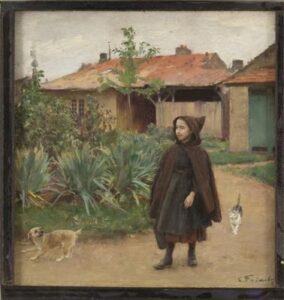
Girl in garden scene with a cat and a dog
The Garden Walk, by Emile Friant. Retrieved from WIKIART

In our study, we explored these bodily mechanisms—the ways our physical sensations and actions might shape how we connect sights and sounds—to better understand how cross-modal associations arise.

To explore these associations, we collected a set of sounds produced by the human body, such as the sound of someone drinking. We called these embodied sounds. To provide a contrast, we also included sounds that cannot be produced by the human body, such as electronic or synthesized sounds, which we called synthetic sounds.

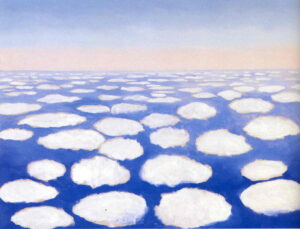
Because we were interested in how sounds are connected with visual experiences, we also gathered a collection of images. These included two types of paintings: figurative paintings, which show recognizable subjects like people or objects (eg, The Garden Walk by Emile Friant), and abstract paintings, which do not represent specific things (eg, Sky above clouds by Georgia O’Keefe). We then paired the paintings with the sounds and asked our participants a simple question: “Does this sound and this painting fit together?”

Glowing horizon with fluffy white clouds below
Sky above clouds, by Georgia O’Keefe. Retrieved from Custom Prints, Georgia O’Keefe Museum

We found that embodied sounds were more often associated with figurative paintings, while synthetic sounds were more often linked with abstract paintings. This suggests that the body—and the way we experience sensations physically—plays an important role in how people connect what they see with what they hear.

Why might these associations occur? One possible explanation lies in the difference between concrete and abstract ways of thinking. Figurative paintings depict familiar, tangible things—people, objects, and scenes—so they may evoke more concrete thinking. Abstract paintings, on the other hand, invite a more imaginative or distant mindset.

Interestingly, previous research has shown that people tend to associate abstract art with more distant situations—whether in time or space—compared to figurative art. This idea is related to the psychological concept of psychological distance, where concrete things feel close to us and abstract things feel farther away. Our results suggest that this distinction between the concrete and the abstract may also shape how we connect sights and sounds.

Some researchers believe that psychological distance is one of the main concepts which can help us understand how the mind works. They developed the Construal Level Theory or CLT – which explains how our mental distance from things – called psychological distance – affect the way we think about them. Psychological distance can take many forms: something can feel distant in time (happening in the future or past), in space (far away), in social distance (involving people unlike us), or in hypotheticality (something uncertain or imaginary). It is suggested that people think about things that feel close to them—such as events happening soon or nearby—in a more concrete and detailed way. In contrast, things that feel distant in time or space, are understood in a more abstract and general way.

If abstract thinking is linked to distant, less embodied experiences, and concrete thinking to close, bodily ones, then the way we perceive and connect sounds and images may depend on how “distant” or “close” they feel to us psychologically. In other words, our sense of distance—both mental and sensory—may shape how we integrate what we see and hear.

Thus, the concept of abstraction offers valuable insight into how people interpret and understand the world around them. Art, in particular, provides a powerful way to explore these processes. Recent research suggests that engaging with beauty in art can encourage people to think in more abstract ways, making art an especially meaningful tool for studying perception and the connections between our senses.

See our blog for Activities; especially 85-87.

Some suggestions for further reading, listening, and watching:

Applying Bodily Sensation Maps to Art-Elicited Emotions

From Perception to Pleasure

From Sensory to Movement

How Does Your Body React to Art?

How Music Changes Your Mind

Processing Internal Sensory Messages

See What Your Brain Does When You Look at Art